
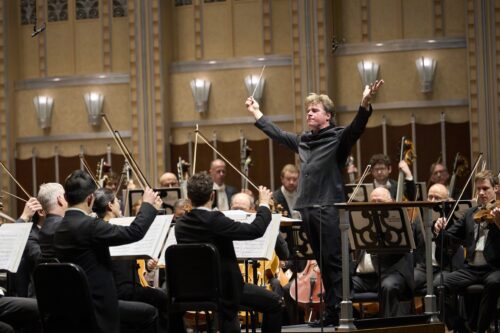
 United States Brahms, Martinů, Kaprálová: Cleveland Orchestra / Jakub Hrůša (conductor). Mandel Concert Hall at Severance Music Center, Cleveland, 5.3.2026. (MSJ)
Brahms – Symphony No.3 in F major, Op.90
Martinů – Symphony No.3
Vitězslava Kaprálová – Military Sinfonietta, Op.11
Jakub Hrůša made a welcome return to Cleveland after an absence of five years. During that time, he has been enormously busy elsewhere, including serving as chief conductor of the Bamberg Symphony, music director of The Royal Opera, Covent Garden and now chief conductor and music director-designate of the Czech Philharmonic in Prague. He typically brings intriguing repertoire and only rarely disappoints.
An actual disappointment came right at the start. The first movement of the Brahms Third Symphony is marked Allegro con brio, ‘fast, with vigor’, and while Hrůša was mostly attentive to the former, his leadership was surprisingly lacking in the latter, at least at first. In music that cries out for urgency, Hrůša was polite and restrained, coiffed and unmoving. He tried to whip up excitement in a few places as the movement developed, but it was psychologically unmotivated and failed to launch. This music needs a performance that leans into the phrases and scales, not one that just plays them accurately. The Cleveland Orchestra can most certainly deliver urgency, but the conductor must require it, and Hrůša appeared satisfied with mere accuracy.
The mysterious Andante was much better, conveying far more emotional connection without going too far and getting bogged down in the layers of overlapping harmonies. The third movement likewise sang richly without oversaturating, giving Nathaniel Silberschlag a great moment of melancholy lyricism when the French horn took over the main theme. The finale was reasonably crisp, only lacking a reason from the first movement to completely motivate its battles. It was powerfully played by the orchestra. Even with its underpowered first movement, this performance wasn’t bad, outpacing the dispiriting trudge that Alan Gilbert led in 2019, though not necessarily scoring higher than Jahja Ling’s alert performance in 2021 at the Blossom Music Festival. At any rate, the quest for a great live Brahms Symphony No.3 continues and is likely to take time for there are few more difficult works to put across in concert than this one. Perhaps the secret to sparking the piece to life is to not treat it like filler (as all three of the conductors discussed here did), but to place lighter works alongside the Brahms so that it becomes the emotional heavyweight of the program. It can take it.
Hrůša blazed through the second half of the concert, starting off with a performance of Martinů’s Symphony No.3 that was searing from first note to last. Like most three-movement symphonies, the piece is set up on a fast-slow-fast pattern for the movements, but here the often teeming and nervous textures of the first movement yielded to an even tenser and more explosive Largo. After all, how many slow movements can you think of that start at full volume, growling like some kind of monster? This one does, reflecting – one supposes – Martinů’s anxieties about World War Two in Europe during the 1940s. How uncanny that Hrůša should have planned this concert more than a year before, when the US had just hurled itself into a war, whether justified or not. The tension remains: lives are at stake, and you feel it in this anxious music.
The orchestra shone in Martinů’s teeming textures, running the range from exquisite to abrasive, sweet to malevolent, especially the jagged chords played in the highest register by the double basses in that slow second movement. Central to many moments in the score were the woodwind solos, particularly Robert Walters’s eloquent English horn soliloquys and numerous crisp and startling details in the percussion. The finale was electrifying, turning brighter toward a seemingly positive ending, at least until the glowing closing chords were punctured by harsh stabs from the orchestral piano. What compelling music, and Hrůša gave it life-or-death urgency, which it fully deserves. It would be glorious to see him regularly return with more Martinů symphonies, which are rarely heard here even though Cleveland premiered his Symphony No.2 in the early 1940s.
To close the concert was the intriguing Military Sinfonietta by Vitězslava Kaprálová (1915-1940), a brilliant young Czech composer (and conductor) and a student of Martinů’s who was sadly taken by illness at the age of only twenty-five. A couple of years before her untimely death, Kaprálová penned this work as a patriotic gesture supporting her homeland against threatened incursions by Hitler’s Nazis. This was remarkable programming, again, by Hrůša, who somehow sensed in advance the need for new defiance against loathsome Nazis, this time infiltrating the government of the concert’s host country. The gesture was apt, and it was received with great warmth by the Cleveland audience who stood and cheered for the stirring, distinctive piece. It suggests that Kaprálová was one of the great ‘what ifs’ of classical music. This is not yet a perfectly focused piece but coming from the pen of a twenty-three-year-old woman – at a time when female composers were barely tolerated – makes it an important rediscovery.
In sum, intriguing programming from Hrůša, with mostly compelling realizations.
Mark Sebastian Jordan
Overall my impressions were very similar to the review. Particularly in the Brahms Third Symphony, which historically is a Cleveland specialty. The recordings by Szell, Dohnányi and Ashkenazy are all excellent in their own ways; the one with Maazel is a bit too mannered for me. I remember a performance with Sir Colin Davis following Mozart’s Jupiter Symphony that was particularly memorable.
But that’s the past and performances are made today, and Cleveland must secure its future. This has become even more challenging now that the Boston podium is open along with LA and San Francisco. Listening to the Brahms, I was reminded about reservations I had of Hrůša‘s Cleveland performances of Mahler’s Fourth Symphony and Beethoven’s Third Symphony five or so years ago. I was also missing that phenomenal orchestral cohesion and sound that Alain Altinoglu got last week and Antonello Manacorda a few weeks ago.
It was unfortunate that I was unable to review the Altinoglu concerts, only so many hours in the day! I’ve heard he was very good. And Manacorda definitely was. Looking forward to the next couple of weeks with Elim Chan.