 Sweden Janáček, Jenůfa: Soloists, Chorus and Orchestra of Gothenburg Opera / Alejo Pérez (conductor). Gothenburg Opera main stage, 18.3.2026. (NS)
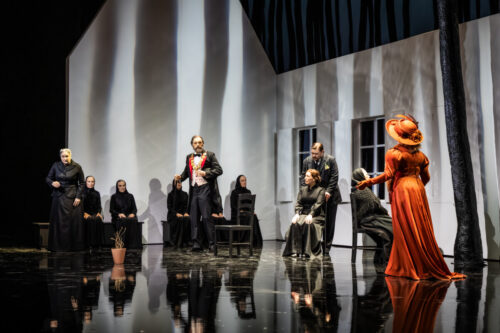
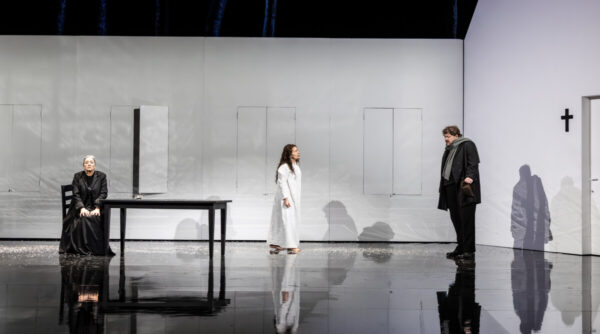
Jenůfa is back in Gothenburg after 30 years, this time in a production originally from the Greek National Opera. The set is uncluttered and slightly abstract but has a constant sense of encroaching darkness, fittingly for this story of secrets and shame. George Souglides’s costumes faithfully reflect the time the opera was written, and the Moravian folk costumes (in particular those for the dancing and singing bridesmaids) really lift the spirits with their colours and craftsmanship. In contrast, a (largely) silent chorus of old widows in black is a frequent presence on the stage, observing the action and a visual reminder of how easily a reputation can be ruined by village gossip.
Nicola Raab’s direction and the skillful lighting by David Debrinay and Clémentine Pradier are very effective in showing the deeper pressures several of the characters are under, such as how Jenůfa moves during Act I, carrying her secret pregnancy and terrified that it will be discovered before she and Števa can get married, and the haunting lighting for Jenůfa and Kostelnička during Act II. Alejo Pérez and the Gothenburg Opera Orchestra show a sensitive understanding of Janáček’s score and skillfully transitioned between the very different atmospheres that the composer created even in the same act. The large chorus had a terrific impact in their scenes.
The cast were of excellent quality. The youngsters Jano and Barena (sung by Ellen Larsson and Stella Chatzidaki respectively) both had delightfully fresh and expressive voices and impressive projection. Eugenia Babich’s maid was characterful. Mats Almgren as the Mayor reflected the joviality of his character but also a moving sense of sympathy for Kostelnička after her shocking confession, while Carolina Sandgren as the Mayor’s wife had the perfect voice for a lady confident of her own position and opinions. Ann-Kristin Jones is almost luxury casting for Karolka, with a mezzo-soprano voice vibrating with warmth and optimism.
Kristian Lindroos was brilliantly in character as the mill foreman, a rather deaf old man who tries to get Laca to change his behaviour towards Jenůfa. The combination of his costume and acting was so convincing, and his warm and powerful baritone was a joy to hear. Ingrid Tobiasson was also a powerful presence as Grandmother Buryjovka, querulous and imperious but also loving, with a lovely warm timbre to her voice.
Kjetil Støa brilliantly captured the character of Števa, handsome and superficially charming but morally weak. His bright tenor shone in the rollicking celebration after the army mustering but was also expressive of his feelings in the second act: when he brutally tells Kostelnička that his love for Jenůfa has died and that he will never acknowledge his child his voice was shot through with fear.
Adam Frandsen’s Laca is a character who develops substantially during the opera, in Act I jealous and immature but by Act III he takes the responsibility that his half-brother Števa flees from and shows his true love and commitment to Jenůfa. Frandsen’s tenor has a ping and a cheeky edge that work brilliantly in Act I but is equally capable of deeper colours and sincere expression. The final duet of Jenůfa and Laca was a brilliant musical demonstration of their love and Laca’s choice of love over his reputation.
Katarina Karnéus is utterly gripping as Kostelnička. Her first entrance, interrupting the joyous party in Act I, showed the power of her personality. Her singing to Jenůfa of the unhappy history of her marriage was emotionally powerful and helps the audience understand what later drives her to go to such extremes to protect her foster-daughter. Her voice in Act II has a chilling edge of resentment towards Jenůfa’s baby that presages her dreadful ‘solution’, and her acting vividly shows how Kostelnička is changed forever after committing her terrible crime.
Julia Sporsén is a compelling Jenůfa, in Act I still showing some of the vivacity that Števa fell in love with even as she is overshadowed by her fears about her pregnancy. We see a changed woman in Act II, and Sporsén’s quietly expressive soprano was heartbreaking in her prayer for her child. Her characterization was truly believable and powerful, showing that Jenůfa’s capacity to love and be loved is never completely crushed.
Apart from these truly memorable performances, the vivid characterization in this production and in Janáček’s libretto meant that the audience were completely engaged in the story. There was not one moment when the music or story seemed to flag. This Jenůfa is a true reflection of Janáček’s early masterpiece and the great artistry of today.
Niklas Smith
Featured Image: Laca’s proposal: [l-r] Kostelnička (Katarina Karnéus), Jenůfa (Julia Sporsén) and Laca (Adam Frandsen) © Håkan Larsson
Playing until 26 March 2026. For tickets and more information see the Gothenburg Opera website (click here). Swedish Radio P2 recorded the premiere, which is available for streaming from the Swedish Radio website or SR Play app until 13 April. For this broadcast Adam Frandsen was indisposed so the role of Laca was sung by Jesper Taube.
Production:
Director – Nicola Raab
Assistant director – Angela Saroglu
Set and Costume design – George Souglides
Lighting designer – David Debrinay
Assistant Lighting designer – Clémentine Pradier
Choreographer – Sara Suneson
Cast:
Grandmother Buryjovka – Ingrid Tobiasson
Laca – Adam Frandsen
Števa – Kjetil Støa
Kostelnička – Katarina Karnéus
Jenůfa – Julia Sporsén
Mill foreman – Kristian Lindroos
Mayor – Mats Almgren
Mayor’s wife – Carolina Sandgren
Karolka – Ann-Kristin Jones
Barena – Stella Chatzidaki
A Maid – Eugenia Babich
Jano – Ellen Larsson