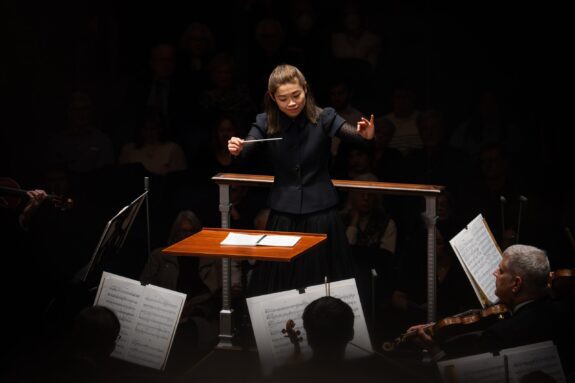
 United States Kidane, Bartók, Scriabin: Patricia Kopatchinskaja (violin), Cleveland Orchestra / Elim Chan (conductor). Mandel Concert Hall at Severance Music Center, Cleveland, 19.3.2026. (MSJ)

Daniel Kidane – Sun Poem
Encore: Sanchez-Chiong – ‘Crin’
Bartók – Violin Concerto No.1; Dance Suite
Scriabin – Poem of Ecstasy, Op.54
Patricia Kopatchinskaja finally got her chance to debut with the Cleveland Orchestra, and it was worth the wait. Though she was originally scheduled in a previous season, travel restrictions interfered but late is far better than never with an interesting artist. To be sure, there are traditionalists who froth at the mouth about the distinctive style of ‘Pat Kop’, as she has become popularly known. She strides on stage, her violin held high, slips off her shoes next to the conductor’s podium and then tears into the music like a woman possessed. She turns at times to deliver particular phrases to various sections of the orchestra, she grimaces, she stomps and basically does whatever the music moves her to do. This is unlike the traditionally taught mode of standing impassively still, and some classical concertgoers can’t stand it.
I say, bring it on. Kopatchinskaja’s bold, imperative style won’t please everyone, and it might not suit every piece. But if there was ever a concerto that benefitted from this intensity of approach, it is Bartók’s First Violin Concerto, written in unrequited love when he was young and unheard and unpublished until after his death. Mature Bartók developed to a point where his intensity was so distilled in his wry melodies and barbed harmonies that no performance can possibly miss the point. Here, Bartók wasn’t quite to that level of distillation. The work is driven by a more traditional romantic sense of emotion in the first movement, and Kopatchinskaja brought out the desperate longing of the music. Other violinists play it safe with smoother techniques, but Pat Kop is less interested in the surface of the music and more interested in its gut emotions. This kept the movement engaging and personal.
In the folk-influenced second movement, Kopatchinskaja jumped joyfully into the carnival-like atmosphere, balancing fiery brilliance with a sense of humor which made the composer’s wit crackle. It was a performance that persuasively argued for the stature of the first concerto alongside the acknowledged greatness of Bartók’s famous second concerto. The violinist was brought back for several ovations before playing a brief encore, ‘Crin’ by Jorge Sanchez-Chiong, which Kopatchinskaja described as being what she feels like whenever she turns on the television. It combined an outrageous succession of avant-garde effects combined with vocal keens and screams from the violinist, proving that even modern classical music can be funny.
The concert opened with a modern piece that, while not humorous, proved quite moving. Daniel Kidane’s Sun Poem didn’t start that way, though. The young British composer’s piece is stated to be a meditation on the loss of his father around the same time that his son was born. Even if the listener knew nothing of this program, though, the work would make an absorbing musical progression. At first, with its bright but fragmented gestures dominated by percussion and pan-tonal masses of sound, the piece sounded like any number of other modern abstract compositions. But an interesting process began to develop as gestures slowly condensed into melodic, tonal phrases that became emotionally compelling without ever sounding like a cliched recycling of older styles. After a buildup to a bright and satisfying climax, the textures quickly dissipated to a recollection of the opening fragments. Conductor Elim Chan found the shape of the work and steered the orchestra effectively through. This was the Cleveland premiere of the piece, written in 2022 and premiered by Sir Simon Rattle and the London Symphony Orchestra.
The second half of the concert brought more Bartók and his 1923 Dance Suite. Chan savored the details of this music and securely guided the orchestra through its many changes of tempo. She also emphasized the bright colors of the music to a degree of vividness not often heard here. After all, when you reflect on previous Cleveland music directors, George Szell was known for achieving an old-masters blend of orchestral sound, something that Christoph von Dohnányi notably enriched, while Franz Welser-Möst has favored a sleeker, more restrained sound. Among previous Cleveland leaders, only Lorin Maazel favored such a bright sonic palette. It would be a bold choice, should Chan be picked from the field of candidates being considered to direct the orchestra after Welser-Möst’s departure in 2027.
A taste of Chan’s approach at full force came in a sumptuous yet comparatively focused performance of Scriabin’s Poem of Ecstasy, a twenty-minute exercise in delayed harmonic resolution. Those who love the piece – and there were plenty in the audience – enjoyed Scriabin’s sensual soak rapturously, buoyed upward on pillows of seventh and ninth chords, with Michael Sachs’s glowing solo trumpet phrase serving as a repeated melodic gesture upward into the heavens. It is interesting, however, that there are those of us who adore Scriabin’s piano music but find this (and Scriabin’s other orchestral pieces) ineffective. Is it the composer’s inability to extend his ecstatic (and static) chords structurally, other than just repeating them? Or is it the amount of close harmony crowded into the midrange of the instruments of the orchestra? Such close chords sound good on the piano, but the conflicting timbres of the orchestra thicken it up. Or maybe it is simply that Scriabin was fearless about exploring unknown regions on the piano, which he knew better than almost any other composer, whereas the orchestra was a collection of instruments, none of which he knew with comparable intimacy. As a result, did he choose to play it safe and just wallow in what he knew?
Whatever the case, the piece builds in an obviously pseudo-erotic way to a big climax, complete with organ, which makes a terrific racket. Chan played the work for maximum effect, encouraging players to rattle the roof with the closing passage. Exciting it certainly was, and it was met with a cheering ovation. Whether this was the ideal use of a poised instrument like the Cleveland Orchestra is debatable but, after decades of restraint on the podium, the appeal of at least a little blowing off steam was palpable.
Mark Sebastian Jordan
Featured Image: Elim Chan conducts the Cleveland Orchestra © Aireonna McCall-Dubé/TCO
Do we have any idea as to who is really in the running to replace FWM?
I believe she is a serious candidate. And I have heard Santtu-Matias Rouvaliis as well.
I think this is a very fair review. Out of all the potential candidates to replace Franz Welser-Möst, I have found Chan’s concerts to be consistently the best. I saw the Saturday concerts from the last two weeks. Both weekends were lively and interesting. However, neither performance was particularly subtle – with the notable exception of Kopatchinskaja, who was really amazing at points.
I think if you saw these two concerts, you might wonder what Chan has to do with the Cleveland Orchestra. Some parts came off loud and even immature. But on the positive side, she showed a great deal of range, and none of her interpretations could be said to be inappropriate. In the Bartók concert, Chan and the orchestra held down some really tricky time signatures. Lots of other conductors have come through might have made a meal of it.
Her two best concerts that I saw were when she filled in for Welser-Möst in 2024 and conducted Rachmaninoff’s Symphonic Dances, and then in January 2025 when she conducted Hadelich in Brahms’s Violin Concerto. I would put those two concerts up against any from the last three years. Only Welser-Möst has been better, and from a guest conductor, only Klaus Mäkelä’s Shostakovich 10th Symphony in 2022 was in the same tier, in my estimation.
I thought her Bartók was fine. For me she is the front runner, unless someone else can come out of nowhere and show better command. Her biggest question marks are not musical; rather, unknowns about leading the institution as ably as Welser-Möst has, particularly over the last 6 years. Bronfman kind of rolled over her in his performance from 2024; can she reign some of that in when needed when she’s music director?
Anyway. Welser-Möst has grown into quite the music director and conductor. But I think the consensus is he’s come a long way. Can Chan have similar growth? If the board is satisfied with all the other intangibles that we in the audience can’t know, from a music perspective, I think she would be a fine choice as music director.
Historically, the music director choice in Cleveland has not been based on success with the orchestra over several engagements. For example, Maazel and Dohnányi had very limited interaction in Cleveland, and FWM had mixed results over several engagements in Cleveland. Management prefers a conductor with significant opera experience (a Szell legacy criteria) and experience conducting the Berlin and Vienna Philharmonics. Chan doesn’t have those experiences, but may still be a top contender and is very impressive. However, if she was the one, it seems an announcement would have been made after her two-week stint. We may have more insight after the next few weeks when Rustioni (experienced in opera), Rouvali and Harding (experienced in Vienna and Berlin) conduct in Cleveland. Also, the LA Times music critic recently noted that Petr Popelka is being considered by Cleveland.