 United States ‘United in Sound: America at 250’ [3] – Various: Hayato Sumino (piano), The Philadelphia Orchestra / Marin Alsop (conductor). Carnegie Hall, New York, 30.3.2026. (RP)
Adams – The Rock You Stand On
Gershwin – Piano Concerto in F
Encore: Gershwin – ‘I Got Rhythm’ (arr.Hayato Sumino)
Prokofiev – Selections from Romeo and Juliet, Op.64
Encore: Shostakovich – ‘General Dance of Enthusiasm and Apotheosis’ from The Bolt
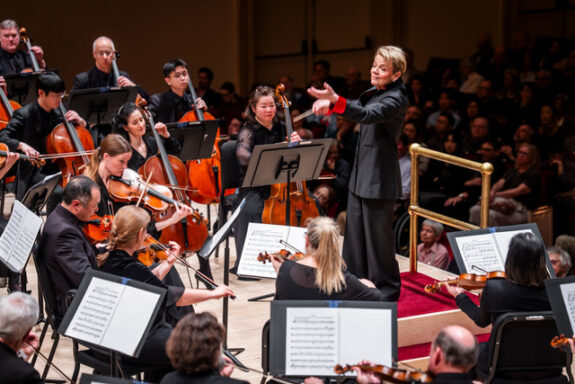
Marin Alsop brings so much to music, but her feel for rhythm is spectacular. Now in the second year of her three-year contract as principal guest conductor of The Philadelphia Orchestra, she proved it once again at Carnegie Hall. The concert popped with energy and rhythmic vitality, even in its most lyrical moments.
John Adams wrote The Rock You Stand On as a gift for Alsop, who is one of the great champions of his music. He doesn’t ascribe any particular meaning to it, but he describes Alsop as loyal, determined and devoted, suggesting that these qualities may have inspired the title.
The Rock You Stand On is a new twist on Adams’s post-minimalist stylistic signature strokes – constant repetitive rhythmic drive and rich orchestration. He went for broke with the latter, composing for a mammoth orchestra that filled the stage. It opens with a short, snappy dialogue between the strings. The rhythmic cell they played expanded into a quirky fugue until the trumpets got stuck on a single note. Some jazzy bits alternated with more sustained passages which cast a reflective mood. A particularly lovely section with the delicate tolling of chimes increased in tension with each repetition figure. The music became more concentrated as it escalated into chaos before suddenly stopping.
Alsop timed all this stop-and-go perfectly, as well as the hairpin turns of energy and mood. The orchestra was ever alert and reveled in the colors and the complexity of Adams’s score. It is an unsettled piece that begs the question of what kind of rock Adams had in mind and whether it is a solid enough foundation upon which to construct a work.
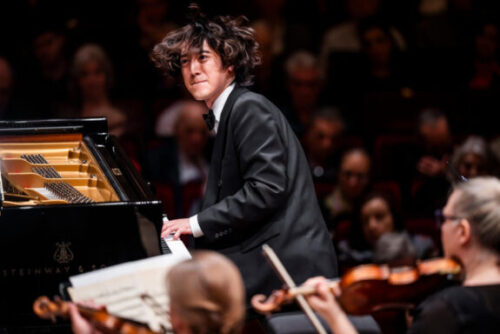
Adams acknowledges a certain big-band quality to The Rock You Stand On with its underlying, jazz-inflected pulse. George Gershwin’s Piano Concerto in F provided the real thing, especially with pianist Hayato Sumino as the soloist. The classical world took note of the Japanese pianist when he reached the semi-finals of the XVIII International Chopin Piano Competition in 2021. To the online world, he is ‘Cateen’, a YouTube sensation with more than 1.4 million subscribers and 100 million views.
Alsop immediately got to the essence of Gershwin’s style, beginning with the timpani flourish that opens the first movement. The syncopated ‘Charleston rhythm’ shifted this most New York City-sounding of concertos to South Carolina without missing a beat. Sumino entered with soft, scintillating playing that assumed weight and energy with the orchestra’s entrance, followed by arpeggios and spinning swirls of sparkling notes in the piano’s upper ranges.
Trumpeter Anthony Prisk set the mood in the second movement with the languid, blues-inspired melody played on a muted trumpet. The entry of a trio of clarinets, bassoon and muted horns made the atmosphere even sultrier. As in the first movement, Sumino made the piano’s upper range sing with remarkable lightness and sensitivity.
Without a pause, it was off to the races in the final movement, which Gershwin described as ‘an orgy of rhythms, starting violently and keeping the same pace throughout’. That meant a torrent of pyrotechnics as Sumino set the keyboard afire. He is a natural communicator, and his sensitive dialogue with the orchestra in the quieter moments were equally impressive. Throughout, he played with remarkable grace, lilt and charm, which went hand in glove with his classy, top-hat performance.
Sumino is also a composer whose works combine classical music and jazz. With the applause still ringing, he sat down and played his own arrangement of Gershwin’s song, ‘I Got Rhythm’. Call me crazy, but Sumino must have listened to Ethel Merman sing the song she introduced to Broadway in 1930 which made her a star. The swagger and articulation were pure Merman but the imagination and virtuosity were Sumino’s alone.
In the second half of the program, Alsop led the orchestra in a viscerally and emotionally satisfying performance of selections from Prokofiev’s Romeo and Juliet. The ‘Montagues and Capulets’ set the scene with the knights’ thunderous plodding, which was interrupted by eerie, gossamer-like playing from the violas, celeste and woodwinds. In ‘The Young Juliet’, she was first painted as a lively, playful girl in pinpoint pizzicato from the strings, but then transformed into a dreamy teenager through a tender, moving flute solo.
Combatants crossed swords in fast-paced rhythms to intense, perfectly etched dissonances from the brass and percussion in ‘The Death of Tybalt’. More exotic sounds and rhythms were heard in the ‘Dance of the Antilles Girls’ where maracas and tambourines supported delicate and airy woodwind solos. In the final scene, ‘The Death of Juliet’, the orchestra played melodies recalling Juliet’s dreams of love with heartbreaking gentleness before depicting her grief in torrents of sound punctuated by horrible, overwhelming drumbeats. The effect of the final clarinet solo expressing Romeo’s love for Juliet was cathartic, as was the final chord effortlessly floated into the hall.
The orchestra also played an encore, the ‘General Dance of Enthusiasm and Apotheosis’ from Shostakovich’s ballet suite The Bolt. It began with a flourish, followed by a languid saxophone solo that smacked with irony. After that, Alsop drew clockwork precision from the orchestra in the raucous mechanical march. The audience was on its feet before the reverberation from the final tremendous explosion of sound hit the back wall.
Rick Perdian
Featured Image: Marin Alsop conducting The Philadelphia Orchestra © Chris Lee
I attended this concert, and it was truly wonderful.
In particular, Gershwin’s Piano Concerto felt like a beautiful coexistence of classical music, jazz, and blues, each retaining its own character.
The encore, ‘I Got Rhythm’, was also amazing, with Hayato Sumino’s unique improvisation adding something fresh and exciting.
I was deeply moved by the orchestra, the conductor, and the piano.
I completely agree with this excellent review.