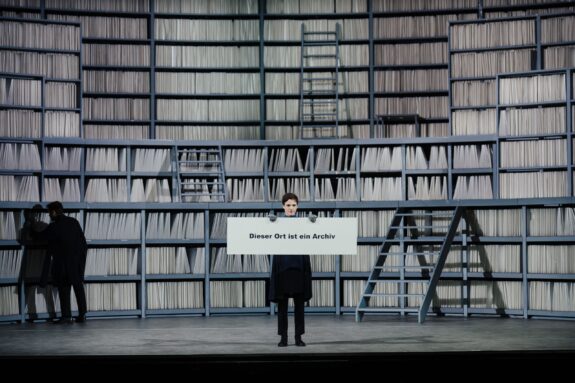
 Germany Wagner, Tristan und Isolde: Hessian State Chorus and Orchestra / Leo McFall (conductor). Hessian State Theatre Wiesbaden, 1.5.2026. (DM-D)
This production by Tiago Rodrigues was first seen in Nancy in 2023. It was set in an archive, with documents stacked on three levels. The ground level was used predominantly by two dancers (Sofia Dias und Vítor Roriz) in festive suit and coat. They spent the first more than ten minutes of the performance pulling large, rectangular sheets of cardboard from the shelves and showing them to the audience, revealing three to four words each printed in black ink with a combination of plot and analysis. Halfway through these silent ten minutes, an audience member shouted ‘das reicht!’ (that’s enough), and there was a mild wave of applause.
After some poignant comments about the score, the music finally started. The dancers initially listened motionlessly, while gradually engaging in dance movements of a contemporary kind in line with or in contrast to the music. The singers were on the next level up, further back from both orchestra and audience. The dancers accompanied all the singing with further text posters, referring to Tristan and Isolde as ‘der traurige Mann’ and ‘die traurige Frau’ (the sad man/the sad woman). On at least one occasion, the grammar of the text was inaccurate. The cardboard panels also served as objects at times, and on those occasions, they were used by the singers – mainly as their weapons. In the long run, having to read along with the music was rather a strain and the content did not add anything to the intellectual or aesthetic experience. As a production idea it can serve as a two-minute gimmick at best, but for the entire duration of the opera it was nerve-wracking, at least for me. At the curtain call, the production team received a mix of boos and bravos.
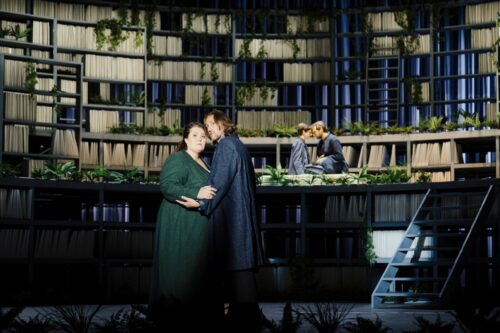
For Act II, some of the archive material was replaced by plastic green foliage, and the first text panel suggested we were to imagine seeing a garden with large trees. The dancers were on level one and the singers on the ground level and thus closer to the audience. For the third act all the cardboard cards had been placed on a pile stage right, which Tristan used to lean against as his sick bed.
Musically, Leo McFall’s reading of the score was on the brisk side; brass and woodwind served to create a tight mesh, a framework, which held the massive strings in place, under control and in check, always maintaining a gentle but strict dominance.
Ric Furman, who was so impressive as Tristan in Lübeck (see review here), was uncharacteristically quiet in Act I and had considerable vocal problems in the Act II. After the management announced he was as suffering from pollen allergy he went on to give the best of his performance that evening, leading to well-deserved bravos at the curtain call. In full voice he would of course have been much better. Carla Filipcic Holm as Isolde grew steadily in vocal command and control, with more and more integrated lower register and effortless ringing top notes. In the love duet in the second act she was probably a bit hampered by concerns for Furman’s voice but rose to a glorious ‘Liebestod’ at the end, her voice soaring admirably over and with the orchestra.
Tommi Hakala sang Kurwenal with the gusto often heard in this role, and Irene Roberts is among the best Brangänes today (I am looking forward to her debut as Isolde next year at the Tiroler Festspiele in Erl). Young Doo Park fielded a massive, booming voice as King Marke, but struggled, especially early on, to maintain accurate intonation, owing to the sheer size of his massive instrument.
Richard Trey Smagur contributed a sturdy Melot, Yoontaek Rhim was a fresh Helmsman, and Katieho Mokhoabane was particularly radiant as the Shepherd and the voice of the Sailor.
Daniel Meyer-Dinkgräfe
Featured Image: Sofia Dias und Vítor Roriz © Max Borchardt
Production:
Director – Tiago Rodrigues
Revival director – Sophie Bricaire
Set design – Fernando Ribeiro
Costume design – José António Tenente
Lighting design – Rui Monteiro
Chorus director – Aymeric Catalano
Dramaturgy – Simon Hatab, Hanna Kneißler
Dance / Choreography / Translation – Sofia Dias, Vitor Roriz
Cast:
Tristan – Ric Furman
Isolde – Carla Filipcic Holm
Kurwenal – Tommi Hakala
King Marke – Young Doo Park
Brangäne – Irene Roberts
Melot – Richard Trey Smagur
A Helmsman – Yoontaek Rhim
A Shepherd / Voice of a Sailor – Katieho Mokhoabane