 Switzerland Mozart, La clemenza di Tito: Zurich Opera Chorus, Orchestra La Scintilla / Marc Minkowski (conductor). Zurich Opera, 30.4.2026. (MF)
La clemenza di Tito, completed by Mozart in the last months of his life and premiered in the same month as Die Zauberflöte, has long occupied an awkward position in the canon, overshadowed by the three Da Ponte operas. Composed to celebrate the coronation of Leopold II as King of Bohemia, this work was dismissed by some as a commissioned piece of flattery.
If evidence was ever needed, this Zurich Opera production impressively demonstrates how spurious any such snubbing was. And against current events worldwide, not least events in Washington including the Correspondents’ Dinner shooting on the same day as Clemenza’s Zurich opening night, this story of intrigue, betrayal and assassination attempts gains unsettling contemporary relevance.
Roman emperor Titus was famed for his alleged magnanimity and his generosity towards the population after the Vesuvius eruption that wiped out Pompeii. Mozart’s Tito stages himself as a benevolent leader preferring to give money to the poor rather than erecting a taxpayer-funded self-aggrandising monument.
Director Damiano Michieletto questions such moral greatness, suggesting it is driven not simply by Tito’s kindness of heart but as much by calculation and strategy. Having overseen the Colosseum’s completion, an antique equivalent of today’s TV show stages, the emperor was no doubt a master at putting panem et circenses to work in his favour.
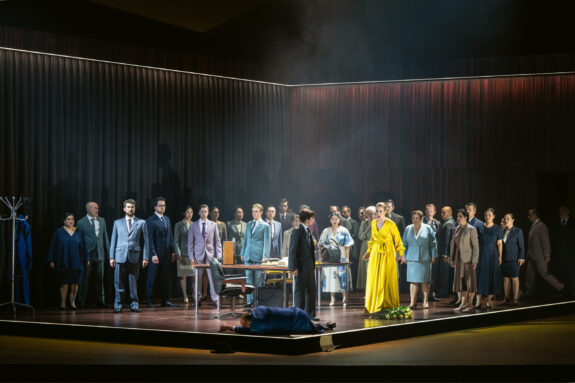
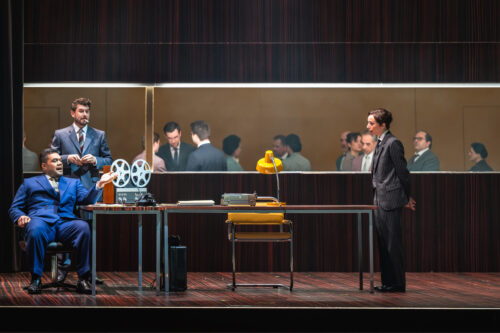
The director pushes his questioning of the relationships between the protagonists further yet. Before the overture is over, the curtain goes up on Publio (Andrew Moore), traditionally thought to be Tito’s loyal friend and adviser, as he hides various bugging devices. In a Dick Cheney or – closer to the present perhaps – tech mogul-style, Publio has long taken over the reins in the background. He will complete his scheme by delivering a poisoned chalice to the emperor as the last bars of the evening are played. No one can be trusted. With psychological mastery, Michieletto dissects the rapport between the characters. Through a network of interdependencies, loyalty and friendship it is treason and betrayal that carries the day.
The set is austere, to great effect. A dauntingly sterile classical modern interior, with a 1960s style and 1970s colour palette, evokes a Stasi- or James Bond villain-like atmosphere in which the various front and backroom relationships are fostered and pretended. Deals, and individuals, are executed. An L-shaped wall on the revolving stage separates the exterior from the interior world; either can be one or the other. Klaus Bruns’s timeless costumes, business attire of sober colours, intensify the dreary menacing mood. Tito and Vitellia are the exception in an electric blue suit and canary-yellow dress respectively.
Conductor Mark Minkowski and La Scintilla who play on historic instruments from an elevated pit deliver a masterclass in well-balanced differentiation and virtuosity, allowing in equal measure for forward momentum and intimate introspection. The conductor and his orchestra effortlessly move between the silky texture of the wind section and near Verdi-esque power in some of the chorus numbers. A special mention goes to the recitatives by Enrico Maria Cacciari (fortepiano) and the clarinet and bassett horn of Robert Pickup accompanying the soloists. Whereas some apparent coordination slip-ups were reported from opening night, this second performance stood out for its harmony between the instrumentalists and the singers.
The cast largely had a night of role debuts. Lea Desandre, who recently enthused the Zurich audience as Cherubino and Poppea, displayed richly varied colours as Sesto, with an intonation of haptic quality. Her Sesto is palpably torn in the emotional triangle the character forms with Tito and Vitellia. Tito (Pene Pati in a Zurich debut) is a strong, lyrical tenor with resonant Schmelz. Following director Michieletto’s reading of the characters, his emperor is not a dominant figure, but one acutely aware his power is only borrowed. After a short warm up period, Margaux Poguet’s Vitellia convinced with an impressively broad vocal range, a tyrannical, spiteful conspirator as much as a despairing woman and lover in ‘Non piú di fiori’. Her mezzo-soprano was in perfect marriage with the bassett horn from the pit. Andrew Moore as Publio incarnates the deadly conspirator with effectful bass-baritone. The couple formed by the ever-enchanting Siena Licht Miller as Annio and Yewon Han as Sevilia completed a grand cast.
Performances run to 25 May 2026.
Michael Fischer
Featured Image: Zurich Opera’s La clemenza di Tito © Toni Suter
Production:
Director – Damiano Michieletto
Set – Paolo Fantin
Costumes – Klaus Bruns
Lighting – Alessandro Carletti
Chorus director – Ernst Raffelsberger
Dramaturgy – Kathrin Brunner
Cast:
Tito Vespasiano – Pene Pati
Vitellia – Margaux Poguet
Servilia – Yewon Han
Sesto – Lea Desandre
Annio – Siena Licht Miller
Publio – Andrew Moore