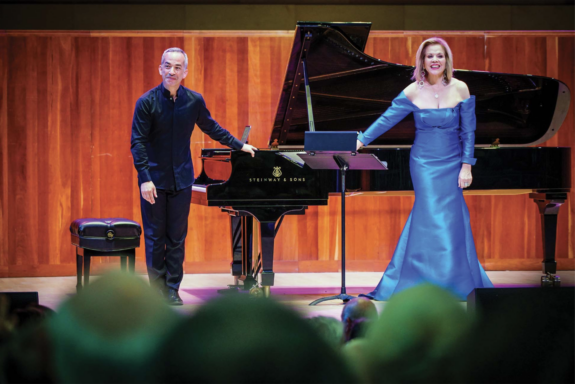
 United States Various: Renée Fleming (soprano), Inon Barnatan (piano), Tessa Lark (violin). Cal Performances, Zellerbach Hall, University of California Berkeley, 3.5.2026. (HS)
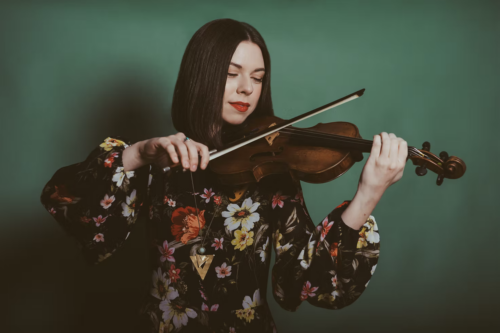
Who would have guessed that violinist Tessa Lark’s arrival as a surprise guest would spark an already good recital by soprano Renée Fleming and pianist Inon Barnatan and make it memorable?
Like Fleming, Lark can straddle musical genres. Fleming has not only graced opera stages with gold-standard Mozart and Richard Strauss heroines, she has starred on Broadway and can adjust her voice to create natural-sounding jazz and pop vocals that win Grammy nominations. Lark freely blends her bluegrass fiddle roots with classical elegance and precision in familiar concertos and ones written for her.
Barnatan is a musical chameleon too, his virtuosity in classical music transferring to a feel for other genres including jazz and, in this concert, bluegrass. The Israeli-born pianist has become a regular recitalist with Fleming since they met flying to the Aspen Music Festival. The pairing won a 2023 Grammy for Voice of Nature: The Anthropocene.
The program for Fleming’s Cal Performances recital listed only ‘Traditional American songs to be announced from the stage’, to be included in a second-half of American music. Midway through, Fleming brought out Lark to add extra depth to Joni Mitchell’s ‘The Fiddle and the Drum’, and Lark followed with her own composition, Appalachian Fantasy, which applies bluegrass fiddling to music by Schubert and Brahms.
This unexpected turn fit perfectly after a set of two pieces inspired by American history. The first, ‘We Hold These Truths’, features stirring music by J. Todd Frazier built around the first sentences of the Declaration of Independence. (Fleming sang the premiere in 2017.) Then came John Kander’s music for ‘A Letter from Sullivan Ballou’, a touching Civil War letter by a Union major written to his wife just before the Battle of Bull Run. (Fleming famously sang it at the Obama White House in 2012.)
Mitchell’s ‘The Fiddle and the Drum’ expanded on the unstated political commentary underlying those patriotic songs in the current moment vis-a-vis the U.S. presidency and the stench of war. Michell’s lyrics center on ‘And so once again, Oh, America, my friend, you are fighting us all’, and stanzas end with ‘How did you come to trade the fiddle for the drum?’ Lark’s fiddle elaborations on the melodies and the thrum of the rhythms from Barnatan created a stunning moment.
Lark introduced her Appalachian Fantasy by pointing out that classical composers routinely ‘stole’ folk songs and popular music of their day as bases for their own works. She turned the tables by ‘borrowing’ a tune from Schubert’s Fantasy in C major and the virtuosity of Brahms’s concerto, topping it off with a fully bluegrass version of ’Bonaparte’s Retreat’ (the tune Copland use for his ‘Hoedown’).
That made a perfect setup for Barnatan’s verve and swing in Earl Wild’s expansion on ‘I Got Rhythm’ from his 7 Virtuoso Études after Gershwin. And that segued perfectly into Fleming’s Broadway salute, beginning with a tenderly bittersweet rendering of Cole Porter’s ‘So in Love’. She got some strong soprano voices in the university auditorium’s audience to sing along with her on the second verse of Lerner and Loewe’s ‘I Could Have Danced All Night’.
Andrew Lippa’s ‘The Diva’, a semi-rap song written for Fleming as an encore, poked fun at opera-singer tropes. Its bouncy rhythm underlay three minutes of fun as Fleming highlighted snarky and self-deprecating lines and Barnatan supplied an energetic and deft foundation.
The second half overshadowed a first half that focused on beautiful melody chosen from composers with whom Fleming has a long and elevated history. Though not stated outright, the program seemed designed to sample the repertoire that led to Fleming’s reputation for vocal beauty and stylistic flexibility.
Mozart’s ‘Laudate Dominium’ opened the proceedings with carefully placed simplicity, after which Fleming noted that she considered Mozart her ‘teacher’ – she specialized in Mozart for the first decade of her career. ‘And, yep, it looks simple but it’s still hard’, she added.
Handel’s livelier ‘To fleeting pleasures make your court’ (from the oratorio Samson) showed abilities in coloratura that are still there but felt pressured. Much better was Handel’s ‘Lascia ch’io pianga’ from (Rinaldo), a superb melding of sleek vocalizing and Baroque passion. Concluding the opera portion of the afternoon, Puccini’s ‘O mio babbino caro’ showed off the combination of sheer vocal sound and an ability to tweak the texture to create a breathtaking moment. Fleming and Barnatan took it at a deliberate pace that created space for details to make a difference.
Barnatan’s vigorous romp through Mendelssohn’s Rondo capriccioso contrasted frisky cavorts through light runs (a classic example of ’tickling the ivories’), climaxing in impressively rapid double-octaves. Throughout the recital, the connection between his musicality and Fleming’s was apparent. They both managed to shade phrases with appropriate taste: Fleming soared, and Barnatan provided the ribbon to tie it all together.
A set of three lushly lyrical songs by Reynaldo Hahn completed the first half. ‘L’heure exquise’ and ‘Si mes vers avaient des ailes’ were fine, but ‘Les étoiles’ put the cap on the first with truly exquisite sound and expression.
Hahn exploited the soprano voice with music to showcase long, lyrical lines. Richard Strauss, if anything, did it even better. It was fitting that the afternoon’s only encore combined these elements with Lark’s violin representing a full orchestra in Strauss’s ‘Morgen’. Fleming dedicated it to Michael Tilson Thomas who died on 22 April. She recalled visits to San Francisco that included private lunches or dinners with MTT and his husband, Joshua Robison, at their home. In 2002 she premiered his Emily Dickinson songs. Perhaps it was that history and depth of emotion that imbued the encore with rich emotion. The first tender measures of ‘Morgen’ and the opening line, which translates to ‘And tomorrow the sun will shine again’, brought a tear to my eye. Lark’s violin playing against Fleming’s perfumed legato, supported by Barnatan’s elegant touch, created an unforgettable moment.
Harvey Steiman
Featured Image: Soprano Renee Fleming with pianist Inon Barnatan at the Aspen Music Festival in 2023 © Diego Redel
Mozart – ‘Laudate Dominum’ from Vesperae Solennes de Confessore
Handel – ‘To fleeting pleasures make your court’ from Samson; ‘Lascia ch’io pianga’ from Rinaldo
Puccini – ‘O mio babbino caro’ from Gianni Schicchi
Mendelssohn – Rondo capriccioso, Op.14
Hahn – ‘L’heure exquise’, ‘Si mes vers avaient des ailes’, ‘Les étoiles’
J. Todd Frazier – ‘We Hold These Truths’
John Kander – ‘A Letter from Sullivan Ballou’
Joni Mitchell – ‘The Fiddler and the Drum’
Tessa Lark – Appalachian Fantasy
Earl Wild – ‘I Got Rhythm’ from 7 Virtuoso Etudes after Gershwin (‘The Man I Love’)
Cole Porter – ‘So in Love’ from Kiss Me, Kate
Alan Jay Lerner and Frederick Loewe – ‘I Could Have Danced All Night’ from My Fair Lady
Andrew Lippa – ‘The Diva’
Encore: R. Strauss – ‘Morgan’