
 Germany Puccini, Turandot: Soloists, Chorus of Hannover State Opera, Lower Saxony State Orchestra Hannover / Mazaru Kumakura (conductor). Hannover State Opera, 3.5.2026. (DM-D)
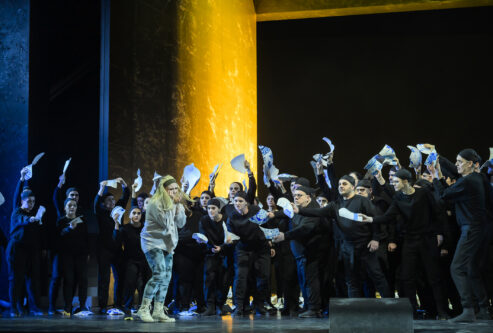
For this production of Turandot, a massive cube provided the main element of the set. The cube was placed on a revolve, and a straight, steep staircase was visible on one side, used by Ping, Pang and Pong to comedic effect on one occasion, and Xavier Moreno started singing Calaf’s aria ‘Nessun dorma’ seated on its steps. At other times, the cube revealed massive gold walls. It represented a fairy-tale empire unspecific in terms of historical period or geographical location. The only vague reference to China was provided by shards of porcelain carried by the chorus of citizens and spread on the floor by them. The costumes supported the age and timelessness of this non-location. The chorus, representing the citizens of the empire, initially wore oversized masks reminiscent of mice. When Calaf answered the three riddles and it broke the spell of terror, the citizens took off their mice heads and became humans. After Liù sacrificed herself out of love for Calaf, she was placed face-up on a table.
Turandot was accompanied by a young woman (dancer Marianne Besser) whenever she was on the stage, who seemed to be clinging to her, restricting her movements, stifling her life. It was meant, as the programme notes and audio-intro to the opera revealed, to represent a personification of the influence causing Turandot’s actions – possibly a ghost of the ancestor who was raped and whose fate Turandot wished to avoid. At the end of the opera, Turandot killed this shadowy figure and placed her on the table instead of Liù. She was now free of her past obsession and free to develop love for and with Calaf. This interpretation made sense, was cogently narrated and the presence of the dancer was well integrated into the events, unobtrusive and aesthetically pleasing. For the ending of the opera, which Puccini could not complete, Hannover State Opera chose the 2002 version composed by Luciano Berio.
The title character was sung by Liene Kinča. Her voice was strong and able to ride above the orchestra with ease. Her breath control was such that she was able to sustain long melodic lines. Exposed notes were a little on the shrill side at times, but her overall command of the difficult role made up for that shortcoming. Kiandra Howarth sang Liù with exquisite beauty of voice (no sign anywhere of the distracting vibrato or an edge to her voice that I had noted in her 2024 Desdemona and Countess in Figaro). Xavier Moreno brought much experience to the role of Calaf. His tenor was strong and beefy, in a good sense, and Moreno was able to wield it with sufficient ease despite its weight. The top notes were duly ringing. Shavleg Armasi as Timur brought good control to his voluminous bass, making it sonorous and steady. Lars-Oliver Rühl appeared feeble in body but sang with significant authority as Altoum. Matteo Guerzè, Jonathan Winell and Michał Prószyński acted and sang well together as Ping, Pang and Pong, the seriously ridiculous or ridiculously serious ministers. Juhyeon Kim’s strong baritone appropriately opened the opera as the Mandarin.
Mazaru Kumakura conducted with verve, differentiating well between movingly gentle and wildly emotional passages, never exaggerating, always aware of the acoustics of the venue, and always taking care not to drown out the singers.
Daniel Meyer-Dinkgräfe
Featured Image: Matteo Guerzè, Jonathan Winell and Michał Prószyński as Ping, Pang and Pong © Bettina Stöss
Production:
Director – Jakob Peters-Messer
Stage design – Sebastian Hannak
Costume design – Tanja Liebermann
Lighting design – Johannes Paul Volk
Movement coach – Amna Shadad
Chorus director – Lorenzo Da Rio
Children’s chorus director – Tatiana Bergh
Dramaturgy – Anna Maria Jurisch
Cast:
Turandot – Liene Kinča
Calaf – Xavier Moreno
Liù – Kiandra Howarth
Timur – Shavleg Armasi
Ping – Matteo Guerzè
Pang – Jonathan Winell
Pong – Michał Prószyński
Altoum – Lars-Oliver Rühl
A Mandarin – Juhyeon Kim