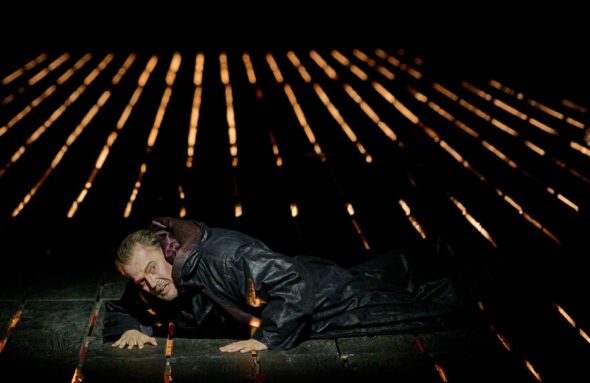
 Austria Wagner, Der fliegende Holländer: Chorus and Orchestra of the Vienna State Opera / Bertrand de Billy (conductor). Broadcast live (directed by Anna Gallieni) from Vienna State Opera, 3.5.2026. (JPr)
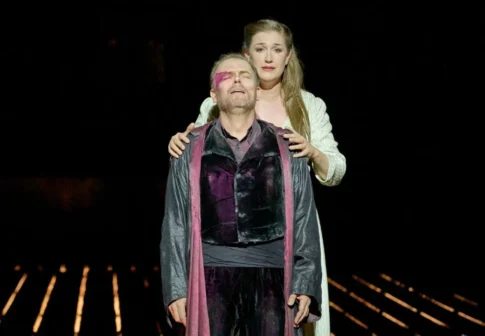
This Der fliegende Holländer is perhaps the oddest I have ever seen and heard despite being excellently sung by the cast and superbly played by the incomparable Orchestra of the Vienna State Opera under experienced Wagner interpreter Bertrand de Billy. It was not the mise-en-scène of Christine Mielitz’s 2003 staging – performed without intervals – that was the issue. Indeed, it was all fairly traditional and may have influenced Christoph Marthaler’s 2005 Tristan und Isolde as that was also essentially set in the hull of a large ship with rear doors and with vaguely 20th-century costumes.
Of course, Melitz’s Holländer current revival had its moments: the Dutchman seems to be the captain of a plague ship with his zombie-like crew in dark hooded cloaks; there are four smallish portraits above Daland’s doors which I understand are all revolutionaries (and even I spotted Karl Marx and Che Guevara!); and up above those doors is Senta’s (?) extensive collection of birds in cages (of which she appears to be another and eager to escape her own confinement). Later as the opera reaches its conclusion, during all the merrymaking some girls are sexually assaulted by half-naked sailors. It is near the end of this Holländer where what we see gets a little messy: the ghostly crew (themselves bare-chested) burst through the rear doors to an odd-sounding whistling wind and challenge Daland’s men before collapsing to the floor before huddling round the Dutchman. Finally, Senta douses herself in petrol from a can, sets light to herself, and descends presumably to hell (?) before the curtain falls.
None of this particularly was that strange (these days?) though what for me was different was that Wagner’s Romantic ghost story, which was a precursor to his use of ‘endless melody’ (in Tristan especially) and eschewed – if not entirely – distinct numbers for something more through-composed, was performed here exactly like middle-period Verdi. Singers faced forward, arms spread out and they made the most of any set pieces such as the Steersman’s Song, Senta’s Ballad, the Dutchman’s Monologue, Daland urging Senta to accept marriage to the Dutchman and the Dutchman’s subsequent duet with Senta. (I must add here how Tomasz Konieczny – perhaps one of the finest of the Dutchmans I have heard – ended his opening ‘Die Frist ist um’ almost taking the roof of the Vienna State Opera as if he had sung ‘Nessun dorma’ and the audience were eager to applaud him as if he had!) There are also Erik’s impassioned interventions and all the structured choruses, such as for the spinning girls and the sailors early in the opera and towards the end. Betrand de Billy conducted one of the wildest and stormiest overtures I can remember and with its concert ending that also seems designed to encouraged applause before de Billy pressed on.
Apart from the singers often in a spotlight at the front of the stage everything looked rather dark in the livestream. At the very beginning there is the image of turbulent seas with a shape of a man seemingly trying to tame the huge waves and soon the appearance of the silhouette of the Dutchman’s ship is accompanied by a red glow. Costumes are mostly in sombre colours, black, grey or blue; though Senta is in a white dress with the women in pastel shades (blue, pink and yellow), Mary severely dressed, Erik – supposedly a huntsman – in a tan leather jacket (looking as if the singer was in his rehearsal clothes), whilst the sailors come on to party in black jackets, white shirts and ties. There is a moving walkway on one side of the stage where the Steersman begins on lookout and then some spindles with wool on them hang down for the Spinning Chorus; regardless everything we see is mostly centred within the ribbed framework of the ship on the stage.
I had no real idea what Mieltiz was trying to ‘tell us’ though Daland did appear to be an arch-capitalist and there were those portraits on the stage of course. Neither were there many new interpretative insights from Bertrand de Billy and perhaps none could be expected for Wagner’s early effort (1843) ending as it does with two emphatic chords like a Verdi or Puccini opera of a later date. It had suitable forward momentum and was stormy, dramatic, spectral and nightmarish by turns with only fleetingly more intimate moments.
As suggested, Tomasz Konieczny showed he is one of the best Dutchmans of this generation, as impressive in his compelling stage presence as in his resonant voice was in evincing his character’s emotional anguish and sense of supernatural longing. Erica Eloff is a South Africa-born French soprano who made her professional debut in the UK in 2008 at Garsington. (Believing her to be a new name to me and Seen and Heard I see I had reviewed her in a minor role in Chelsea Opera Group’s Ernani in 2015.) Eloff was a near-perfect doppelganger for Lise Davidsen in demeanour and voice – and I mean this in the most flattering way possible. Now a member of Linz Landestheater ensemble Eloff began her ballad ‘Johohoe!’ reflectively – and in mezza voce – before rising to all its challenges as she conveyed an intense spiritual obsession with wanting to redeem the cursed Dutchman. Elsewhere she brought to her Senta a slightly distracted, preoccupied air and was rather reluctant to accept she had to marry the Dutchman until Daland insisted, and then she swore to be true till death. Andreas Schager is everywhere these days and whether he needs to keep Erik in his repertoire is questionable. His flowers-clutching Erik was typically hyperactive and sung ardently with some attractive colours and a certain lyricism, though his top notes were, also as usual, a little effortful.
The supporting characters were very strongly cast with Franz Josef-Selig’s somewhat gruffly-sung and bluff Daland neither as jovial nor paternal as some can be, here he is clearly more driven by materialism (he reads the Financial Times) whilst his treatment of his sailors was rather dubious initally. Stephanie Maitland was a stern, school-mistressy Mary, sweet-toned tenor Hiroshi Amako was an extremely eloquent Steersman, whilst the male chorus sang up a storm of their own, either as sailors or phantoms.
Jim Pritchard
Featured Image: Tomasz Konieczny (Dutchman) © WS/Michael Pöhn
Cast:
Daland – Franz-Josef Selig
Senta – Erica Eloff
Erik – Andreas Schager
Mary – Stephanie Maitland
Steersman – Hiroshi Amako
Dutchman – Tomasz Konieczny
Creatives:
Director – Christine Mielitz
Designs – Stefan Mayer
Dramaturgy – Eva Walch
Chorus director – Thomas Lang