 United States Various, London Foundation – ‘A Love Letter to the Americas’: Shelén Hughes Camacho (soprano), Joseph Parrish (baritone), Amir Farid (pianist), Diego Fernández (guitar), Daniel Jimenez (percussion). Merkin Hall at Kaufman Music Center, New York, 30.4.2026. (RP)
In ‘A Love Letter to the Americas’, soprano Shelén Hughes Camacho and baritone Joseph Parrish paid tribute to the continent writ large. Although no settings of Langston Hughes’s ‘I, Too, Sing America’ were on the program, his spirit pervaded the hall for this deeply personal and endearing mix of Classical, Latin American, African American and pop pieces.
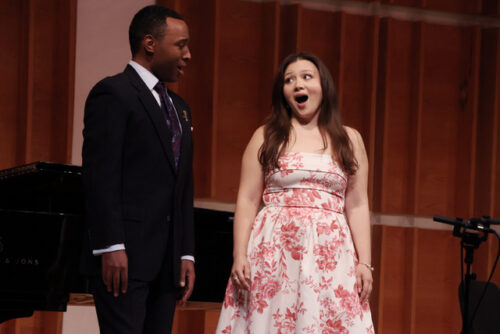
The concert began with Parrish entering as Figaro, taking measurements of the room he will share with his fiancée, Susanna, in the first scene of Mozart’s Le nozze di Figaro. He was all business, but Camacho proved an enticing distraction with her meltingly beautiful, creamy soprano. In ‘Come Paride vezzoso’ from Donizetti’s L’elisir d’amore, Parrish as Belcore was more suave than arrogant as he wooed Camacho’s Adina. Comacho charmed with her luscious tone as she gave voice to Suzel’s first awareness of love in ‘Son pochi fiori’ from Mascagni’s L’amico Fritz. More Mozart ended the set, with Parrish’s granite-voiced Don Giovanni seducing Comacho’s alluring Zerlina in ‘La ci darem la mano’.
Pianist Amir Farid changed the mood and era with a piano transcription of Gershwin’s ‘Promenade’. The piece was originally composed for the Fred Astaire and Ginger Rogers film Shall We Dance, and Farid made short work of it with his stylish and sophisticated playing. Ten years earlier, Kern and Hammerstein’s musical Show Boat broke new ground with its racially integrated cast. Comacho’s voice was silken in ‘Bill’, Julie’s love song to an ordinary guy, turning it from a torch song to something equally sensual but far more tender. Her final ‘He’s just my Bill’ was as soft, wistful and loving as imaginable.
Camacho began her artistic journey in her native Bolivia as a folklore singer and dancer, before studying classical music at The Juilliard School and the Manhattan School of Music. She is the founder of Voices for Bolivia, an international nonprofit organization dedicated to supporting elderly individuals living in extreme poverty through classical music and community-based initiatives. The songs she sang spanned the vibrant culture of South America to pop standards, including ‘Cuando vuelva a tu lado’. The song was made famous by Eydie Gormé, whose career took off with the Spanish-language radio program Cita Con Eydie in the 1940s.
On the classical side of the equation, there was Villa-Lobos’s ‘Evocação’, which Camacho ended in a heartbreaking expression of pain. There was also Ernani Braga’s rapid-fire tongue twister, ‘Engenho Novo!’, in which farmers celebrate a new sugar mill. Her final song was ‘Gracias a la Vida’ by Chilean artist Violeta Parra, which has become a global anthem of resilience and hope. Camacho sang its last stanza, which mixes joy and sorrow, with a depth of emotion equaled by the beauty of her voice.
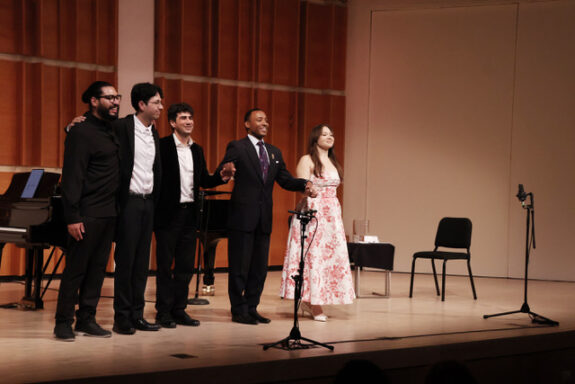
Camacho invited guitarist Diego Fernández and percussionist Daniel Jimenez to the stage, saying that they have been part of her musical life since childhood. The duo performed ‘Tico-Tico no Fubá’’ which became an international hit when Carmen Miranda sang it to Groucho Marx in the Hollywood movie Copacabana. Fernández and Jimenez performed it with far more soul, although perhaps not as much glee as did the famed Brazilian bombshell with a fruit basket on her head.
Parish described his training as a classical singer as being heavy on German Lieder, listing topics that inspired those composers and drawing a laugh when he added ‘even a trout’, alluding to Schubert’s ‘Die Forelle’. The songs he sang resonated with the American experience which for most, especially for African Americans, entailed persistence, faith, family and hard work. His clarion voice rang out with precision and triumph in Hal Johnson’s setting of the spiritual ‘Honor! Honor!’. In Johnson’s setting of Langston Hughes’s ‘Dusty Road’, Parrish, ever the consummate stylist, imbued its evocation of endless drudgery with a soft, soulful dignity.
Parrish sang Moses Hogan’s setting of ‘Where You There’ with a solemn intensity, made all the more grave by the sepulchral rumblings of his voice when he sang ‘tremble, tremble’. Without a moment’s pause, he segued into Harry T. Burleigh’s ‘My Lord, What a Morning’. Singing without accompaniment, Parrish’s straightforward eloquence took on new dimensions of wonder and awe when harmonizing with Camacho in the final strain.
To the strumming of Fernández on the guitar, Parrish was as cool as the glass of water that a working man calls for in Lead Belly’s ‘Sylvie’. His baritone gleamed like the steel that John Henry drove in the American folksong, performed as a tribute to the great-great-grandfather who helped build the Chesapeake and Ohio Railway in the 1870s. In an even more personal vein, Parrish accompanied himself in Donny Hathaway’s ‘A Song for You’, conjuring a moment with his mother as she drove him home from his first young artists program.
Parrish gamely joined Comacho, Fernández and Jimenez in the Bolivian folk song ‘Cantarina’, brandishing a white handkerchief that he flashed with precision to woo Camacho. The effort was a success, judged by their final kiss. Rapture infused their closing duet, ‘One Night to Love’, from the film of the same name, made famous first by soprano Grace Moore and, decades later, by Anna Moffo. For an encore, they turned up the heat with ‘Besame Mucho’, which has been covered by everyone from Vera Lynn to Connie Francis.
Rick Perdian
Featured Image: [l-r] Daniel Jimenez (percussion), Diego Fernández (guitar), Amir Farid (pianist), Joseph Parrish (baritone) and Shelén Hughes Camacho (soprano) © Beth Bergman
Mozart – ‘Cinque, dieci’ from Le nozze di Figaro; ‘Là ci darem la mano’ from Don Giovanni
Donizetti – ‘Come Paride vezzoso’ from L’élisir d’amore
Mascagni – ‘Son pochi Fiori’ from L’amico Fritz
Gershwin – ‘Promenade’
Jerome Kern & Oscar Hammerstein II – ‘Bill’ from Show Boat
Hall Johnson – ‘Honor! Honor!’, ‘Dusty Road’
Villa-Lobos – ‘Evocação’
Ernani Braga – ‘Engenho Novo!’
Moses Hogan – ‘Where You There’
Harry T. Burleigh – ‘My Lord, What a Morning’
Eydie Gormé – ‘Cuando vuelva a tu lado’
Lead Belly – ‘Sylvie’
Zequinha de Abreu – ‘Tico-Tico no Fubá’’
Eduardo Caba – ‘Flor de Bronce’
Traditional – ‘John Henry’, ‘Water Boy’
Milton Cortéz – ‘Cantarina’
Violetta Parra – ‘Gracias a la vida’
Donny Hathaway – ‘A Song for You’
Victor Schertzinger – ‘One Night of Love’
Encore: Consuelo Velázquez – ‘Besame Mucho’