 United States The Met: Live in HD – Tchaikovsky, Eugene Onegin: Soloists, The Metropolitan Opera Chorus and Orchestra / Timur Zangiev (conductor). The Metropolitan Opera’s Live in HD broadcast 3.5.2026 (directed by Gary Halvorson) and seen at the Everyman Cinema, Chelmsford, Essex, 5.5.2026. (JPr)
Deborah Warner’s staging of Eugene Onegin was last revived at the Met in 2022 not long after Russia invaded Ukraine and it was staged then under the mantra ‘Cancel Putin, not Pushkin’ and the Met’s General Manager Peter Gelb used this same justification for the current run of performances. This forgiveness seems to extend to the three Russian mezzo-sopranos in the cast, Maria Barakova (Olga), Elena Zaremba (Larina) and Larissa Diadkova (Filippyevna) and a Russian conductor Timur Zangiev. They were actually joined by two Ukrainians, Iurii Samoilov (Eugene Onegin) and Alexander Tsymbalyuk (Prince Gremin). Gelb is still holding out against Anna Netrebko who has returned recently to a number of opera stages who originally banned her. In fact, it was Netrebko who was Tatiana the only other time I have seen Warner’s Onegin (in 2017 again as a Live in HD broadcast).
Whilst Tchaikovsky’s Onegin was first put on in Moscow in 1879 it was not put on at the Met until 1920 and this production arrived at the Met in 2013 from the London Coliseum where it was first seen in 2011. Apparently Onegin is considered more a set of ‘lyric scenes’ rather than an opera with its seven scenes and 22 numbers across three acts. Therefore, it has a rather stop-start nature – respected too reverentially at the Met – and Tchaikovsky employed a leitmotif-like structure to span those acts, so you hear the same recurring themes repeatedly, basically from Tatiana’s Letter Scene through to the final climactic duet. While hinting at leitmotifs it is important to note how Wagner was clearly a major influence on the composition of Onegin which occurred only a couple of years after Tchaikovsky saw the Ring at Bayreuth in 1876.
At end of each scene the curtain descends and there is a wintry (video?) projection. At this point the action seizes up, and a great deal of whatever atmosphere has been created dissipates. This was not helped during the broadcast by the unnecessary sights and sounds of the scene changes going on behind that curtain. (In only helps confirm suspicions that the backstage crew at the Met is vastly overmanned – and I do mean manned!) Warner’s staging – with sets by Tom Pye and Chloe Obolensky’s good-looking costumes – updates what we see from Pushkin’s original 1820s to more Chekhovian times at the end of the nineteenth century, concurrent with Tchaikovsky writing the opera.
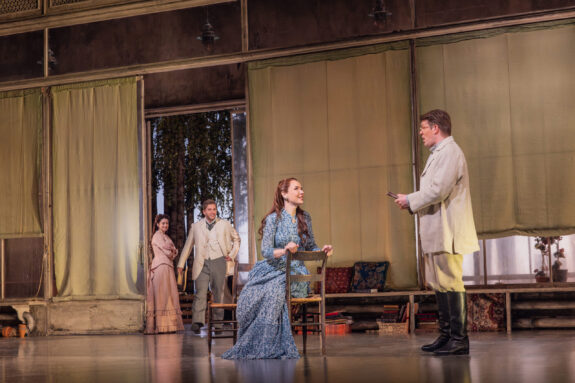
The opening scene is – according to the stage directions – set in a garden of the Larin country estate and there we should meet the sisters Tatiana and Olga and their mother, Madame Larina. However, Warner has the first three scenes take place in a rather dilapidated conservatory looking out onto countryside through windows covered with large blinds. Country-dwellers enter to celebrate the harvest and immediately the stage looks rather cluttered with all their singing and dancing. Some choreography from Kim Brandstrup – even stranger-looking with this second viewing – has a young girl thrown about and generally man-handled. (A feature of Tchaikovsky’s Onegin is that, for me, some of the dance music could be left out without harming the opera).
Tatiana is bookish and a dreamer who loses herself in her books and my mind recalled BBC TV’s recent The Other Bennet Sister series. Her sister Olga is more of a free-spirit and has a fiancé, Lenski, an aspiring poet. He arrives with his friend, the wealthy, if bored, Onegin. Flirting with Tatiana amuses an aloof and uncaring Onegin, however it unleashes pent-up adolescent urges in Tatiana which does not go unnoticed by Filippyevna, the sisters’ nurse. For some reason Tatiana’s more intimate conversation with Filippyevna about her childhood and marriage, as well as the Letter Scene – when Tatiana declares her love for Onegin in writing – takes place in the conservatory; as does Onegin’s subsequent rejection of her affections. Onegin asserts marriage is not for him and he can only love Tatiana as a brother would.
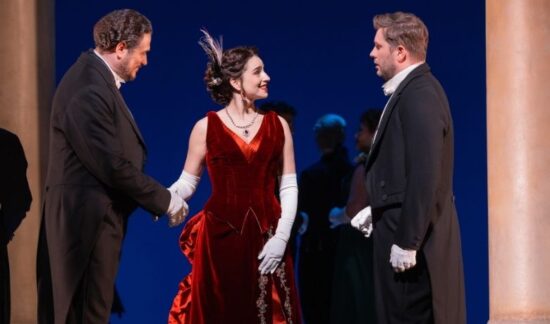
At the beginning of Act II, Onegin is bored and amuses himself flirting with Olga and making Lenski jealous. There is a nicely choreographed waltz with a lot of whirling for Onegin and Olga around a plush ballroom. This leads to a quarrel between the two friends and their subsequent duel in a suitably ominous, mist-shrouded setting ends with Onegin as Lenski’s somewhat reluctant killer. For the final two scenes in Act III, we are in Prince Gremin’s St Petersburg palace, and some large marble-like columns suggest it is suitably palatial. Five years have passed since Lenski’s death as Onegin has travelled the world trying to overcome what he did. Returning to St Petersburg he is astonished to find Tatiana has been married to Gremin, a military hero much older than her, for two years and Onegin finally realises how much he loves Tatiana. With Doctor Zhivago-like snow falling – though still in the palace it seems – the opera ends with Tatiana confessing that though she does love Onegin she will stay faithful to her husband and bidding the emotionally-devasted Onegin farewell forever.
I must say this Onegin never outstayed its welcome even with all the interruptions between scenes and two longish intervals. Lithuanian Asmik Grigorian (Tatiana) – in a charming backstage mutual admiration encounter with legendary mezzo-soprano Joyce DiDonato – remarked how in opera today you cannot just be a singer, or just an actor, you must be both. So it was good that – apart from being an incomparable singer – Grigorian could get away with portraying a teenage girl; just as her Onegin, Iurii Samoilov looked young enough to claim to be 26 in Act III. Grigorian’s Tatiana then believably metamorphosed into the third-act’s sophisticated and elegant princess who turned men’s heads The singing of Grigorian and Samoilov (once I got over his character’s uncharismatic, passionless and haughty demeanour) was exceptional with Grigorian’s intense and highly dramatic outpourings perfectly expressing Tatiana’s shifting emotions and Samoilov’s Onegin equally capable of conveying his descent from cynicism and arrogance to the desperately remorseful wreck he becomes at the end of the opera. Samoilov’s baritone is incisive, compelling, warm-toned and effortless and he brought, considerable pathos to his Act III reflections over his feckless life, distress about being the cause of Lenski’s death and that he has genuine feelings for Tatiana.
French tenor Stanislas de Barbeyrac’s singing thrillingly confirmed his current Wagnerian credentials. As Lenski he embodied a sensitive and gentle soul and his lyrical voice veered impressively from poetic romanticism to vehement jealousy. The highlight was his deeply-affecting Act II aria ‘Kuda, kuda vï udalilis’. Maria Barakova caught the eye and ear more than some Olgas do due to her stature and dark mezzo sound. Elena Zaremba, a former Met Olga, and Larissa Diadkova sang the same roles in 2017 as a concerned Larina and world-weary and kind Filippyevna. Sadly, Zaremba and Diadkova’s voices betrayed their veteran status. Alexander Tsymbalyuk brought immense dignity to his inconsolable outpouring of love for Tatiana in Act III. Kudos too to the Met’s own Tony Stevenson returning in Act II as the French tutor singing a song for Tatiana at her name day party; his vignette was a comic relief masterclass in miniature.
Unless my eyes deceived me, Timur Zangiev appeared to conduct Eugene Onegin without a score before him. Regardless of what was happening on the stage there was a pleasing forward momentum and Zangiev – supporting his soloists and the always-reliable orchestra and chorus – emphasised the music’s role in mirroring the characters’ emotions and brought to what we heard, as appropriate, chamber-like intimacy or all-consuming desire.
Jim Pritchard
Featured Image: Asmik Grigorian (Tatiana), Iurii Samoilov (Eugene Onegin), Maria Barakova (Olga) and Stanislas de Barbeyrac (Lenski) © Evan Zimmerman/The Met
Cast:
Eugene Onegin – Iurii Samoilov
Tatiana – Asmik Grigorian
Lenski – Stanislas de Barbeyrac
Olga – Maria Barakova
Prince Gremin – Alexander Tsymbalyuk
Larina – Elena Zaremba
Filippyevna – Larissa Diadkova
Triquet – Tony Stevenson
Captain – Ben Brady
Zaretsky – Richard Bernstein
Offstage voice – Remy Martin
Production:
Production – Deborah Warner
Revival director – Paula Williams
Sets – Tom Pye
Costumes – Chloe Obolensky
Lighting – Jean Kalman
Projection – Ian William Galloway, Finn Ross
Choreographer – Kim Branstrup
Chorus director – Tilman Michael
Live in HD director – Gary Halvorson
Live-in-HD Host – Joyce DiDonato
Now I want Boris Godunov!