 United States Spears, Sleepers Awake: Soloists, Opera Philadelphia Chorus (chorus master: Elizabeth Braden), Opera Philadelphia Orchestra / Corrado Rovaris (conductor). Academy of Music, Philadelphia, 26.4.2026. (DS)
Typically, there are three approaches to the telling of a fairy tale: the child-friendly version that ends happily, the frightening version, often steeped in traumatic experience, and the one that psychoanalyzes the characters’ perspective. For example, is it possible we simply misunderstood the witch who wanted to coax children into her oven, overlooking her unique storyline all this time?
Composer Gregory Spears delved into this third type with Sleepers Awake, based on the story of Sleeping Beauty (or Thorn Rose as she’s called here). His libretto backs away from the idea of love and, instead, deftly grapples with a compelling examination of consciousness, desire, reality versus illusion and the perpetual human question of self-fulfillment.
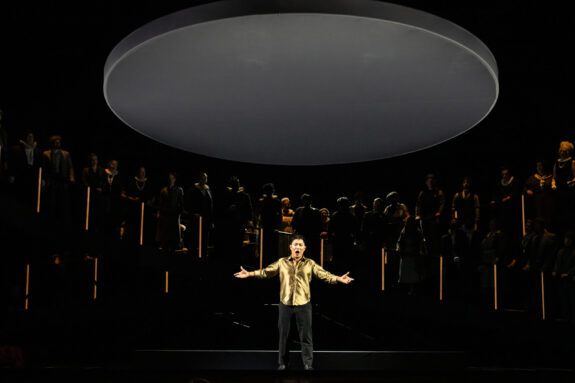
Spears’s angle centered on the insecurity of a questioning, if somewhat bewildered, prince (called The Stranger), sung by tenor Jonghyun Park. Park faces a domineering, forceful (and unabashedly disgusted) princess who is less than happy to be awakened, performed with declarative ardor by the soprano Susanne Burgess. Both singers were making their debut in this season-closer production at Opera Philadelphia which required a full chorus for the entirety of the 90-minute work. Even before it began, a handful of costumed choir members roamed (or sleepwalked, rather) through the rustling opera crowds with candles in their hands. A hurried attendee might have missed this subtle touch, but, as in a dream, might have still registered the figures subconsciously. The effect was marvelous.
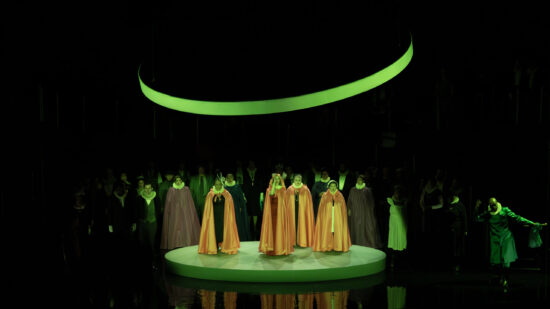
Jason Ardizzone West’s set was also visible before the official start. Two crescent chrome metal ramps (reminiscent of a Ziegfield Follies stage pared down to a modern prototype) crisscrossed each other under a hanging white disk that moved around at various angles throughout the performance (think Russian Constructivist). Chorus members were gradually populating the stage in shimmering blue veils, and in the ground level box seats adjacent to the stage were key instruments from the orchestra: on the right a harp and to the left the theorbo, whose giraffe-like neck gives this Baroque lute an uncanny aura – so well suited to the strange, dreamy effect of the work.
Maiko Matsushima’s costumes for the chorus cleverly reflected two eras of the Sleeping Beauty story in a dream-like mash up: collar ruffs around the neck represented the early emergence of the fairy tale by Italian Giambattista Basile from the turn of the 17th century, and the 1920s style black suits and dresses captured the mood of Robert Walser’s early 20th century existentialist version of the story that was the principal source for Spears’s libretto.
The score proved a superb example of the style Spears has developed in his ever-increasing oeuvre which mines soundscapes from Renaissance polyphony and incorporates them into the contrapuntal explorations at the root of his music; they emerge out of the long duration, time-versus-pitch compositional structures pioneered by Morton Feldman and Christian Wolff in the 1970s. In a work like Sleepers Awake, Spears presents his aesthetic with an unquestionable skill that succeeds at matching it with a story – no small feat for such abstract formulations of sound.
All the same, he does not reject excursions into melodic lyricism which transition seamlessly from the modernist uncentered passages into the anchoring cadential material of soul-searching song. This was most evident when Park performed his remarkable solo: his voice went straight to the heart with a piercing blend of the gently romantic set against timbres that revealed a mixture of fear and insecurity. Park blew me away with this palpably unnerving texture – it felt more real than reality itself.
But that was the point. In this short opera, both art and listener were lost in a reverie of contemplation blurring reality and illusion. Spears’s artistic space hovered between the abstract and the concrete so well that both fairy tale and the drawn-out lines of music unfurled before us.
As the story slowly came to a close, percussive whip cracks began to punctuate the material – an alarm waking us or trying to. The chorus pulled veils over their heads again, marking the powerful, addictive draw of unconsciousness. A marriage occurred but the outcome was questionable in these less than happily-ever-after characters.
The chorus itself was a fiercely domineering force. All the singers handled the deeply complex music beautifully with Elizabeth Braden’s superb leadership. They played a collective character – more invested than a Greek chorus and more necessary to the momentum of the work. (This work would stage well as a choral piece with soloists.)
Under Jenny Koons’s direction, Sleepers Awake was glorious, its narrative and score married to the visual elements. Burgess sang in a bold, eye-catching red gown and Brian Major’s Court Poet was in a contrasting glittering green (with combat boots for footwear!). The color block lighting by Yuki Link emanated almost magically from that hanging disk – sometimes blue, other times green, purple or red. All our senses were fired up, fully awake in the face of sleep.
Daniele Sahr
Featured Image: Jonghyun Park (The Stranger) © Steven Pisano
Production:
Director – Jenny Koons
Set – Jason Ardizzone West
Lighting – Yuki Link
Costumes – Maiko Matsushima
Cast:
Thorn Rose – Susanne Burgess
The Stranger (Prince) – Jonghyun Park
Court Poet – Brian Major
Godmother – Sophia Santiago
Godmother – Annalise Dzwonczyk
Godmother – Maren Montalbano
Godmother – Robin Bier