
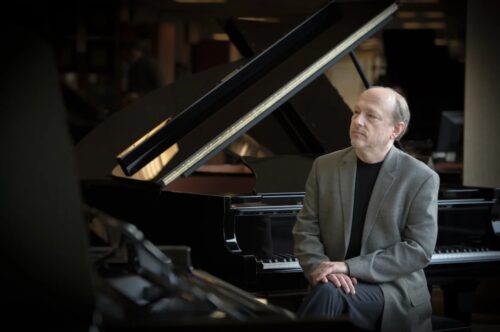
 United States Various: Marc-André Hamelin (piano). Mandel Concert Hall at Severance Music Center, Cleveland, 5.5.2026. (MSJ)
Haydn – Piano Sonata in D major, Hob.XVI:37
Beethoven – Piano Sonata No.3 in C major, Op.2
Weinberg – Piano Sonata No.6, Op.73
Rachmaninoff – Etudes-tableaux No.5 in E-flat minor, Op.39; Piano Sonata No.2 in B-flat minor, Op.36 (1931 version)
Encores: Debussy – Préludes Book Two, No.6, ‘Général Lavine – eccentric’; No.12, ‘Feux d’artifice’; Hamelin – ‘Music Box’
Marc-André Hamelin doesn’t have a one-sound-fits-all approach to playing the piano. In this program at Severance Music Center, the renowned virtuoso made one piano sound like four different instruments for the main composers on the program, plus a couple more for the encores. It is remarkable, considering that Hamelin’s fame is based on his formidable technique. But the truth is that his vaunted technique isn’t built merely on digital dexterity, it is built on a thoughtful realization of each composer’s soundworld on the instrument he plays. In other words, Hamelin has fast fingers but wait till you hear his brain!
The perfect demonstration of this was in the opening Haydn piano sonata. Classical composers like Haydn and Mozart don’t always sound fresh on the modern concert grand because it is a much stronger and more resonant instrument than the one for which they wrote. That instrument, commonly referred to now as the fortepiano, is a lighter one, and players such as Paul Badura-Skoda have demonstrated that much classical and even early romantic keyboard music pops on the original instrument more than it does on a modern grand. But Hamelin proved that even a modern piano can float. His fast movements were crisp and effervescent yet completely without brittle rigidity. Notes danced with light-footed wit because this pianist knows how avoid the traps of the modern grand which can steamroll such music. Instead, he preserved the spirit of Haydn, making it feel like listening to a colorful story being told by a witty person. In contrast, the dark aria of the slow movement was quietly piercing without exaggeration or heavy pedaling.
A few notes into the Beethoven sonata, the piano’s sound was subtly but totally transformed. It was clear that we were still in the classical world of Haydn and Mozart, but a greater sense of muscle and searching was immediately evident in the keyboard of the young Beethoven, who was about to blow the doors off the old style. Hamelin caught the sense of this music being connected to Haydn’s style, but savored the moments where Beethoven suddenly vaulted off into visionary new directions, such as the coda of the first movement when the composer suddenly opens a Pandora’s box of shadows. The sense of discovery was palpable.
After intermission, Hamelin played a work by Mieczyslaw Weinberg (1919-1996), a younger contemporary of Shostakovich whose work is starting to be recognized for its genius. (Nota bene to the host of this recital, the Cleveland Orchestra: Weinberg wrote twenty-two symphonies.) If I hadn’t been sitting in the hall throughout intermission, I might have thought the piano had been switched: Hamelin’s sound for Weinberg was alternately steely and somber in the Piano Sonata No.6. Though dating from midway through Weinberg’s career, it proved to be his final piano sonata, compressing what he had to say through the instrument in ten intense minutes which started with ringing chords that turned searchingly introspective before erupting in a pounding final movement.
A moment later, Hamelin again completely transformed the instrument into one of lush, rich resonance for the music of Rachmaninoff. The Opus 39 Etude-tableau No.5 surged like a storm front, searching for and finding peace in its closing measures. The Second Piano Sonata roared to life with as great a volume as the Weinberg had closed, but with an utterly different nature. Rachmaninoff is not a composer with whom Hamelin is closely associated, but the pianist bears something in common with the composer himself: a classical reserve that keeps Rachmaninoff’s imaginative effusions from becoming indulgent. The sonata heard here in its revised 1931 edition moved from dramatic grandeur to lyrical tenderness to a triumphant closing in a single, continuous breath. In Hamelin’s hands, no grandstanding was necessary.
As if four piano soundworlds had not been enough, Hamelin pulled out more for a trio of encores awarded to the enthusiastic audience. First came two Debussy preludes, ‘General Lavine – eccentric’ and ‘Feux d’artifice.’ The former was droll and humorous, a perfect release of tension after such a vivid program, and the latter was a blazing swath of colors. Finding the crowd still wanting more, Hamelin closed with a special treat, a composition of his own which he had written as a student. ‘Music Box’ gave us an entirely new soundworld. It is modeled on the mechanical sound of a music box, but here it was distorted by harmonic suspension into a surreal, mesmerizing otherworld, that slowly and unevenly wound down, leaving its question hanging, unanswered, in the air.
This season’s recital series at Severance has moved from strength to strength. One can hardly wait to see what treasures next season will bring.
Mark Sebastian Jordan
Mark, thanks for this. I was down on the orchestra level while you were above, but I share your appreciation of a great program. And I appreciate that you were able to answer my question ‘What were the two Debussy pieces he played for encores?’