
 United Kingdom Meredith, Beethoven: Manchester Camerata (Caroline Pether [violin], Alex Mitchell [viola], Hannah Roberts [cello], Aaron Barrera-Reyes [double bass], Charlie Walker-Harris [clarinet], Richard Ion [bassoon], Nivanthi Karunaratne [horn]). Turner Sims Concert Hall, Southampton, 5.5.2026. (CK)
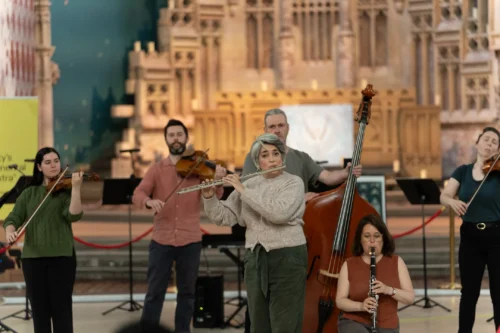
Anna Meredith – Lanolin; Scrying
Beethoven – String Trio in D, Op.9 No.2; Septet in E-flat, Op.20
We were fortunate that the splendid Manchester Camerata made the long trip from their home city to Southampton, bringing with them two major pieces by the young Beethoven, composed either side of his Opus 18 String Quartets; bringing, also, a pair of pieces by the quirky and unclassifiable Anna Meredith.
As David Truslove’s excellent programme notes reminded us, Meredith made her biggest splash (so far) at the Last Night of the Proms in 2008, where her piece Froms (she described it as ‘a punch in the face’) involved 800 performers in different UK locations connected by satellite. Her other work includes the intriguingly titled 18 Studies for Dodgems, music for Manchester shopping centre lifts and a sarabande for the resurfacing machine at the Somerset House ice rink.
My memory may be at fault here, but I recall a Peter Ustinov sketch, an interview with the famous avant-garde composer Karlheinz Strumpfhausen. A few seconds of plinkyplonk were heard, and the interviewer murmured that it was an extract from the composer’s latest concerto. ‘Zat was my concerto’, said the composer indignantly. ‘Zey played it twice’.
Why have I inserted that paragraph? I have no idea. Probably because of the alarming brevity of the two Meredith pieces. While the concert brochure promised us Music by Beethoven and Anna Meredith, it failed to tell us that the programme panned out at over an hour of Beethoven and around four minutes of Meredith. Not that anyone was complaining.
Lanolin and Scrying are from Meredith’s six-movement Tripotage Miniatures (Tripotage apparently has several meanings, Meredith’s preferred one being ‘jiggery-pokery’). Lanolin proved to be a brief but animated discussion – contretemps, even – between E-flat clarinet and horn; Scrying, for B-flat clarinet, viola and double bass was murkier and spookier, as if their activity was taking place at the bottom of the sea.
The audience was so flummoxed that we kept totally silent as a young lady came on and unhurriedly altered the seating arrangement to accommodate the Beethoven Trio (there would have been time for one, or possibly two further Meredith pieces while she did this). I bumped into an ex-colleague (we were both English teachers) in the interval; she had wondered if she had wandered into a Beckett play.
I am tempted to invert the proportions of the concert itself by saying merely that the performances of the Beethoven String Trio and Septet were magnificent. Which they were. I am not familiar with the Opus 9 String Trios, but I understand that they were (and still are) highly regarded, not least by the composer himself; the culmination of his early chamber music, and a necessary precursor to his early quartets. The opening Allegretto immediately caught the ear (not least because of the clarity and warmth of the sound in the Turner Sims acoustic); its balance of energy and beauty brought spontaneous applause as it ended. The Andante, with its offbeat charm and its alternations of major and minor, suavity and sweetness, was equally winning in the hands of these players: it had the character of all great chamber music performance, that sense that we are listening to players who are perfectly attuned to the music and to each other. This sense persisted through the lightly bouncing gait of the Menuetto and the playful energy of the concluding Rondo: it was a lovely performance, one to inspire me to explore the other two Opus 9 String Trios.
The substantial, divertimento-like Septet was a joy from start to finish, not least because of the continual feast of sonorities flying back and forth among the semicircle of players: violin, viola and cello to the left, double bass back centre, horn, bassoon and clarinet to the right. They were brilliant players all, with personality as well as skill. Rather than work my way dutifully through the six movements, I will simply say that I can think of no more delightful way of spending forty minutes.
Chris Kettle