 United States Verdi, Falstaff: Soloists, Pittsburgh Opera Chorus and Orchestra / Antony Walker (conductor). Pittsburgh Opera, Benedum Center, Pittsburgh, 3.5.2026. (RP)
With Verdi’s Falstaff, Christopher Hahn, Pittsburgh Opera’s General Director, brought his 26-year career with the company to a close. Verdi’s last opera was a comedy and a fitting choice for Hahn to take his final bow. His rationale was the same as Verdi’s, who likewise wanted to exit with a smile rather than with opera’s usual tragic ending.
For his final cast, Hahn highlighted the depth of talent in southwestern Pennsylvania and the excellence of Pittsburgh Opera’s Resident Artist program. Marianne Cornetti (Mistress Quickly) ticks both boxes – she is a native of neighboring Butler County and an alum of the program, and she has enjoyed an international career as one of the leading Verdi mezzo-sopranos of her generation. Danielle Pastin (Alice Ford), who also participated in the program, calls Pittsburgh home and has sung in the US and Europe.
Four current resident artists – Shannon Crowley (Nannetta), Audrey Welsh (Meg Page), Logan Wagner (Fenton) and Matthew Soibelman (Pistola) – were also in the cast. In April, Crowley was a grand finals winner of the Metropolitan Opera’s 2026 Laffont Competition. She wasn’t a one-off as soprano Emily Richter, a past resident artist not in the cast, did the same in 2024.
The libretto for Falstaff is drawn from Shakespeare’s The Merry Wives of Windsor and augmented with excerpts from the Bard’s two Henry IV plays. The plot centers on an aging, vainglorious knight of great girth, Sir John Falstaff. Short of funds, he schemes to woo two married women, Alice Ford and Meg Page, to alleviate the strain on his purse. He slips up by sending them identical love letters, which they duly compare upon receipt and then plot their revenge.
Falstaff gets his comeuppance, not once but twice, from ladies. First, he is dumped into the River Thames to escape Alice Ford’s jealous husband and then lured to Windsor Forest, where spirits and fairies torment him. Alice’s husband is simultaneously tricked into consenting to the union of the young lovers, Nannetta and Fenton, which he has tried to thwart. The opera ends with all singing that the world is a joke, to which Falstaff adds that he who laughs well gets the final laugh.
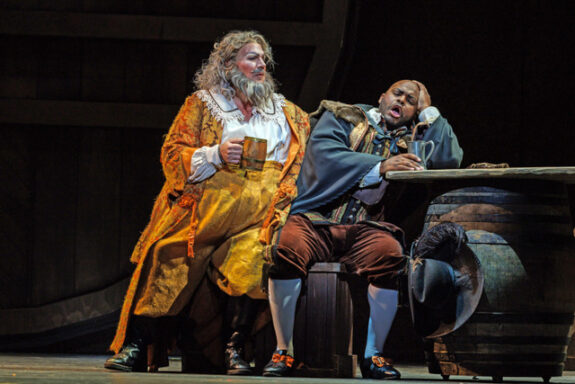
José Maria Condemi’s production, originally conceived for Opera San José, is streamlined, attractive and traditional. The action takes place in a large wine barrel, a libation which Falstaff consumes to excess without the means to pay. In the first act, the wooden structure is the Garter Inn, where Falstaff is waited upon by the equally feckless Pistola and Bardolfo, and where Mistress Quickly later arrives to abet the ladies’ revenge. An opening at the rear of the barrel, where topiary animals cavort, transforms it into a room in Ford’s house. With the substitution of Herne’s Oak and a full moon, the scene becomes Windsor Park at midnight.
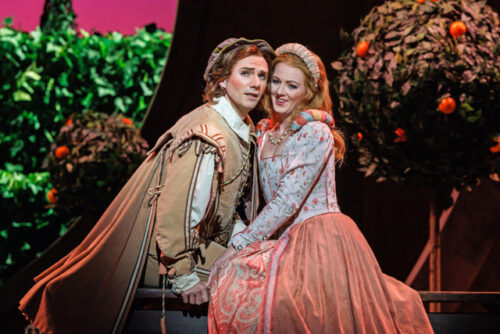
Crystal Manich, another Pittsburgh native, directed the production, whose deft touch crafted a tightly knit ensemble piece. The larger-than-life characters, such as Michael Chioldi’s Sir John Falstaff and Cornetti’s Mistress Quickly, got their laughs, but never blew the ship out of the opera’s dramatic waters. As a result, Nanetta and Fenton’s romance was given more space to bloom than in many a production.
Chioldi, who hails from neighboring Westmoreland County, was an affable Sir John Falstaff. His baritone was robust and resonant, roaring like a lion when Falstaff’s ego exploded or his pride was pricked. Chioldi’s flair for physical comedy inflated Falstaff’s braggadocio, while his subtlety as an actor exposed the knight’s underlying humanity.
Pastin’s dignified Alice Ford reigned over the contretemps as gracefully as she sang. As Meg Page, Audrey Welsh revealed an alluring mezzo-soprano voice that made one wish the character had more to sing. The ripeness of Cornetti’s voice and her comic timing made for a grand Mistress Quickly. Each low-curtsy and obsequious greeting of ‘Revereza’ (Reverence/Your Honor) unnerved Falstaff as much as they delighted the audience.
Blake Denson, one of the few in the cast without a Western Pennsylvania connection, was a dynamic Ford with a magnificent baritone voice. Crowley’s silvery soprano and Wagner’s fine lyric tenor captured the first blush of love to perfection. Each repetition of Verdi’s soaring melody, in which they sang of streams of kisses that never lose their allure and renew like the moon, was lovelier than the last.
Joseph Frank’s detailed Dr Caius, the much older man whom Ford wishes his daughter to marry, was deliciously detailed in voice and character. Matthew Soibelman’s Pistola was dark-voiced and conniving, while Rick Hale’s affable Bardolfo was a towering presence physically and vocally.
Antony Walker led the Pittsburgh Opera in a perfectly paced reading of Verdi’s score, in which the wit and drama emerged in equal measure. There was fabulous horn playing that accompanied Falstaff’s gallant strokes. Fine, shimmering string sound provided the backdrop to Nanetta and Fenton’s expressions of love and cast a magical spell over Windsor Forest in the final scene. The chorus, too, was in fine fettle, with its enthusiasm and rich sound. All joined for the spirited account of the complex fugue that ends the opera.
After the curtain calls, Hahn invited everyone who had anything to do with the production onto the stage, from stagehands to ticket sellers. 400 people celebrated the success of this brilliant Falstaff and bid farewell to an era at Pittsburgh Opera.
Rick Perdian
Featured Image: Michael Chioldi (Falstaff) and Blake Denson (Ford) © David Bachman
Production:
Director – Crystal Manich
Sets – Steven C. Kemp
Lighting – Cindy Limauro
Wigs & Make-up – James Geier
Chorus master – Mark Trawka
Cast:
Sir John Falstaff – Michael Chioldi
Ford – Blake Denson
Alice Ford – Danielle Pastin
Nannetta – Shannon Crowley
Meg Page – Audrey Welsh
Mistress Quickly – Marianne Cornetti
Fenton – Logan Wagner
Pistola – Matthew Soibelman
Dr Caius – Joseph Frank
Bardolfo – Rick Hale