 United Kingdom Vespers, Vivaldi’s Venice & The Ancient Mediterranean: Iestyn Davies (countertenor), FIGURE / Frederick Waxman (conductor,), Idrisi Ensemble / Thomas Fournill (conductor), Sam Rayner (stage director). Sinfonia Smith Square, 2.6.2026. (AK)
Vivaldi met his ancestors in this concert where his Vespers were interspersed by old Roman and traditional Corsican chants as well as traditional Sephardic-Ladino and Greek songs.
Titled as Vespers and subtitled as Vivaldi’s Venice & The Ancient Mediterranean, the idea presumably was to demonstrate that what preceded Vivaldi was relevant later and that music was of significance far and wide before and beyond Venice.
The concept is fine, and I assume that – with his Cambridge degree in Archaeology and Anthropology – countertenor Iestyn Davies was in full agreement (or was the originator of the idea). However, to my thinking, the Vesper sections and the earlier/traditional music were slightly off balance.
In spite of the main title Vespers, Vivaldi had much shorter time than the other contributions. Presumably this was intentional (to show the past with its variety) but the balance remains questionable. Also of note is that the secular Sephardic-Ladino and Greek songs were, clearly, not devotional while the Vespers as well as the old Roman chant and traditional Corsican prayers were fully concerned with belief in God.
The performances too were, of course, in sharp contrast. Countertenor Iestyn Davies excelled in his delivery what could be termed as a masterclass in Baroque style and beauty. In their contributions, the excellent Idrisi vocal group (with a zither and a traditional flute in the last two items) presented what was supposed to be ancient as well as traditional style. Iestyn Davies might have based his baroque performance style on books surviving from Baroque times. But how do we know how Old Roman chants (in this case from 4th-11th centuries) were recited? I am intrigued also about the performance practice on offer of the traditional Corsican, Sephardic-Ladino and Greek songs although the performers at this concert hail from relevant national background (and Idrisi researches ‘into medieval sources, music archaeology and postcolonial history’).
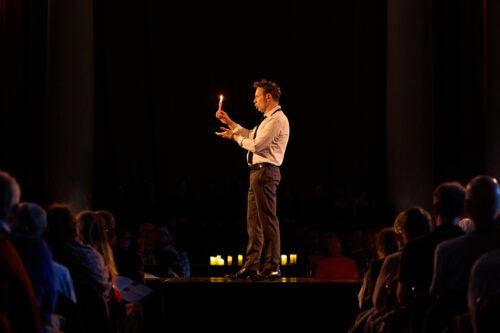
Notwithstanding my quibbles, the event was mesmerising. Staged as a theatrical event – as, according to Iestyn Davies in the programme notes, Vespers in Vivaldi’s time often were – there was drama evolving all way through the evening. Iestyn Davies might have sang only about twenty minutes or so, but he was on the stage non-stop (although appearing in the balcony for the Gloria). He presented modern man’s relationship to God (with laptop and headphone on hand) with many dramatic tools, which included him blindfolding himself as well as tackling a candlelight while singing, faultlessly, demanding virtuoso passages. He also endured kneeling or lying on stage motionless for long periods of time during the Idrisi prayers.
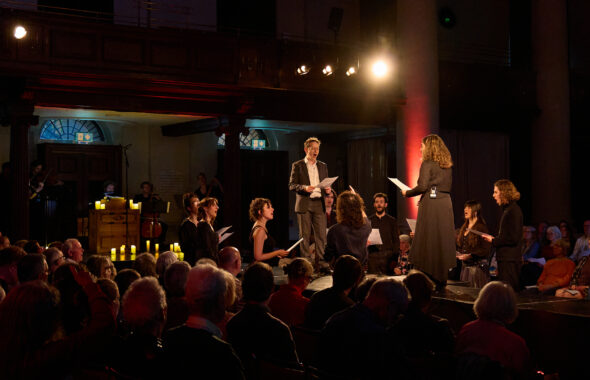
The stage was small but set in the middle of the hall with audience members sitting at both sides. The stage design evidently intended to show a church (which the venue once was in its capacity as St John’s Smith Square) and introduced the performance with church bells ringing for several minutes while the audience was gathering (and Iestyn Davies was sitting on the stage with his laptop).
Stage director Sam Rayner used the space to its maximum with the Idrisi singers appearing at various parts of the church for their different numbers. FIGURE’s small instrumental ensemble of two violins, one viola, one cello, one double bass, one lute and a chamber organ was a few meters to one side of the stage although for Vivaldi’s Gloria section obbligato violinist James Toll took centre stage with Iestyn Davies singing from the balcony. Full praise to Toll for remembering to turn several times to address each side of the audience while playing his part from memory and providing full support to the countertenor solo part.
Full praise is also due to conductor and creative producer Frederick Waxman whose brainchild this event is likely to have been and whose FIGURE ensemble excelled. Idrisi conductor Thomas Fournil and his ensemble mesmerised and might start me on research into the ancient and the traditional of the Mediterranean.
The final word? The last number, a traditional Corsican prayer, was sang/played by all performers together…unity was achieved (and, for me, hope was raised for a better world to come).
Agnes Kory
Featured Image: Vivaldi’s Venice & The Ancient Mediterranean (final scene) © Sophie Oliver Photography
Vivaldi – Nisi Dominus: Cantata for Vespers RV608, interspersed with Roman chant and music from the Ancient Mediterranean
Corsican traditional – Kyrie Eleison, solo voice Noémie Ducimetière
Vivaldi – i. Nisi Dominus, ii. Vanum est vobis, iii. Surgite
Old Roman chant (4th-11th centuries) – Communio, solo voice Dunja Botic
Vivaldi – iv. Cum dederit
Corsican traditional – Stabat Mater
Sephardic Ladino traditional, arr. Idrisi Ensemble & Henry Tozer – Morenica, solo voice Isadora Pulman
Vivaldi – v. Sicut Sagittae, vi. Beatus vir
Greek traditional, arr. Idrisi Ensemble – Manes Karip Hitzaz, solo voice Irini Arabatzi
Vivaldi – vii. Gloria Patri, viii. Sicut erat in principio, ix. Amen
Corsican traditional – Communio, solo voice Dunja Botic
FIGURE – James Toll, Agata Daraškaitė (violins), Thomas Kettle (viola), George Ross (cello), Carina Cosgrave (double bass), Sergio Bucheli (lute), Frederick Waxman (chamber organ)