
 United Kingdom R. Strauss, Ariadne auf Naxos: Soloists, London Philharmonic Orchestra / Robin Ticciati (conductor). Glyndebourne Opera House, 19.7.2026. (CC)
This performance of Ariadne was dedicated via an opening, front-of-curtain speech by Stephen Langridge, to the memory of Dame Felicity Lott (who we lost in May) – she was, of course, a noted Straussian.
Richard Strauss’s Ariadne first landed at Glyndebourne in 1953 and has been no stranger since; the most recent staging, by Katharina Thoma, was last seen in 2017. Expectations were high, at least from me, for this new stage realisation by Laurent Pelly: his Donizetti La fille du régiment at Covent Garden remains a marvel. Funny and insightful, it is one of those productions that never fails to deliver (2019 review here).
Pelly’s latest Ariadne is less immediately impressive (he directed it some 20 years ago in Paris). Strauss’s opera certainly fits the season’s theme of meta-theatre well – it is an opera about opera, the Prologue set backstage, preparing for the concert with hilarious results thanks to the clash with the commedia dell’arte troupe. Pelly does extend this: the combination of Greek myth and commedia dell’arte is extended by the watchful, silent presence of the Composer. Towards the close, the Composer and Ariadne’s movements become one, or at least mirrors
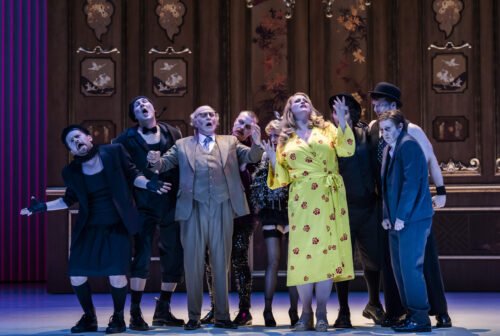
Pelly sets the opera in the house of the richest man in Vienna, as Strauss asks, but the vast decorated doorway, by Massimo Troncanetti, is strangely mobile. It remains, too, for the opera proper, against a huge craggy (and surely difficult to negotiate) rock. His frame of reference is large, as it should be, from myth to white-face Weimer/Berlin cabaret, with a few wheelbarrows thrown in for good measure, and a thicket of lights that looks like IKEA, but on crack. Juxtapositions are stark: a corrugated backdrop that can be, and is, saturated with primary colours. The ‘colour’ comes from the lighting more than the sets; one almost wants lighting director Marco Giusti to take equal billing, whether setting atmospherics or fiercely spotlighting (both Giusti and Troncanetti make their Glyndebourne debuts here). The costume designer automatically gets a double-bow, for he is Pelly himself, delighting in equivalent bright yellows for the Tenor and Prima Donna in the Prologue and offering Zerbinetta figure-hugging bodice, fishnets and post-Papagena, feathery arms. Not to mention the Dancing Master’s sparkly outfit. Those yellows deliberately counterpointed the darker, drabber colours prevalent in the Prologue (highlighted by bookended person placement). The Composer, knitted cardigan, blue jacket, looks like (s)he is the only one who actually does any work.
The production works as far as it goes, and certainly fits in with that season theme, but I was left wanting more: more depth, and more play. Far fewer complaints – not that I had too many, anyway – about the realisation of the music, though.
There is a sort of crescendo of appreciation for Robin Ticciati: every time I hear him, my appreciation of his talent runs deeper. His sense of layering, of orchestral detail, of polyphony, was second to none here; he pinpoints Strauss’s orchestral voices, too, from neo-Rococo to faux-Wagner to the most deliciously-crafted dance music. Ticciati also inspires his players to their best, collectively (gossamer strings) and individually (some fabulous bassoon playing, for instance). Most of all, though, it is the give and take, the warp and weft, of Strauss’s inspiration that Ticciati understands. His tempi can pose challenges to singers, challenges at times audible, but everything made such perfect sense – a level of depth and understanding that Strauss’s score fully deserves. Interestingly, some of the spoken (the excellent Major-Domo/Haushofmeister of William Relton) and near-spoken lines of the Prologue seemed to veer close to the Doctor in Berg’s Wozzeck, which is a new parallel to me.
The cast was broadly excellent. The two principals both gave fine accounts, perhaps weighted towards David Butt Philip’s remarkable, tireless, infinitely strong Tenor/Theseus, powerful in the Prologue but absolutely breath-taking in the Opera. The titular heroine was Rachel Willis-Sørensen as Prima Donna/Ariadne. Her voice sounds fabulous for the majority of its range (Strauss asks just a touch too low for her); the ear was rather led to the London Philharmonic Orchestra’s Ticciati-inspired magical sonorities in the pit for ‘Es gibt ein Reich’, though.
Zerbinetta is a killer of a role, not least for her showstopping aria ‘Grossmächtige Prinzessin’, delivered here by Alina Wunderlin with consummate virtuosity and matching panache, who relished each and every challenge throughout, musically or dramatically The only fly in her Zerbinetta-ointment was a tendency for her voice to become too thin in the longer-breathed, legato passages (admittedly very much in the minority in this part).
Samantha Hankey was brilliant as the Composer, the epitome of the harried and frustrated creator who sees the premiere unfold into potential disaster and what seems certain farce. Michael Kraus was a superb Music Master, round of tone, fine of presence, each word audible. Ru Charlesworth excelled as the Dancing Master, and of what I think of as Strauss’s mechanicals (the commedia dell’arte), it was Mikhail Timoshenko’s Harlequin that shone brightest within a very fine group (Caspar Singh almost as impressive as Scaramuccio).
But surely it was the mythic elementals that came so close to stealing the show, at least in the sheer vocal quality and in their ability to work as a collective: the Naiad (Anna Denisova), the Dryad (Ekaterina Chayka-Rubinstein), and the superb Echo (Erin Rognerud). They were a joy to hear. In fact, all of the smaller parts were well taken, including the late substitution of Owen Lucas for Liam Forrest as the Officer
Of the meta-theatrical stagings I have been privileged to see at Glyndebourne this summer, it was Rossini’s Il turco in Italia that worked by far the best (review here); William Kentridge’s Orfeo was too overloaded. This, as a realisation of that thread, sits somewhere in the middle. And of the various Ariadnes of my life so far, Jessye Norman, James King and Kathleen Battle at Covent Garden – conducted by Jeffrey Tate in the mid-1980s – may never be surpassed. But musically, this was a terrific evening.
It is Ariadne that will be the Glyndebourne BBC Prom this year, on Wednesday, August 19. And finally, a nod of admiration to the several authors of the Glyndebourne booklet material for Ariadne: Mark Valencia for his interview with Pelly, Hugo Shirley, Katherine Cooper and Andrew Mellor.
Colin Clarke
Featured Image: Zerbinetta (Alina Wunderlin), Bacchus (David Butt Philip) and Ariadne (Rachel Willis-Sørensen) © GPLtd/Tristram Kenton
Production:
Director, Costume designer – Laurent Pelly
Set designer – Massimo Troncanetti
Lighting designer – Marco Giusti
Cast (Prologue):
Music Master – Michael Kraus
Major-Domo – William Relton
Lackey – Oliver Williams
Officer – Owen Lucas
Composer – Samantha Hankey
Tenor – David Butt Philip
Wigmaker – Hector Bloggs
Zerbinetta – Alina Wunderlin
Prima Donna – Rachel Willis-Sørensen
Dancing Master – Ru Charlesworth
Comedians – Liam Bonthorne, Liam James Karai, Caspar Singh. Mikhail Timoschenko
Opera:
Naiad – Anna Denisova
Dryad – Ekaterina Chayka-Rubinstein
Echo – Erin Rogneraud
Ariadne – Rachel Willis-Sørensen
Zerbinetta – Alina Wunderlin
Harlequin – Mikhail Timoschenko
Scaramuccio – Caspar Singh
Truffaldino – Liam James Karai
Brighella – Liam Bonthorne
Bacchus – David Butt Philip