
 United Kingdom BBC Proms 2026 [1] – Ravel, de Falla, Rodrigo: Rafael Aguirre (guitar), Spanish National Orchestra / David Afkham (conductor). Royal Albert Hall, London, 19.7.2026. (AV-E)
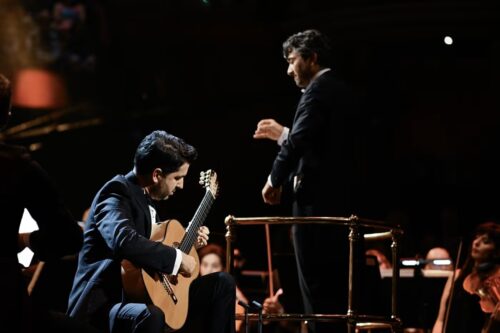
Ravel – Alborada del gracioso; Boléro
de Falla – Fantasia bætica (orch. Francisco Coll); The Three-Cornered Hat: Suite No.1 & Suite No.2
Rodrigo – Concierto de Aranjuez
World-renowned guitarist Rafael Aguirre, the Spanish National Orchestra and conductor David Afkham were all making their BBC Proms debuts. By the time these words appear, Spain will have won the World Cup; on Sunday evening, however, the Spanish National Orchestra had already scored a memorable victory at the Royal Albert Hall, netting an emphatic Proms triumph and winning the hearts of the audience from the very kick-off.
Titled Boléro: Rhythms of Spain, their captivating concert was enhanced by the lighting design whose appropriately atmospheric beams of red and gold aptly echo the colours of the Spanish national flag; the evocative wisps of suave smoke adding to the Andalusian allure.
They opened with a perfumed performance of Maurice Ravel’s Alborada del gracioso, played with such style, charm, and aplomb. It was a dazzling masterclass in texture — combining clockwork precision with a prismatic cascade of crystalline woodwinds, the brilliant glare of incandescent brass, and shimmering, sun-drenched strings that scattered sound like the clacking of castanets and a shattered necklace of thrown pearls, bouncing and gleaming across a marble floor. This served as the perfect ‘showcase for orchestra’, revealing the Spanish National Orchestra to be a world-class ensemble.
What impressed me most about the percussion section was its extraordinary musicality and characterful expressivity. So often the percussion can be treated as mere impact; here it became an expressive voice in its own right sounding like soloists. The percussionists combined incisive intensity with finesse and flair, delivering power and precision without ever descending into brute harshness or uncouth loudness (as I have so often heard from our London orchestras).
Francisco Coll’s orchestration of Manuel de Falla’s Fantasía bætica proved a dazzling display of orchestral colour, rhythmic vitality and Spanish flair. Originally conceived for solo piano and commissioned for and dedicated to the legendary pianist Artur Rubinstein, its transformation into a full orchestral canvas lost none of the work’s fierce energy, improvisatory freedom or elemental force.
David Afkham directed the score with consummate panache, drawing playing of extraordinary refinement, imagination and conviction from every section of the orchestra. Rhythms danced with buoyant elasticity and natural lift, the strings articulating every gesture with incisive precision and lithe elegance, while the woodwind and brass infused the score with burnished sonority, iridescent colours and unmistakable Iberian warmth. The eloquent percussion, once again, impressed not through sheer volume but through exceptional musical intelligence and rhythmic instinct, every accent contributing to the work’s irresistible momentum. This was playing of distinctive personality and colouristic imagination, capturing de Falla’s intoxicating fusion of fire, finesse and freedom.
I have heard Joaquín Rodrigo’s Concierto de Aranjuez countless times — yet never heard it before. This is the miraculous genius of this evocative work: one carries memories of previous encounters with it, yet each fresh performance seems to erase every previous memory of itself, creating the illusion of hearing it for the very first time, as though each performance unlocks another lost memory. This sounds like paradoxical nonsense but it is not; it is the elusive magic of the work.
Rafael Aguirre approached the concerto with extraordinary concentration and restraint. Rather than treating the guitar as a vehicle for virtuoso display, the playing revealed an intimate, inward focus, every phrase shaped with exquisite sensitivity and instinctive musicality. There was no sense of calculation or self-conscious display; everything unfolded with complete naturalness. Intensity emerged not through force but through subtlety, the quietest moments drawing the audience closer to the instrument. Each note spoke with crystalline clarity and unhurried precision, allowing the music’s fragile beauty and emotional depth to unfold with effortless inevitability.
After the exuberance and rhythmic fireworks of de Falla, Rodrigo’s shimmering world became intimate, reserved and tranquil. In the Adagio, the packed Royal Albert Hall fell into total silence, the audience mesmerised by the hypnotic stillness of the unfolding music. The effect was extraordinary: time seemed suspended as Aguirre’s agile guitar floated above the orchestra with luminous delicacy and seductive warmth of tone. Afkham provided a perfectly judged accompaniment, allowing the orchestral colours and translucent textures to breathe naturally around the soloist without disturbing the work’s fragile serenity.
Aguirre’s enticing encore, Recuerdos de la Alhambra, was received in spellbound silence. Such distilled clarity in so vast a hall was truly remarkable; each delicate tremolo suspended with breathtaking purity.
The Three-Cornered Hat Suites revealed the orchestra at its most flamboyant, overflowing with panache, individuality and theatrical flair. Here again was orchestral playing infused with passion and personality, revelling in de Falla’s intoxicating blend of buoyant elegance and rhythmic exuberance. Afkham captured every rhythmic nuance with tremendous flair, drawing playing of remarkable precision and vitality. The taut strings cut through with incisive brilliance while the percussion provided razor-sharp clarity and irresistible drive. The rhythmic bite was thrilling, every accent alive with a heated Spanish temperament, yet never sacrificing elegance or sophistication. This was music-making of extraordinary colour and imagination, the vibrant orchestra fully inhabiting de Falla’s world of dance, drama and celebration.
It is a great shame that these two suites from The Three-Cornered Hat are not played more frequently in concert, for they remain among de Falla’s most colourful, rhythmically incisive and theatrically vibrant creations.
I have never heard Ravel’s Boléro played with such sensuous, sultry and seductive sonorities, especially from the woodwinds and trombone; this performance overflowed with wit, charm and carnivalesque caprice. The tension from the opening pianissimo to the gradual accumulation towards its explosive climax was held with iron-tight control. Afkham’s timing was immaculate, every layer of orchestral colour emerging with complete precision, the gradual crescendo unfolding with extraordinary patience and discipline. This was by far the finest Boléro I have ever heard because it achieved the great paradox of the work: repetition without sounding repetitious. Each return of the rhythmic pattern felt freshly energised, each new instrumental colour transforming the familiar into something newly alive. The mesmerising music seemed to advance with irresistible inevitability, yet this inevitability was ultimately an illusion: just when the listener believes the destination has been reached, Ravel suddenly overturns the expected course with his extraordinary harmonic shift, creating an ending without ever having anticipated an ending. This was a paradigm performance of this hypnotic score.
This is the first time I have heard a concert at the Royal Albert Hall where the acoustic proved surprisingly favourable, seemingly contradicting everything I have previously written on the subject. I say ‘seemingly’ because I have realised that where you sit can radically affect how you hear the music. Tonight I struck the jackpot sitting in Stalls 8, Row 8, Seat 38: here I experienced none of the notorious after-echoes or excessive reverberation, and, even more remarkably, the sound was far superior to what I have encountered at the Barbican and Royal Festival Halls, with everything emerging in unexpected crystal clarity.
I freely confess to knowing absolutely nothing about the science of acoustics, yet even the most accomplished acousticians have never entirely solved the enigma of the Royal Albert Hall. So if you can secure that seat I had, you may discover one of the hall’s best-kept acoustic secrets. Don’t tell anyone.
The difference between the live acoustic experience and the mediated recording is always significant, and one wonders whether the BBC Radio 3 broadcast, with its necessarily closer microphone placement, could fully capture the extraordinary intimacy of the live experience. The huge space paradoxically enhanced the delicacy of the playing, allowing the quietest details to bloom naturally within the acoustic environment. However faithful a recording may be, the ‘live’ concert experience offers something fundamentally different: the shared silence of the audience, the physical presence of the performers and the sensation of sound unfolding in real time can never be entirely reproduced through speakers. Live music remains, in its most profound moments, a lived experience rather than merely a recorded document edited, filtered and removed from the immediacy of the original event.
Afkham concluded with the Intermedio from Gerónimo Giménez’s zarzuela La boda de Luis Alonso, providing a dazzling final reminder of the Spanish National Orchestra’s flamboyant style, expressive brilliance, rhythmic vitality and infectious sense of jubilation that had defined the entire sun-drenched Spanish evening. The packed Prom audience erupted ecstatically.
One could not help reflecting on the wider contrast with English football and orchestral culture: too often we value discipline and correctness above instinct, imagination and personality. Spain’s football players and orchestral players demonstrated that precision need not come at the expense of flair, character and expressive freedom. Both football teams and orchestras are made up of professional players, yet professionalism alone is not enough: too often our own performances — whether on the football pitch or the concert platform — can feel cautious, lacklustre and under-committed, technically competent but lacking the individuality, imagination and personality that transform professionalism into something truly memorable.
After Spain’s World Cup triumph on the football pitch and their conquest of the concert platform, I only wish our English footballers and orchestral players would perform with the same style, attack, panache, personality and commitment as their Spanish counterparts. Thomas Tuchel should be sacked.
Alexander Verney-Elliott
Featured Image: Conductor David Afkham © BBC/Chris Christodoulou