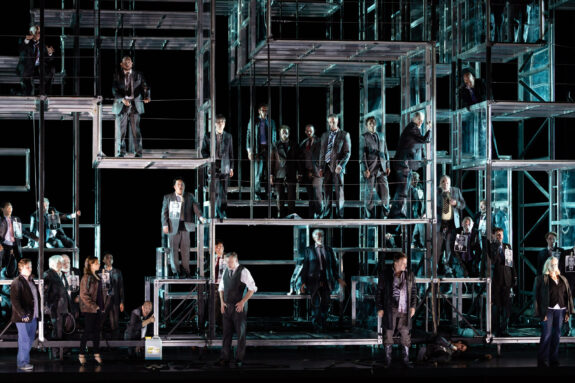
 Germany Beethoven, Fidelio: Soloists and Chorus of Bavarian State Opera, Bavarian State Orchestra / Yoel Gamzou (conductor). Nationaltheater, Munich, 18.7.2026. (AL-L)
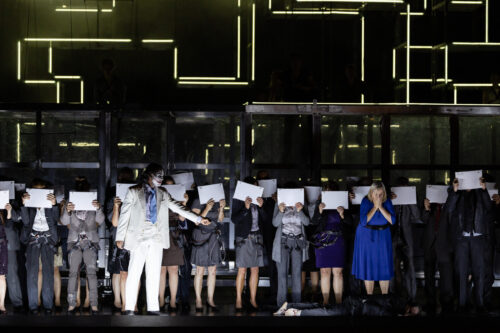
Over the decades, Bavarian State Opera has accumulated a repertoire of hallmark productions, the kind one would take a first-time visitor to see without thinking twice. Ponnelle’s La Cenerentola, Everding’s The Magic Flute, Schenk’s La bohème, Wernicke’s Elektra: these remain vivid and theatrically alive. Alongside them sit productions that may once have had their reasons but have since been emptied of purpose — a listless Die Entführung, a drifting La traviata — and this Fidelio, which premiered in Munich in December 2010, directed by Calixto Bieito, and now belongs firmly in that category.
The set consists of two large interlocking steel scaffolding structures, one of which rotates on the stage. The intention, one supposes, is less to evoke Florestan’s imprisonment than to map the labyrinthine entanglement of his relationship with Leonore — a plausible reading of the opera that the production then declines to pursue consistently. By the time Leonore has twice thrown acid at Pizarro’s face and Don Fernando makes his liberating entrance disguised as the Joker (how many in the audience got this Batman reference?), the threads of any coherent directorial argument have been lost. These conceits sit uneasily with Beethoven’s score and story, which makes its own very clear demands on a director’s attention.
Among the production’s practical drawbacks is the separation it imposes on the performers. With singers placed at different levels of the scaffolding the ensemble is compromised from the outset: the Marzelline–Jaquino duet suffered, and the opening of the Prisoners’ Chorus lacked the unanimity it needs.
In the pit, Yoel Gamzou was conducting at the end of a demanding season, and the orchestra sounded like it. There were coordination slips unusual for this ensemble, balance problems in the tuttis, and a general sense that rehearsal time had been constrained by the festival schedule. The cumulative effect on an already problematic evening was difficult to ignore.
The principal men were a further disappointment. René Pape was once a Rocco of authority and vocal roundness; what remains is the memory of that quality rather than its substance. Matthew Polenzani is a lyric tenor of true accomplishment in his own repertoire, but Florestan’s demands — the sustained thrust of ‘Gott! Welch Dunkel hier’, the heroic weight of the second-act finale — lie outside his natural range, and no degree of commitment could bridge that gap. Tomasz Konieczny threw himself into ‘Ha! Welch ein Augenblick’ with genuine energy; the orchestra, for its part, might have followed his phrasing more attentively.
The evening belonged to the two women. Mirjam Mesak, who has taken smaller roles in recent seasons, revealed in Marzelline a freshness of tone and a natural stage elegance — including, the production obliging her to demonstrate this, considerable agility on steel ladders in high heels. Camilla Nylund’s Leonore was in another register entirely: the voice firm and luminous across its range, the text carried with unusual clarity, the dramatic commitment unforced and unerring. Both deserved a worthier frame.
Antoine Lévy-Leboyer
Featured Image: Calixto Bieito’s Fidelio at Bavarian State Opera © Geoffroy Schied
Cast:
Leonore — Camilla Nylund
Florestan — Matthew Polenzani
Rocco — René Pape
Don Pizarro — Tomasz Konieczny
Don Fernando — Ryan Speedo Green
Marzelline — Mirjam Mesak
Jaquino — Samuel Stopford
First Prisoner — Tansel Akzeybek
Second Prisoner — Paweł Horodyski
Production:
Director — Calixto Bieito
Stage designer — Rebecca Ringst
Costume designer — Ingo Krügler
Lighting — Reinhard Traub
Chorus master — Franz Obermair
Dramaturge — Andrea Schönhofer