 United States Colorado Music Festival [1] – Various: Yuja Wang (piano), Colorado Music Festival Orchestra / Peter Oundjian (conductor). Chautauqua Auditorium, Boulder, 17.7.2026. (DS)
If you plan to see the world’s premiere pianist, expecting her to conduct an orchestral standard might not be on your evening’s dance card. At the Colorado Music Festival in Boulder – where artists and musicians can rely on opportunities to explore varied interests under the nurturing auspices of Music Director Peter Oundjian – this is exactly what happened.
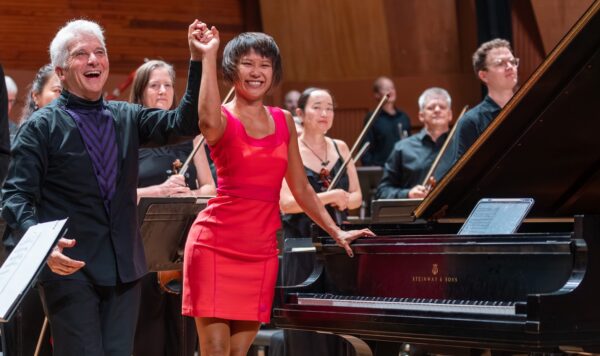
Yuja Wang made her conductor debut (yes, in Christian Louboutin heels) with the Colorado Music Festival Orchestra in the sure-fire crowd pleaser, Saint-Saëns’s Bacchanale. Despite her skills being in the developmental stage, watching her movements synchronize with the phrases as the orchestra followed (and helped) her in this new endeavor was humbling. (My favorite moment was when she used ‘piano hands’ to insist on louder articulation – arms raised above her head, fingers reaching out to pound at an imaginary air keyboard; I imagined a passionate child Wang conducting in her living room.) It proved the deep love of music that keeps Wang fresh in her exceptional musicianship.
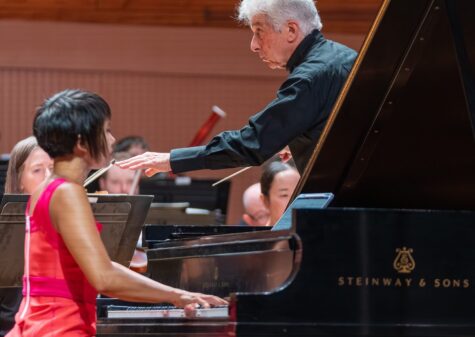
The experience was a bonus that followed after Wang’s flawless performance of Samuel Barber’s Piano Concerto, which she has been touring internationally for the 250th anniversary of the United States. When Barber composed the work in 1961, at the behest of G. Schirmer’s publishing company to commemorate their 100th anniversary, pianists (including Vladimir Horowitz) deemed sections technically unplayable. Barber eventually complied and made changes. One cannot help but wonder if Wang, with her unstoppable technical range, had been alive then, Barber could have kept the original.
Opening with a demanding piano cadenza, Wang needed no warm-up. She introduced the serialist, rhythmic themes (less common than Barber audiences are wont to hear) with a hammered clarity that afforded the unfamiliar listener the opportunity to understand the structure of the work as well as connect choppy thematic material with emotional depth – no easy feat but executed with fluidity by Wang.
With the tutti entrance, an immediate dialogue was established between the piano’s voice and orchestral material: this concerto really has two soloists, requiring as much of the orchestra as the pianist with lengthy, involved orchestral interludes. Oboist Olav van Hezewijk was particularly in tandem with Wang as their parts spar in Barber’s writing; their collaboration helped crystallize this uber-scherzo movement. Another piano cadenza closed the movement, proving to be a powerful showcase for Wang. Her hands scampered across the keyboard as if they were busy merchants haggling in a square – two voices split into four, eventually bubbling up into what sounded like an octet emerging from the keyboard. Consistently, she kept each part succinct. Slower moments were not lacking, and she demonstrated a command of elasticity in timing that added a flavor of contemporary dichotomy to the movement.
Marvelous solos continued in the melodious, more typically Barber-like soulful second movement, as flutist Viviana Cumplido Wilson played the opening theme with delicate caress. Wang masterfully matched the flute’s line and timbre as Wilson passed the melody to her. A sweetness emerged from this movement and settled over the auditorium. Each ritardando glimmered in enticing, summery idleness. Wang played the air above the keys as much as the ivories below, creating a tension that was a contrast to the first movement’s deliberately antagonistic musical dialogues.
The final movement – a highly energetic Allegro molto – blends various styles, including a jazz-infused opening, and holds a subtle musical humor throughout over a 5/4 motoric beat. Wang and the orchestra performed with acrobatic fervor and it was difficult to hold applause with all the feats that were displayed. At one point, Wang stretched her arms across the length of the keyboard to power through accumulating chords, while at another a stunning full-keyboard run met at the top perfectly in time with percussionist Gerald Scholl’s triangle ring (sentence punctuation in musical form). Under Oundjian’s baton and with evident commitment to close ensemble listening between musicians, the evening’s performance gelled in a work that offers little space for error.
The concerto in no way exhausted Wang and she proved it with three encores (all before she would take to the podium to conduct). She shared her love of Latin music – currently part of her other projects – with a lilting Malagueña from Ernesto Lecuona’s Suite Andalucía and a swooning Arturo Márquez Danzón No.2. Both revealed a contemplative and relaxed side to Wang. Then for something completely different, she played an arrangement of the Allegro molto vivace from Tchaikovsky’s Pathétique Symphony to roaring applause from an audience perhaps hungry to hear a canon work.
This was not the only Russian on the program. Oundjian opened with a nod towards America’s 250th anniversary celebrations by way of Prokofiev’s American Overture, originally written for the opening of a now-defunct concert hall on Fifth Avenue. A short portrait full of pomp and urban-influenced music reminiscent of early-20th-century New York City life, Oundjian drew out the strength of the orchestra’s brass section while ensuring that a pleasing harp part stood out.
To round out the evening, the orchestra’s performance of Bernstein’s Symphonic Dances dazzled despite a few hiccups in rhythmic ensemble shifts between strings and winds but, after an evening of demanding works, this was most forgivable. Oundjian led as much and as little as the players needed, which created – in this 1898 wooden barn auditorium on the side of a mountain – just the right swing in beat to evoke a loose summer night in hot New York City where a story as old as time would play out again, both loving and tragic.
Daniele Sahr
Featured Image: Conductor Peter Oundjian, pianist Yuja Wang and Colorado Music Festival Orchestra © Geremy Kornreich
Prokofiev – American Overture (version for orchestra)
Barber – Piano Concerto, Op.38
Encores: Lecuona – Malagueña from Suite Andalucía; Márquez (arr. by Leticia Gómez-Tagle) – Danzón No.2; Tchaikovsky (arr. by Samuil Feinberg) – Allegro molto vivace from Symphony No.6
Saint-Saëns – Bacchanale from Samson and Delilah
Bernstein – Symphonic Dances from West Side Story