 United States The Glimmerglass Festival 2026 [1] – Mozart, Così fan tutte: Soloists, Glimmerglass Festival Chorus and Orchestra / Joseph Colaneri (conductor). Alice Busch Opera Theater, Cooperstown, 17.7.2026. (RP)
Smoke from wildfires in Ontario and far northern Minnesota disrupted The Glimmerglass Festival’s schedule this past weekend. Quick thinking by festival management and a venue change made the performances possible. However, it was the dedication and resilience of the stagehands and artists across the festival’s four main stage productions that made these performances so memorable.
Weather is always a consideration at the Alice Busch Opera Theater. The theater has no climate control: the walls open before performances and during intermission to admit fresh air and sweeping views of the surrounding countryside. It is a feature that usually enhances the experience – but not when the air is unsafe to breathe, posing a hazard to wind and brass musicians to say nothing of the singers.
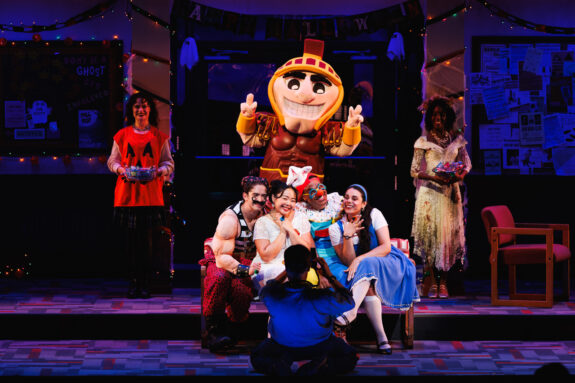
There were blue skies and moderate temperatures for the first performance this season of Mozart’s Così fan tutte. Although the smell of smoke lingered, particle levels remained low enough for the curtain to rise on Eric Einhorn’s adaptation of Mozart’s comedy, set on an American college campus during Halloween weekend, with Kelley Rourke providing an updated English version of Lorenzo Da Ponte’s libretto. Rourke sets the action in the 1980s because it predates smartphones and social media, allowing misunderstandings and relationships to unfold face-to-face. The setting also supplies a colorful, instantly recognizable backdrop, with costumes becoming integral to the plot. For once, audiences do not have to suspend disbelief that Fiordiligi and Dorabella could be fooled by Ferrando and Guglielmo’s disguises as a clown and a muscle man, respectively. The two best Halloween costumes were undoubtedly the slice of pizza and the robot scooting across the stage.
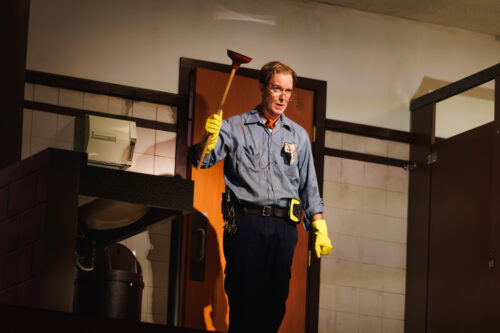
Rourke’s students sound like actual college students, although with only one expletive – and a mild one at that. The text is punchy and maintains the original’s brisk pace. She has a fondness for rhyme, managing to combine ‘monk’, ‘punk’ and ‘hunk’ in a single breath. Don Alfonso, a crusty, cynical janitor armed with a plunger, quotes Yogi Berra – the Hall of Fame Yankees catcher and 1973 Mets manager – with a spin on ‘It ain’t over till it’s over’.
The action takes place in a college building, condensed on the stage into two stories containing a commons area complete with an elevator to nowhere. Above it are Fiordiligi and Dorabella’s dorm room and the restroom where Don Alfonso attacks a clogged toilet with a plunger, unleashing a stream of scatological asides that would have delighted Mozart who relished such humor. At one point, the stage explodes with energy as cheerleaders shout and perform acrobatic stunts.
It is fun, colorful, and at times a bit over the top – but it succeeds precisely for those reasons. These are relatable characters, Mozart with a sitcom touch. Above all, the music was the evening’s greatest triumph, with Joseph Colaneri leading a cast that proved to be both natural comedians and fine Mozartians.
Amanda Batista traced Fiordiligi’s journey from the rock-solid certainty of youth to the painful recognition of human complexity with the same dexterity she brought to the role’s formidable vocal and musical challenges. She impressed in ‘Come scoglio’, rendered in Rourke’s version as ‘Like a stoic’, dispatching its dramatic leaps, wide intervals, rapid passagework and long sustained phrases with both technical command and emotional depth.
As Dorabella, Michelle Mariposa displayed a remarkably clear, inviting mezzo-soprano voice and embraced the role’s melodrama, balancing it with charm and innocence. Travon Walker’s Ferrando was as gung-ho as they come, but his honeyed tenor quickly won hearts. Gregory Feldmann was equally eager and confident as Guglielmo, bringing an elegant, rich baritone capable of expressing rage as readily as romance. His comic gifts were especially evident as he railed against feminine perfidy while simultaneously extolling his own virtues and attractions.
Keely Futterer’s Despina was a comic delight in all her guises, from resident assistant and sympathetic confidante to zany doctor. Vocally, she was equally winning, with a voice far more expansive and richly colored than is often heard in the role. Kevin Burdette’s Don Alfonso was the ideal curmudgeon whose droll delivery and penetrating bass made him a perfect foil for the younger lovers. He dispensed advice and disdain in equal measure to Ferrando and Guglielmo, especially when warning, ‘If you play the game of love, be prepared to suffer’.
There was no suffering, only pleasure, in Joseph Colaneri’s command of Mozart’s score, and its lyrical intimacy was evident throughout. The strings in the Act I trio – as Fiordiligi, Dorabella and Don Alfonso bid farewell to the departing men – seemed to float from the pit in soft, transparent clouds of sound. Equally impressive was the horn playing, especially in Fiordiligi’s great aria, a moment that epitomized the performance’s elegance and beauty.
Rick Perdian
Featured Image: Gregory Feldmann (Guglielmo), Michelle Mariposa (Donatella), Travon Walker (Ferrando) and Amanda Batista (Fiordiligi) © Kayleen Bertrand
Production:
Director – Eric Einhorn
English adaptation & Projected titles – Kelley Rourke
Set designer – James Rotondo
Costume designer – Beth Goldenberg
Lighting designer – Kate Ashton
Choreographer – Madison Manning
Cast:
Fiordiligi – Amanda Batista
Dorabella – Michelle Mariposa
Ferrando – Travon Walker
Guglielmo – Gregory Feldmann
Don Alfonso – Kevin Burdette
Despina – Keely Futterer