
 United States Graphic Content Festival – Feldman and Brown at 100: Conrad Harris (violin), Alex Waterman (cello), Steven Gosling (piano). St. Michael’s Church, New York, 12.9.2026. (DS)
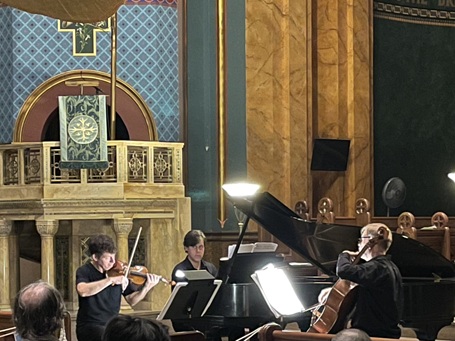
Morton Feldman – Piano Trio
As the musicians approached two hours of playing Feldman’s Piano Trio, I feared my listening endurance might wane. The players had exchanged single pitches and breathy harmonics (‘flageolets’) or tip-toed elegantly through broken chords across a range of dynamics for an extensive time. The composer, who would have turned 100 this year, undoubtedly tests listeners, but he has not forgotten us either. A masterful turn emerged suddenly to close the piece. Piano, cello and violin coalesced into an emotional mezzo forte of crossing pitches, surging moments of unison and a dramatically condensing musical space that tightened around the sparser sounds to which our ears had become accustomed in the mostly hushed hours preceding it.
Throughout this innovative piece, Conrad Harris, Steven Gosling and Alex Waterman were the real heroes: they performed with deliberateness and drew on their years of expertise to hold the long view of its lengthy development. Whether in the quietest ultra-pianissimo moments (marked wildly as ppppp in the score!) or at musical junctures where volume gradually increased or tempo inched ahead, the work was listenable thanks to their acute understanding of it.
Their handling of the piece also slowly revealed (since that’s how anything in Feldman’s output occurs) a glimmer of attachment to a peak era of chamber music, circa Schubert and Brahms. To me, this made it truly ground-breaking. Recognizable motifs returned over the course of the two-hour work. Brief passages of tumultuous urgency mirrored the idea of a cadence without fully committing to one. A crashing forte piano chord 30 minutes into the experience practically shook the church’s nave and startled meditative listeners in the pews. It would have sounded like a cheap shot in an otherwise quiet musical landscape if the exchanges between the performers leading up to it had not been so carefully presented.
Even though the work moved in a slow, mammoth-like way, I realized the players needed intense agility. Pulling back suddenly from a loud climax offered no room for errors. Through two hours of nods, leans and glances at each other, they clearly had to keep a mysterious sense of time. Occasionally, Feldman (going out of compositional character) revealed a time signature that listeners could follow, as when a dance-like syncopation passage emerged or dissonant chords met in rhythmic unison for a period of pulsating 2- or 3- note phrases. One might even have started tapping a foot if it wouldn’t have decimated the stillness of the space.
Feldman’s Piano Trio was the only piece on the program at this opening night of the Graphic Content Festival which will continue to offer concerts across Manhattan and Brooklyn well into November. A proliferation of Feldman-centered concerts this year signals how beloved he is among today’s composers who follow his approach to abstraction and modernity as inspiration. And it makes sense. Our society’s slipping and anxious relationship to time demands a resurgence of Feldman who taught us that endurance to listen is the most radical move any of us – performer and audience – can make.
Daniele Sahr