 United Kingdom Önaç Atlantic Requiem (2026, world premiere): Brittany Renne (soprano), J’Nai Bridges (mezzo-soprano), Orson Van Gay II (tenor), BBC Singers, London Symphony Orchestra / Malcolm J. Merriweather (conductor). Jerwood Hall, LSO St Luke’s, 11.10.2026. (CC)
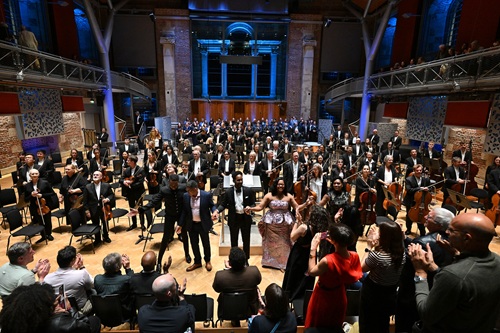
All credit to conductor Malcolm J. Merriweather (director of the New York Philharmonic Chorus and MD of The Dessoff Choirs and Orchestra) for stepping in at the last minute for an indisposed Anthony Parnther for this culturally important world premiere of a score by David Önaç. Merriweather conducted with clarity and assurance, ensuring the score’s multifaceted aspects, from Spiritual to Modernism, all made their mark.
Commissioned by Culture& and Lloyd’s of London as part of a research project, Underwriting Souls, that explores the Lloyds link with the transatlantic slave trade, Atlantic Requiem was born to explore and honour lives lost to slavery while simultaneously honouring the descendants of the slaves.
Taking both Western Classical and African-American musics on one space is both musically effective and symbolic at the same time, a unification in one 40-minute span reflecting the stark juxtaposition of the Latin Mass with texts from insurance documents (in which enslaved people are given a monetary value ‘for the purpose of insurance’) and an account of an enslaved lady who was thrown overboard for contracting smallpox – at which, the Captain reputedly bemoaned the loss of ‘a good chair’.
Possibly the most interesting movement from a text perspective is the third, the ‘Dies irae,’ which takes Christian texts that have been used to justify violence and cruelty. It is only with the fourth movement, the Agnus Dei, that some sort of hope appears (a prayer towards reconciliation) and in the fifth and final section, texts from the Book of Revelation argue for a brighter future. And it is here that the different musical styles combine in a sort of polystylism: perhaps, the new whole is greater than the sum of its parts.
How clear cut this ending is, is up for discussion. It speaks not of paradisical World-harmony, but of ‘mutual coexistence’, a far richer space, but one in which conflict could rear up at any moment. And the use of different musics is at the heart of David Önaç himself, who has studied composition at Cambridge with Robin Holloway and the Royal Northern College of Music with Camden Reeves, and (for his doctorate) with Reeves at the University of Manchester; but who is also an active jazz performer and arranger for gospel choirs.
Önaç uses only ten of the twelve well-tempered notes available: five white and black (itself highly symbolic): the five pentatonic white notes of C, D, E, G and A while the black notes of F, G, A, C, and D sharps balance this (which explains why a lot of ‘dissonant’ passages feature whole-tone clashes). The material is laid out clearly at the opening, with a solo violin followed by a jazzy clarinet solo. Separated by the tritone – the ‘diabolus in musica’ – the separation of black and white skin is again symbolically captured.
The music begins with the sound of a bell – the ‘Lutine Bell’. In this first movement, Önaç calls upon text from a trial scene: we, the audience, are, by implication, an extension of the jury. A full symphony orchestra is used (four horns, triple woodwinds and trumpets, a pair of trombones, a tuba, and three percussion players). The non-Kyrie text of the first movement comes from the Guipúzcoa Insurance Agreement which labelled humans as mere ‘cargo’. Parts of the text are repeated (‘to be insured’ is a framing device). The ‘pro forma’ parts are allocated to the tenor solo, whose music sits somewhere between recitative and rap. Small wonder the opening is marked doloroso (with the extension ma molto ritmico sempre). Benjamin Marquise Gilmore’s violin sang in filigree in response to the choral ‘Requiem’, answered by its harmonic complement on Chris Richards’s clarinet. The two eventually conjoin, before a restatement of ‘Requiem’ in the choir. There are echoes of Negro Spiritual in the music, too. Orson Van Gay II was a superb solo tenor (almost, narrator) who dealt with the sometimes rapid delivery well.
The performance was filmed as well as recorded, and I assume the placement of soloists was for this; they were placed fairly far back from the audience and could get lost in louder passages (the tenor in particular in the third movement). In the first movement, soprano and mezzo-soprano soloists often sing together; the voices of Bethany Renee and J’Nai Bridges worked beautifully together. And when tenor and choir come together in a rapid-fire passage in which they are asked to ‘violently enunciate each syllable’ (at the words, ‘And it is agreed by the insurers’), there is no denying the efficacy of the gesture.
At the end of this movement, the solo violin returns, linking to the ‘Kyrie from the Depths’ and the mezzo’s cry of ‘What is this sickness?’ with the tenor taking the role now of the ship’s Captain (‘The Negro wench has the pox!’: marked molto agitato, naturally). There is the sense here of a drama that could be enacted, much as there are stagings of the Bach Passions, even down to Önaç’s use of the piccolo for the bosun’s whistle. The choir acts as the ship’s collective (‘Smallpox! Lord have mercy’) against which the woman rails (‘Have I no future have I no value?’ she asks). The music is certainly involving, as was the very visceral performance. The mezzo solo is cut off in mid-phrase as an illustration of her loss of freewill (and voice) as the decision is enacted against the choral ‘Kyrie’. Önaç includes screams for the soloists in his score – a risk, for sure. Its very physicality carried this live, but I wonder if this will survive domestic replay?
The ‘Dies irae: Exodus eschatologised’ is the moment the work turns. Carefully chosen and relevant passages speak of the Bible’s inherent violent tendencies (Exodus 21:16: ‘Whoever steals a man and sells him, and anyone found in possession of him, shall be put to death’). Dramatic pauses separate fortissimo statements of ‘Dies irae’. Given the front-page position of the death sentence at the moment (the proposed streaming of an execution in the USA), the impact of these words could hardly be more powerful. Deuteronomy (23:15, ‘If a slave has taken refuge, do not hand them over to their master’, and 16, ‘Let them live among you wherever you like, and in whatever town they choose. Do not oppress them’) was also part of the Biblical schema. Once again, as the quotations and stories piled up, there was the sense of a drama-in-waiting to be staged. The BBC Singers sounded stunning in the ‘Tube mirum’, absolutely honouring the composer’s marking of ‘fortissimo sonoro maestoso’.
It is quite a way to the dolce, affettuoso of the Agnus Dei (here, ‘Agnus Dei in harmony’), clarinet and bell against the choir’s Latin a cappella statement of the Agnus; compositionally and performatively, the return of the violin and clarinet seemed perfectly judged, as did J’Nai Bridges’s solo ‘Dona eis requiem’. The plea for peace was answered by a harmonic warmth. The music is not ‘home’ yet though, as the ‘Miserere’ pulls the music downwards emotionally; it is left to the finale, ‘Caelestis Lux Perpetua,’ marked Maestoso molto grandioso, to elevate us. But Utopia is not achieved fully, or easily, perhaps, despite the conflation of the work’s disparate elements here. The bell tolls still, against which the solo violin has something of a Lark Ascending moment.
The music is certainly impressively constructed, the ideas lofty. This is a piece to hear live, I would suggest; and even then, the final effect, while involving, was far from overwhelming. The message is clear, though, and all credit to the performers, for sure. All three soloists were exceptional (Brittany Renne’s upper register glowing, J’Nai Bridges outstanding throughout and, as our latter-day Evangelist, tenor Orson Van Gay II a real discovery). The BBC Singers were, as always, remarkable and the LSO flawless, with Malcolm J. Merriweather revealing a fine knowledge of the score.
There were two concerts in one afternoon (one 4pm, one 5.30pm) in preparation for an international release on the LSO Live label.
Colin Clarke