 France Wagner, Siegfried: Soloists, Orchestre de l’Opéra national de Paris / Pablo Heras-Casado (conductor). Opéra Bastille, Paris, 28.1.2026. (RP)
Siegfried is perhaps not the best entry point to any new production of Wagner’s Der Ring des Nibelungen, but it contains some of its creator’s most vivid imagery. Almost none of that is to be seen in the third installment of Calixto Bieito’s new Ring for the Opéra national de Paris. The post-apocalyptic, dystopian world of Bieito’s imagination is a strange one where nature and all the living have lost their bearings.
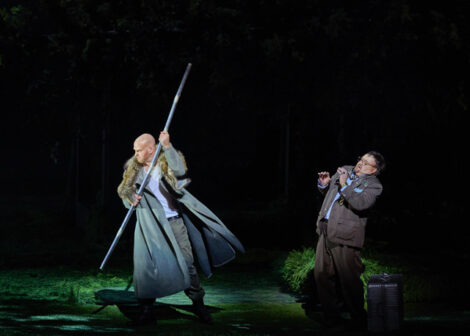
The forest where the dwarf Mime toils to forge a sword for Siegfried is a frightful place where trees grow any which way, except from the earth as nature intended. Behind the lush green foliage, large structures loom, apparently detritus from an extinguished civilization. Siegfried bangs about with a car door while Mime spends a lot of time fussing with the contents of a suitcase.
Things get even odder when the Wanderer arrives at Alberich’s cave. The dwarf’s interest is focused on a cart loaded with sundry odds and ends, and three zombies lurk about, one of whom is pregnant. Alberich places her on his cart, cuts the baby from her womb and deposits it, umbilical cord and all, in a metallic cooler bag, never to be seen again.
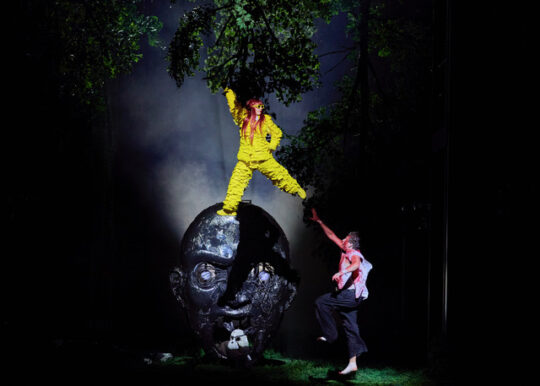
Fafner is a Mad Hatter of sorts, wearing strings of huge beads, while his cave is the gaping mouth of a giant metal skull. For a mechanical creature, it exudes copious amounts of blood, or is it grease? The Forest Bird, sporting long red hair and sunglasses, is a burst of sunshine when she appears, soaring through the sky.
Summoned from her sleep, Erda is rather elegant in a black dress. Her evasive responsiveness to Wotan’s questions triggers his temper. She sits dazed on a chair, draped in a white tablecloth, for the Wanderer’s encounter with Siegfried, who is still covered in blood. Siegfried later places the magical ring, which he has retrieved from Fafner’s cave, atop her head. It slips down to her neck, becoming more of a noose than an adornment, although for a moment she did have the beatific presence of a medieval maiden.
Bieito jettisoned the mountain top where Brünnhilde sleeps, surrounded by a ring of fire. Instead, Siegfried happens upon a tower where a person is encased in a white cube. After smashing up some blocks of ice, he mounts it and tears apart several layers of plastic to reveal Brünnhilde. He proceeds to paw her until passion sparks. After some glorious singing, they walk off the stage together, singing the praises of love.
Throughout it all, Wagner triumphed in the music. Pablo Heras-Casado drew wondrous sounds from the Orchestre de l’Opéra national de Paris. The string playing was notable for its incisiveness and transparency, while the brass added richness and depth to the drama. The leitmotifs emerged clearly and distinctly, amplifying the sense of foreboding that resonated through every scene until the opera’s final moments.
As Siegfried, Andreas Schager was indefatigable and sounded glorious, singing with as much finesse as vigor. The lyricism and, at times, even delicacy of his singing helped to create a Siegfried of impressive depth and complexity. Dramatically, he was just as secure, despite being called upon to work out his frustrations on an old car door or by ripping up the green floor covering. Schager emerged as a hero and, indisputably, the finest Siegfried of our times.
Gerhard Siegel’s fussy and malevolent Mime was another wonderful creation. His penetrating tenor and perfect sense of timing were at one with the nerdish man in an ill-fitting brown suit. Siegel was the perfect foil for both Derek Welton’s Wanderer and Schager’s Siegfried in verbal sparring, although both got the better of him.
Mime’s paranoia and venality were only matched by those of his brother, Alberich, portrayed by Brian Mulligan. This Alberich’s actions may have been unfathomable, but Mulligan captured the dwarf’s maliciousness vividly through his voice and subtle characterization. Mika Kares did not quite convince one that a deranged rabbit was as dangerous as a dragon, but his Fafner sounded deadly.
Derek Welton’s athletic build and virile sound made his Wanderer a potent force. Frustration and violence drove the King of the Gods in his guise as the Wanderer, rather than world-weary resignation. Marie-Nicole Lemieux was a rich-voiced Erda, her imperturbability anchored in an earthy sensuality. The latter was a bit incongruous given the state of affairs, but she probably slept through Armageddon.
Ilanah Lobel-Torres’s Woodbird took flight with her sparkling voice and the glee with which she floated through the forest. Once Tamara Wilson’s Brünnhilde was cut free from the plastic sheeting, her voice blazed as she greeted the hero who had never known fear. It is a pity that flattering the human form no longer appears to be part of a costume designer’s remit, but Wilson has moxie. The soprano sounded fantastic, as did Schager who had been singing for hours by the time their voices soared with ecstasy.
In many ways, Bieito’s Siegfried, while not lacking in imagination, is rather tame. It does, however, beg the question of whether there will be flames consuming the gods when the curtain falls at the end of Götterdämmerung, or is plastic in their future?
Rick Perdian
Featured Image: Ilanah Lobel-Torres (Woodbird) and Andreas Schager (Siegfried) © Herwig Prammer/OnP
Production:
Director – Calixto Bieito
Sets – Rebecca Ringst
Costumes – Ingo Krügler
Lighting – Michael Bauer
Video – Sarah Derendinger
Dramaturgy – Bettina Auer
Cast:
Siegfried – Andreas Schager
Mime – Gerhard Siegel
The Wanderer / Wotan – Derek Welton
Alberich – Brian Mulligan
Fafner – Mika Kares
Erda – Marie-Nicole Lemieux
Brünnhilde – Tamara Wilson
Woodbird – Ilanah Lobel-Torres