 France Lully, Atys: Soloists, Ballet Preljocaj, Leonardo Santini Dancers, Chœur de l’Opéra Royal, Cappella Mediterranea / Leonardo García-Alarcón (conductor). Opéra Royal, Château de Versailles, 25.1.2026. (RP)
Lully’s Atys returned to the Château de Versailles in Angelin Preljocaj’s stark, potent production. It is known as ‘the king’s opera’ because Louis XIV took a particular liking to Lully’s tragédie en musique, humming its melodies as he walked through the palace. Atys premiered at Château de Saint-Germain-en-Laye in 1676 and was first heard in a concert version at the Château de Versailles in 1709. William Christie scored a triumph when he resurrected Atys with Les Arts Florissants in 1987.
Comprised of a prologue and five acts, Atys is based on a libretto by Phillippe Quinaul, which was in turn inspired by Ovid, a Roman poet who lived during the reign of Augustus. The prologue is a combination of political commentary and a paean to Louis XIV. The opera tells the story of Atys, a young Phrygian favored by the goddess Cybèle, who secretly loves him. Atys, however, is in love with Sangaride, a nymph who is promised to another man, King Celenus.
Atys and Celenus are rivals to become the high priest of Cybèle’s cult. Cybèle selects Atys to be high priest, confessing that it was for him and not Celenus’s marriage that she descended to earth. Cybèle then causes Atys to fall into a sleep in which he hears songs of love and is also warned of the dangers of deceiving the gods. He awakes to find Cybèle at his side, ready to comfort him. Sangaride implores Atys to prevent her marriage to Celenus, and he promises to aid her. Cybèle, suspecting their love, laments her fate in one of the opera’s most moving arias, ‘Espoir si cher si doux’. Atys, invoking his powers as high priest, calls off the wedding of Sangaride and Celenus.
Cybèle and Celenus plot revenge against the lovers. Cybèle casts a spell upon Atys, who kills Sangaride, believing her to be a monster. Once Cybèle releases him from the spell, Atys attempts to take his own life. Cybèle intervenes and transforms him into a pine tree which, in Cybèle’s mythology, symbolizes death, resurrection and divine grief. The opera ends in a mood of complete desolation, with the gentle weeping of the nymphs vying with the frenzied dancing of the Corybantes, Cybèle’s attendants.
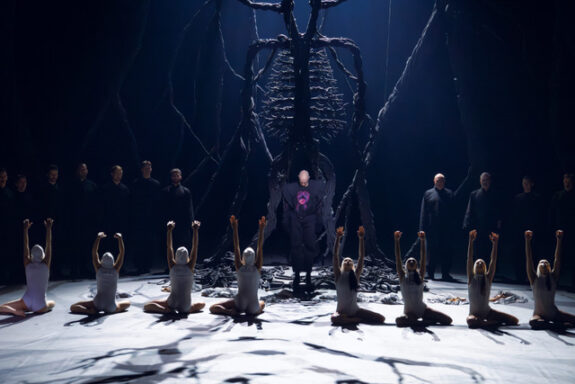
Angelin Preljocaj’s production of Atys premiered at the Grand Théâtre de Genève in 2022. It was the choreographer’s first foray into opera and is a mesmerizing blend of music, drama and dance. Preljocaj achieves an equal balance of the three, but movement was the element that propelled the action and amplified the emotion conveyed in the music. An especially effective device is the pairing of a dancer with a principal singer. It had the potential to be fussy, but the naturalness of the dancers’ movements perfectly captured and amplified the depths of feeling plumbed by the singers.
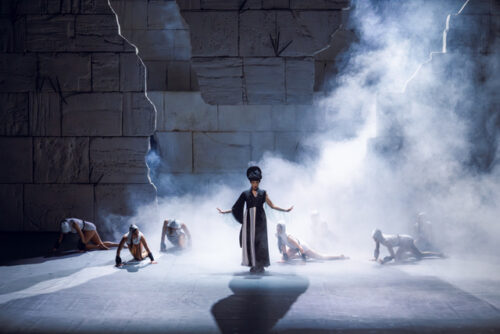
Preljocaj places the action in a timeless space, in which the sensibilities of mythological Greece, seventeenth-century France and the modern world coexist on equal terms. For the prologue and first three acts, the drama unfolds against a massive wall of white stone. It parts to reveal inner spaces as well as to provide a wall that the dancers scale and descend. It is replaced in the final scenes by sinewy roots, which eventually coalesce to form the tree in which Atys is embedded.
The costumes of the singers and dancers are cast in somber hues, employing a color palette of white, gray and black. The design of the singers’ costumes is a timeless blend of ancient Greek style fused with Asian sensibilities, while the dancers’ costumes are a remarkable mix of styles that amplify the visual impact of their movements. The somber color palette is pierced only by the lurid red gash on Sangaride’s body where Atys stabbed her, and a similar one in Atys’s torso, resulting from his futile attempt to commit suicide.
Tenor Matthew Newlin’s Atys was carved out of marble, impervious and implacable. Cracks in that veneer revealed Atys’s vulnerabilities and torments. Newlin sang with eloquence and beauty, and he moved with equal grace. Ana Quintans plumbed the depths of Sangaride’s despair with her crystalline soprano and sensitive acting.
Giuseppina Bridelli’s imperious Cybèle commanded the stage. She expressed the depth of the goddess’s feelings for Atys in a stunning ‘Espoir si cher si doux’, and plumbed equal depths when regretting his fate at the close of the opera. Bass-baritone Andreas Wolf’s Celenus was equally potent, a delicious combination of privilege and pride.
The opera contains a sommeil, a scene in which a sleeping character is placed in a vulnerable position. In Lully’s opera, the sleeping Atys is first serenaded by pleasant dreams, in which the chorus sang of love, and then by bad ones, which are a reminder of the perils he will face for deceiving the gods. As the allegorical character Le Sommeil, Nicholas Scott summoned sleep with the soothing sounds of his fine lyrical tenor.
Bass Luigi De Donato was a profound Le Fleuve Sangar, the God of the River Sangar and Sangaride’s father, who congratulated his daughter over her decision to cancel her marriage to Celenus in his magnificent basso. The god’s good wishes proved improvident and premature.
Leonardo García-Alarcón led Cappella Mediterranea and Chœur de l’Opéra Royal in a performance that transformed Lully’s score into the music of today, rather than a recreation of the past. The quest for authenticity was never lacking, and the performances of principals, chorus and orchestra alike were pristine examples of period style. García-Alarcón, however, channeled the same synergies that Preljocaj conjured through movement into the music for an unforgettable experience.
Rick Perdian
Featured Image: Matthew Newlin (centre, Atys) © OR/Baptiste Lacaze
Production:
Director and Choreography – Angelin Preljocaj
Sets –- Prune Nourry
Costumes –- Jeanne Vicérial
Lighting –- Éric Soyer
Revival Directors – Claudia De Smet and Dany Lévêque
Chorus master –- Thibaut Lenaerts
Cast:
Atys – Matthew Newlin
Cybèle – Giuseppina Bridelli
Sangaride – Ana Quintans
Celenus, Le Temps – Andreas Wolf
Idas, Phobétor, Un songe funeste – Victor Sicard
Flore, Doris, Divinité fontaine I – Mariana Flores
Le Fleuve Sangar – Luigi De Donato
Le Sommeil – Nicholas Scott
Mélisse, Divinité fontaine II – Lore Binon
Morphée, Dieu de Fleuves – Valerio Contaldo
Phantase – Attila Varga-Tóth