 United States MANON!: Soloists, Musicians of the Heartbeat Opera / Dan Schlosberg (conductor). The Space at Irondale, Brooklyn, 3.2.2026. (ES-S)

Since its founding in 2014, Heartbeat Opera has built a reputation on bold adaptations of familiar works from the operatic canon, questioning traditional staging practices and rethinking scale, language and format in order to speak more directly to a contemporary audience. With a new English book and lyrics by Jacob Ashworth and Rory Pelsue, an adaptation of the original French libretto by Henri Meilhac and Philippe Gille and a fresh musical arrangement by Dan Schlosberg, MANON! doesn’t feel like an unjustified exercise in reinvention.
Condensing Massenet’s five-act opera into an uninterrupted span of roughly 100 fast-moving minutes proves to be one of this production’s most consequential choices. The result is a lean reading of a familiar story, one that foregrounds desire, ambition and self-invention over romantic excess and remains deliberate rather than reductive. What is gained is momentum and focus: narrative detours are stripped away, emotional through-lines sharpen and Manon’s trajectory unfolds with near-inevitability. What is lost is a measure of atmospheric leisure, the score’s capacity to linger in digression and social texture.
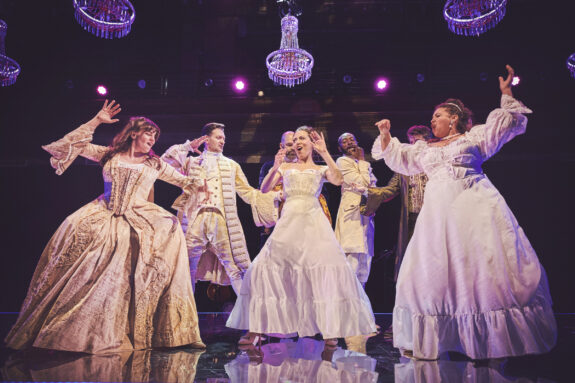
Staged at The Space at Irondale, a former Sunday school within an historical church complex, MANON! takes advantage of the venue’s height, openness and multiple sightlines. The production extends the action beyond the runway thrust stage, pressing the upper balcony into service as a kind of elevated demimonde, a vantage point for the opera’s world of transaction and spectacle. From the opening image, the production announces its visual and thematic vocabulary. Six chandeliers hover above the runway, rising and falling with Manon’s fortunes. Set designer Alexander Woodward’s minimalist environment turns the stage into a marketplace, a catwalk, a church nave or a showroom, while lighting designer Yichen Zhou bathes the space in alternating warmth and glittering chill, making luxury itself feel both seductive and punitive. While Woodward relies on minimal props to define the environment, costume designer David Mitsch supplies eye-catching, witty, fantasy-period costumes that sharpen the production’s sense of artifice.
Manon, rarely offstage, is always on display in Rory Pelsue’s staging. Emma Grimsley interprets her with fearless vocal and dramatic specificity. She is the daughter of acclaimed opera singers Greer Grimsley and Luretta Bybee and her soprano is lustrous but edged with grit, capable of floating sweetness and biting irony in the same phrase. The production avoids presenting Manon as a naïve ingénue; she is seen instead as alert and occasionally cunning, a woman fully aware of the consequences of her choices.
Opposite her, Matt Dengler brings a boyish sincerity to the Chevalier des Grieux, grounding the role in emotional transparency. His vocal effort, occasionally stretched to its limits, becomes part of the character’s bravery. Des Grieux believes, against mounting evidence, that love should be enough. Dengler makes that belief both palpable and heartbreaking.
The supporting cast crackles with specificity, drawing on vocal styles more closely aligned with Broadway’s musical theatre than traditional operatic projection and on commedia dell’arte–inflected characterization, both well suited to the intentions of this mise-en-scène. Occasionally, amplified voices registered with slight distortion, though this never obscured textual clarity or dramatic intent. Glenn Seven Allen’s Guillot is an elderly Casanova-like predator, repeatedly addressed as ‘Daddy’, with just enough charm to keep the room laughing even as it recoils in disgust. Jamari Darling steals scenes as Lescaut, a glittering opportunist whose ballroom-inflected movement and moral slipperiness feel thrillingly contemporary. Justin Lee Miller, heard late in the evening as the Count des Grieux, brings vocal authority and controlled severity to the role, embodying a form of power that is colder and more socially sanctioned than Guillot’s excess. Kathryn McCreary and Natalie Walker as Pousette and Javotte are not content to serve as mere comic relief, investing their courtesans with humor, solidarity and survival instincts.
Dan Schlosberg’s eight-piece orchestration – woodwinds, horn, harp, strings, bass and keyboard – sounds far larger than it is. Embroidering a musical spine that keeps most of Massenet’s melodic DNA intact, the arrangements incorporate Baroque dance and Golden Age Broadway – inspired excursions, sounding plush, propulsive and meticulously paced. Schlosberg conducted from the keyboard with an intuitive sense of dramatic architecture, keeping singers and players in lockstep despite the spatial challenges of the venue.
In a culture saturated with Instagram-curated luxury and algorithm-fed images of ease and abundance, MANON! feels uncomfortably contemporary, exposing how desire is shaped less by need than by what is constantly placed before us. Heartbeat Opera proved – again – that opera does not need a grand house or a grand budget to speak to the present.
Edward Sava-Segal
Featured Image: The company of Heartbeat Opera’s MANON! © Andrew Boyle
Production:
Music – Jules Massenet
Original libretto – Henri Meilhac and Philippe Gille
Adapted with new English translation – Jacob Ashworth and Rory Pelsue
New arrangement and Music director – Dan Schlosberg
Director – Rory Pelsue
Sets – Alexander Woodward
Costumes – David Mitsch
Lighting – Yichen Zhou
Choreographer – Sara Gettelfinger
Sound – Ryan Gamblin
Props – Madisen Frazier
Dramaturg – Peregrine Teng Heard
Cast:
Manon – Emma Grimsley
Chevalier des Grieux – Matt Dengler
Guillot – Glenn Seven Allen
Lescaut – Jamari Darling
Count des Grieux – Justin Lee Miller
Pousette – Kathryn McCreary
Javotte – Natalie Walker
Band:
Oboe / English Horn – Pablo O’Connell
Bassoon – Atao Liu
Horn – Nicolee Kuester
Harp – Deanna Cirielli
Violin – Julia Danitz
Cello – Thapelo Masita
Bass – Eleonore Oppenheim
Conductor / Keyboard – Dan Schlosberg