 United States Tarkiainen, Grieg, Sibelius: Lang Lang (piano), Boston Symphony Orchestra / Andris Nelsons (conductor). Carnegie Hall, New York, 9.4.2026. (ES-S)
Outi Tarkiainen – Day Night Day
Grieg – Piano Concerto in A minor, Op.16
Sibelius – Symphony No.1 in E minor, Op.39
The second night of the Boston Symphony Orchestra’s visit to Carnegie Hall under music director Andris Nelsons drew enthusiasm similar to the first, the audience aware that opportunities to experience this partnership – whose recently announced, abrupt conclusion came as a surprise to many – are now increasingly limited.
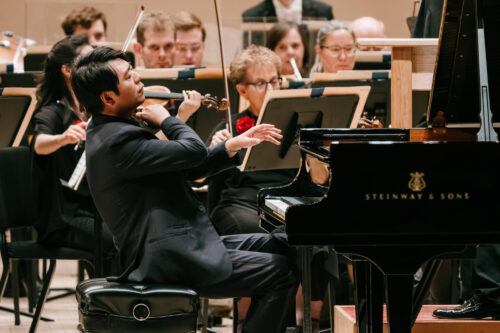
The full hall, of course, also testified to Lang Lang’s enduring magnetism. Edvard Grieg’s Piano Concerto in A minor offered a showcase for his strengths while raising familiar questions about balance and cohesion, as well as the pianist’s penchant for strikingly grandiloquent gestures and not always justified accentuation.
The opening unfolded with emphatic contrast, the piano’s descending gesture establishing a strong presence before yielding to the orchestra’s more expansive response. Throughout the first movement, Lang Lang adopted a highly flexible approach to phrasing, shaping individual ideas with marked contrasts in dynamics and articulation. This brought a heightened sense of immediacy to the musical surface, though at times the broader continuity of the movement felt less firmly sustained, particularly in transitional passages. The cadenza provided a focal point of greater stability, its weight and clarity grounding the movement at its most expansive.
The Adagio offered a different perspective. Here, the piano emerged more organically from the orchestral texture, allowing for a more sustained line and a greater sense of inwardness. The interplay between soloist and orchestra was closely aligned, with the phrasing unfolding in longer spans and the dynamic range carefully graded. Marked elsewhere by extraordinary precision and speed in all manner of runs, Lang’s playing here revealed a more poetic vein, expressed in immaculately shaped, mysterious pianissimos.
The third movement restored forward momentum through its sharply articulated dance rhythms, the soloist engaging fully with the music’s physical energy. While largely in sync with Lang Lang’s abrupt dynamic shifts throughout the performance, here Andris Nelsons and the orchestra occasionally fell a step behind the pianist’s daredevil approach. Even so, the movement’s directness helped channel the pianist’s volatility into a compelling close.
Grieg evokes Norwegian identity through folk elements embedded in the contour and rhythm of his themes rather than in explicit quotation. He builds his musical argument through a succession of clearly profiled exchanges between soloist and orchestra. The two Finnish works that framed the concerto approach both texture and the handling of folk elements differently. Jean Sibelius allows his ideas to emerge and transform continuously, dissolving the boundaries between thematic identity and orchestral texture, while Outi Tarkiainen fashions a shifting surface of timbre and light within which Sámi elements are placed unobtrusively.
Tarkiainen’s Day Night Day, heard in its New York premiere, is a compact, single-movement orchestral work of roughly seven minutes, drawn from the forthcoming opera Day of Night. The opening establishes a delicate, almost suspended soundworld, in which high woodwinds, harp and celesta articulate a space defined more by resonance than by direction. Within this texture, the first clear point of reference emerges in the muted trumpets, introducing a Sámi yoik not as a self-contained theme but as a presence embedded in the surrounding sonority. Without the composer’s indication, as relayed in the program notes, one would hardly recognize the presence of Sámi melodies, so fully are they absorbed into the surrounding texture. The music gathers density without abandoning its essential character. Layers accumulate, brass and percussion expanding the scale, yet the sense of forward motion remains diffuse, driven less by motivic transformation than by shifts in weight, register and timbral intensity, as potential contrasts are absorbed into an evolving surface.
In the final pages, the texture thins and settles. Flute and clarinet trace the outline of the Sámi lullaby ‘Sjamma, sjamma’, its simplicity set against the preceding accumulation of sound. Rather than functioning as resolution, this return acts as a point of stillness, the music receding into near silence without fully relinquishing its suspended state.
Sibelius’s Symphony No.1 revealed itself as a work in which musical thought does not so much present itself as take shape in real time. William R. Hudgins’s opening clarinet solo, with the timpani roll barely audible beneath it, established not only the symphony’s tonal ambiguity but also its method: a mode of presentation in which gestures take shape without being set against a clearly defined orchestral backdrop, their relation to the overall soundscape remaining fluid and ambiguous. Nelsons allowed this introduction to breathe before the full orchestra entered with a surge of energy that felt less like a beginning than a continuation, as if a voice long present had finally taken form.
The first movement progressed through a series of expansions and contractions, its ideas reshaped as they passed between strings, woodwinds and brass. Nelsons drew out these internal shifts with careful attention to balance and pacing, maintaining clarity without overemphasizing contrast. He shaped the span as a continuous whole, the transitions carrying as much weight as the thematic statements themselves. The result was a reading that preserved a sense of forward direction while keeping the surface in constant motion.
The Andante brought a more inward tone, its muted strings and woodwinds shaping a restrained lyricism that avoided sentimentality. Yet the darker orchestral coloring remained present throughout, the calm repeatedly unsettled by timpani interjections and shifting harmonic undercurrents. At moments, the music seemed to hover between lullaby and a more troubled lyricism, recalling, without explicit narrative reference, patterns of loss and recovery that haunt the world of the Kalevala. The return of the opening idea carried a sense not of resolution but of recognition, the earlier tension now absorbed into a more subdued expressive frame.
The ensuing Scherzo, propelled by sharply articulated rhythms in the strings and incisive timpani strokes, took on a more overt sense of urgency. The central trio, with its lyrical flute line and subdued horn writing, offered only a temporary reprieve, its pastoral surface tinged with unease. Nevertheless, there was no clear-cut opposition between moods, as they seemed to bleed into one another, the music unable to escape its own momentum.
Nelsons maintained a firm grasp of the long arc of the Finale, building toward climactic points without forcing them, the brass and timpani driving the music forward while the strings traced more lyrical lines, including the expansive second subject with its faint Tchaikovskian inflection. In the closing pages, he drew out the music’s underlying austerity, allowing its sense of inevitability to register fully.
One might be tempted to hear in this remarkable reading a particular affinity of the Latvian-born conductor for Sibelius’s soundworld, one shaped by the stark northern and Baltic horizons.
Edward Sava-Segal
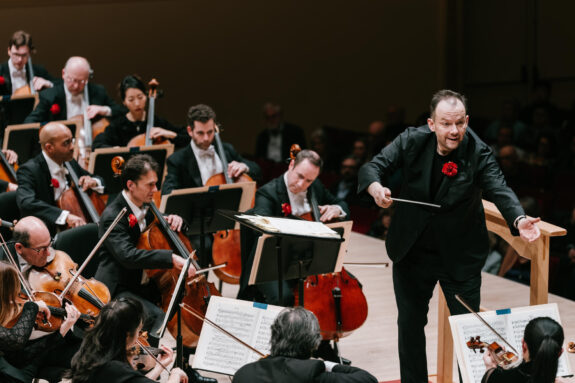
Featured Image: Andris Nelsons leading the Boston Symphony © Fadi Kheir