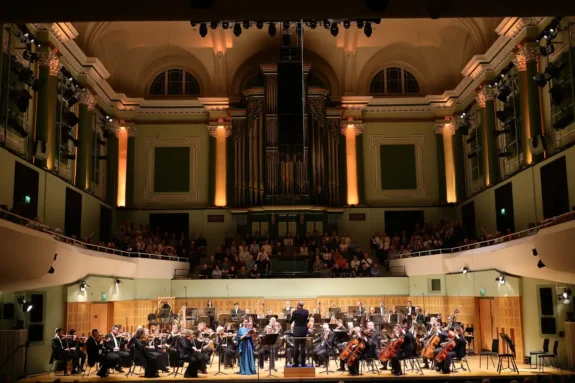
 Ireland Britten, Mahler: Baiba Skride (violin), National Symphony Orchestra Ireland /Jonas Alber (conductor). National Concert Hall, Dublin, 29.5.2026. (RB)
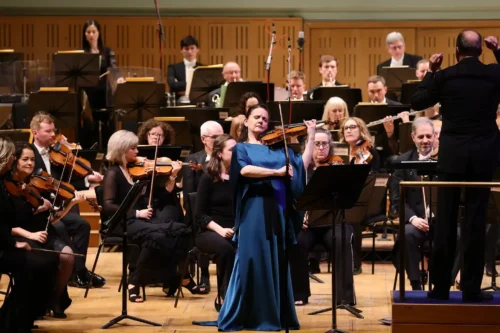
Britten – Violin Concerto, Op 15
Mahler – Symphony No.5 In C-sharp minor
The National Symphony Orchestra Ireland (NSOI) were joined by their guest conductor, Jonas Alber, for this concert featuring works by Mahler and Britten. This year is the 50th anniversary of Britten’s death, so the distinguished Latvian violinist, Baiba Skride, joined them for a performance of his Violin Concerto.
Britten completed his Violin Concerto in 1939, immediately before the outbreak of the Second World War. It is an intense, haunting work which reflects the young composer’s horror at the atrocities of the Spanish Civil War and his dread of the impending Second World War. Given the dark atmosphere and abstruse nature of some of the material, it took a long time for the concerto to be incorporated into the standard repertoire. Ida Haendel was an early champion, but over the last few decades more leading violinists have taken up the work, including Baiba Skride.
The concerto opened with an ominous five-note ostinato on timpani heralding the distant threat of war. Skride played the long, elegiac melodic lines with extraordinary control and beauty of tone. Her intonation was perfect even when playing in the upper reaches of the violin’s register. The martial material was well handled as Skride clashed with the NSOI’s brass and percussion. The second movement owes a debt to Prokofiev and gave Skride an opportunity to demonstrate high-wire virtuosity: octaves, double stops and wide leaps were despatched effortlessly. The orchestra and soloist brought a rhythmic propulsion and dynamism to the movement and Skride captured perfectly the biting, caustic quality of the material. She was not afraid to dig into the strings and to emphasise the discordant elements in the work. The final passacaglia is a difficult piece to bring off in concert, and it is the least audience friendly aspect of this concerto. The NSOI’s trombones ushered in the dark tonally unstable ground bass. The ensuing variations were well characterised by Alber and Skride as the music moved from a mournful elegy to an off-kilter waltz and militaristic march. Alber and the NSOI did an excellent job injecting drama and striking contrasts into the music. Skride closed on a note of unresolved ambiguity as Britten’s final trill hung menacingly in the air.
Mahler’s monumental Fifth Symphony is one of the composer’s best-known works primarily because of the Adagietto fourth movement which Leonard Bernstein performed at the funeral of Robert Kennedy, and which also featured in Visconti’s Death in Venice. It charts a journey which begins with a sombre funeral march and moves to a radiant, triumphant finale. Mahler regarded his Fifth Symphony as absolute music, i.e. music which has no external narrative, although many commentators see the sublime Adagietto as a love letter to his wife, Alma.
Alber and the NSOI were at the top of their game in this symphony, and it must rank as one of the best performances of this work I have heard in concert. Darren Moore’s opening trumpet solo was rhythmically taut and delivered with perfect intonation. It established the dark, grief-stricken character of the movement. Alber did an excellent job establishing the funereal tread of the first subject while injecting lyricism and flow into the music. The juxtaposition between the march and the subsequent sudden wild outbursts was brilliantly executed by the NSOI who played in an unbridled way. Mahler asks for great vehemence in the tumultuous second movement and the NSOI delivered in spades, playing with a jagged, explosive energy. Alber ensured that the textures remained clear even in the loudest, most volatile passages. The NSOI’s brass produced a glorious chorale towards the end of the movement which was swallowed up in the darkness.
The NSOI’s principal horn, Jake Parker superbly navigated the leaps, shifting dynamics and changes of mood in the Scherzo. Alber brought out the distinctive Viennese charm of the waltzes and Ländler which run through the movement. The NSOI unleashed a glorious palette of orchestral colour creating a sprightly buoyant mood. There has been a lot of debate among conductors about how fast to play the fourth movement, Adagietto. Alber seemed to find just the right balance between the still, meditative qualities in the music and ardent expressions of love. The strings played in a beautifully poetic way, creating a feeling of timelessness while giving voice to Mahler’s confessions of love. The dizzying counterpoint in the finale was played with immense clarity. The NSOI conjured up an idyllic pastoral landscape and maintained energy and momentum right to the end of the movement. The coda was a breathtaking tour de force bringing the work to a rousing conclusion.
The audience responded with huge cheers and a well-deserved standing ovation.
Robert Beattie
Featured Image: Violinist Baiba Skride, the National Symphony Orchestra Ireland and conductor Jonas Alber