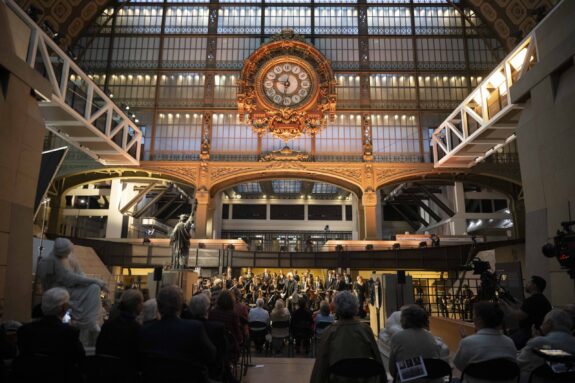
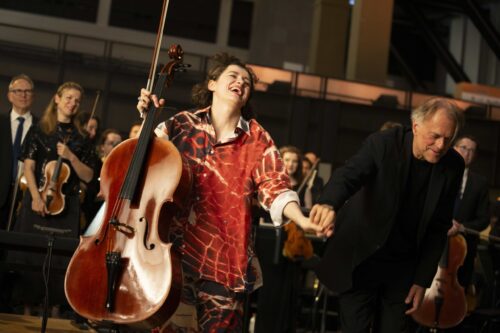
 France Various, ‘Renoir et la musique’: Anastasia Kobekina (cello), Orchestre de chambre de Paris / Thomas Hengelbrock (conductor). Musée d’Orsay, Paris, 1.6..2026. (LV)
Stravinsky – Pulcinella Suite
Saint-Saëns – Symphony No.2 in A minor, Op.55
Thierry Escaich – Poème symphonique pour violoncelle et orchestre (based on paintings by Renoir and Van Gogh). World premiere, commissioned by the Festival d’Auvers-sur-Oise (2026)
The Musée d’Orsay is one of Paris’s most spectacular concert venues. Its vast nave is presided over by a giant golden clock, a relic of the building’s former life as a railway station built for the 1900 World’s Fair, when trains ran through what is now the central gallery. It is also one of the most acoustically challenging venues, its long reverberation time a constant adversary for any ensemble performing there. This performance was part of the museum’s six-concert ‘Renoir et la musique’ series, running alongside its major spring exhibitions, Renoir and Love: Modern Happiness and Renoir the Draftsman, marking the institution’s 40th anniversary. The programming reflects a biographical truth: Renoir was trained as a singer by Charles Gounod at Saint-Eustache, directed the orchestra at the Moulin de la Galette and left behind some fifty paintings evoking his musical passions. Thomas Hengelbrock and the Orchestre de chambre de Paris rose to the challenge across a program that placed Thierry Escaich’s world premiere at its heart.
Stravinsky’s Pulcinella Suite opened the evening, and the space initially took its toll. The brass quacked, sharp edges were softened and the lower end of the texture barely registered. But the orchestra gradually found its footing and, as the suite progressed, the ensemble began filling the hall with sounds Stravinsky himself might not have anticipated – occasionally to thrilling effect. The ‘Variations’ movement had genuine charm, if at the cost of some clarity. The solo trombone was wonderfully fluent in his brief solo. The finale took on a thrilling free-for-all momentum, propelled in equal measure by Hengelbrock and the hall.
The decision to program Saint-Saëns’s Symphony No.2 with a chamber orchestra raised immediate questions. It is a work of considerable ambition – opening after a brief prelude with a bold fugue whose juxtaposition of tonic and dominant outlines scandalized early Paris audiences – and it swings along with an élan that demands real weight. Saint-Saëns understood the classical symphony perhaps better than any French composer of his generation: its architecture, its balances, its expectation that each movement earns its place. This performance caught something of the symphony’s mercurial character, beginning not unlike Brahms’s Tragic Overture in mood. But the finale, and the symphony overall, for all its vivacity and superb intelligence never quite justified its own existence; perhaps Saint-Saëns’s gift for making the simplest material irresistible needed greater heft and conviction than these forces could provide.
The world premiere of Escaich’s Poème symphonique arrived like a slow detonation. Commissioned by the Festival d’Auvers-sur-Oise for Anastasia Kobekina, the work sets three Renoir paintings against three Van Goghs, using the same thematic material for both – the same cells of melody that dissolve into shimmering Renoir light reconstituted as Van Gogh torment. The Renoir triptych unfolded as a polyphony of textures in constant motion, brushstroke-like in its orchestration – Canotiers à Chatou shimmering on the water, Bal du moulin de la Galette and La Danse à Bougival conjuring the warmth of popular dance.
Then, almost without pause, the Van Gogh panels opened. After some braying from the brass, an impressive commotion grew into something eloquent, the cello rising and falling over clanging bells. The knotted entanglements of Van Gogh’s final painting, Racines d’arbres, gave way to the wheeling agitation of Champ de blé aux corbeaux before the music reached its summit in L’Église d’Auvers-sur-Oise – the church bell tolling over repeating string cells as Kobekina’s cello, now alone, evaporated into silence.
Throughout, Kobekina commanded the full range of her instrument, from its lowest registers to its highest, through ferocious double stops and long stretches of intricate figuration that wove in and out of the orchestral texture as if thinking aloud. The variety of character she brought to it all was extraordinary: lyrical, virtuosic, confiding, searching. What made her performance all the more remarkable was the contrast with the world most young soloists inhabit – years of competition preparation, concertos woodshedded in isolation long before any professional orchestra enters the picture. Here she was inside the creative process from the start, the work written for her. It showed.
[With permission from the organizers this review is based on the 1 June dress rehearsal, the evening before the public performance.]
Laurence Vittes
Featured Image: The Golden Clock at the Musée d’Orsay © Laetitia Striffling