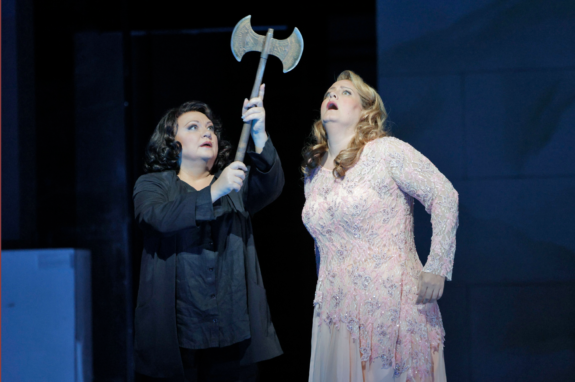
 United States R. Strauss, Elektra: Soloists, Chorus and Orchestra of San Francisco Opera / Eun Sun Kim (conductor). War Memorial Opera House, San Francisco, 7.6.2026. (HS)
San Francisco Opera’s Elektra opened a six-performance run with a powerhouse cast led by Russian soprano Elena Pankratova and a muscular, utterly riveting 95-piece orchestra under music director Eun Sun Kim. These thrills easily overcame an excessively psychological ‘thriller’ production.
First seen here in 2017, the staging places the action in the mind of a woman entranced with Sophocles’s tragic heroine, the revenge-obsessed daughter of Agamemnon, the assassinated king. In Keith Warner’s production, first seen here in 2017, the woman hides as a museum exhibition about the Elektra story closes for the night, imagines herself as Elektra and gradually goes mad, as Elektra does in the classic Greek play.
The modern set provides plenty of room for the action to unfold and is big enough for the characters to move around freely. Projections show the sacrifice of Iphigenia (which is what triggered Agamemnon’s murder), and they capture the interest of the woman who is soon-to-imagine-herself-as-Elektra. A wall on stage right trundles open to reveal a bedroom, a kitchen rolls out stage left and a loge above the stage opens to reveal an area that doubles as a meeting room and an entry hall. All of this takes us one big layer away from the visceral immediacy of the opera but, fortunately, Richard Strauss’s music and Hugo von Hofmannsthal’s libretto trace every emotional element in glowing detail.
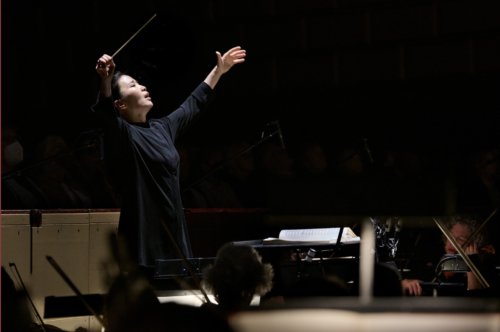
To begin with Kim’s conducting, her orchestra was in top form in this bucking bronco of a score, delivering one magnificent turn after another. The opening ‘Agamemnon’ theme stamped itself on one’s brain with an eloquent intensity and each recurrence, as it expanded upon the idea, unfurled in waves. Quieter moments, which don’t arrive until the last part, managed to combine a sense of calm while underlining further dread. The final 10 minutes achieved genius-level profundity as the orchestra reached crashing climaxes and moments of delirious exhilaration.
Sopranos Elena Pankratova, making her company debut in the title role, and Elza van den Heever as Chrysothemis, Elektra’s more well-adjusted sister, have voices that soar with power and beauty. Even at the end of the taxing performance – Elektra is singing on stage for nearly all of the opera – Pankratova, who has triumphed as Turandot at the Metropolitan Opera and Elektra on three continents, kept delivering one great moment after another.
Van den Heever’s roles at San Francisco Opera have ranged from Donna Anna in Don Giovanni to Leonore in Fidelio, but elsewhere she has been leaning toward more heroic fare, including Sieglinde and, yes, Turandot. Her voice matched Pankratova’s richness and steely focus, and the combination was musically hair-raising in scene after scene. Their harmonization in the finale’s glorious duet was nothing short of magnificent. From a drama standpoint, they created characters that displayed the sisters’ love for each other and impatience with their differences – Elektra intent on vengeance, Chrysothemis yearning for marriage and children.
Pankratova’s extensive scene with Viennese mezzo-soprano Michaela Schuster as Klytemnestra (Elektra’s mother, who was responsible for Agamemnon’s death years earlier) struck a balance between probing conversation and an undertone of more dread. Schuster presented a queenly stature along with imperial disdain for her mad daughter, and their distinctively different voices played off each other. As Aegisth, the queen’s lover and co-conspirator in Agamemnon’s death, company veteran William Burden lent his sleek tenor voice to a character who is sleazy and thinks he’s in charge.
The story turns with the arrival of Orest, the brother of Elektra and Chrysothemis, thought to be dead. Kyle Ketelsen voiced the role with polish and depth, his bass-baritone balancing musically with the women. This staging makes the character into a slasher-movie villain: we see him behead Klytemnestra over the kitchen sink and ax Aegisth in the bedroom. It is uncanny that Strauss’s score for those moments functions well as a horror-movie underscore, glorifying the action despite the visible gore.
The final few minutes reached a summit of exaltation and musical expansiveness that was simply breathtaking. After all the intensity from a sensational cast and orchestra, the roar of appreciation from the audience was almost as thunderous as the music.
Harvey Steiman
Featured Image: Sopranos Elena Pankratova (Elektra) and Elza van den Heever (Chrysothemis) © Corey Weaver
Production:
Original Director – Keith Warner
Revival Director – Anja Kühnhold
Sets – Boris Kudlička
Costumes – Kaspar Glarner
Lighting – John Bishop
Projection – Bartek Macias
Chorus director – John Keene
Cast:
Elektra – Elena Pankratova
Chrysothemis – Elza van den Heever
Klytemnestra – Michaela Schuster
Orest – Kyle Ketelsen
Aegisth – William Burden