 Hungary Wagner, Das Rheingold, Götterdämmerung: Soloists, Hungarian Radio Chorus and Orchestra / Ádám Fischer (conductor). MŰPA, Budapest, 18 & 21.6.2026. (AK)
In June 2026 there were three days in Budapest when truly exceptional events clashed in time. There was the intense international ‘Kurtág 100’ conference (18-20 June) – with occasional participation by the composer György Kurtág who turned 100 in February– and the Budapest Wagner Days (18-21 June) which was conducted for the last time by Ádám Fischer. I opted for a compromise, thus missing one evening from the Kurtág conference but, sadly, also missing Die Walküre and Siegfried from the Ring cycle.
Kurtág’s 100th birthday is not the only anniversary this year. It was 150 years ago in 1876 that Wagner’s Ring was first heard in its entirety in Bayreuth – with a Hungarian conductor, Hans (János) Richter, on the podium. And it was 20 years ago, in June 2006, that the Hungarian conductor Ádám Fischer started what became the Hungarian Bayreuth (Budapest Wagner Days), an annual celebration of Wagner on the banks of the Danube.
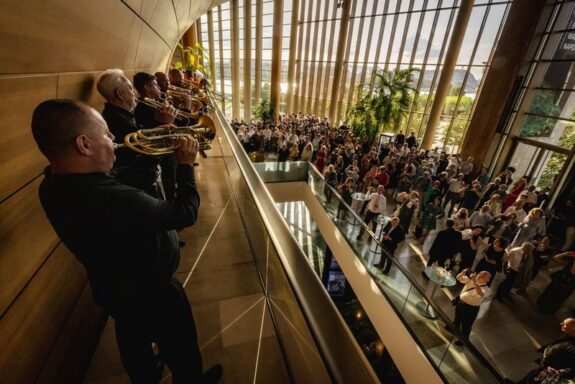
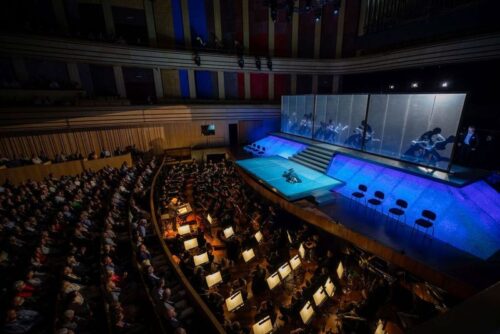
The Budapest Bayreuth performances took some elements from Bayreuth, such as performing the cycle in four subsequent days and inviting the audience to the auditorium with brass fanfares (using music from the Ring). One very big difference, though, is the venue. In Bayreuth the stage was built for Wagner’s operas, but the orchestra is hidden under the stage. In Budapest the performances take place in MŰPA’s main concert hall (although there is a purpose-built theatre in the same building). Arguably, in MŰPA’s concert hall the musical process is helped by the close contact between orchestra, singers and conductors while in Bayreuth many participants hear only part of the music.
The concert hall performance needs a very good stage director and also good collaborators with lights, suitable costumes and various technical issues. The Ring operas I saw this time had them all: they had Wagner’s Gesamtkunstwerk, although much of it via video projections which Wagner could not foresee (but surely would have approved).
Director Hartmut Schörghofer’s so-called semi-staging did not feel like just a partial staging. On the contrary, I for one (admittedly, from an excellent seat on the first floor) felt that I was a close witness to the drama in every dimension. The elegant and tasteful concert dresses of the singers matched the orchestra’s attire, thus bringing visual unity (in addition to the aural unity) between singers and orchestra. However, Loge and, in the final Immolation Scene Brünnhilde, wore very bright red costumes. Nevertheless, crucially, the essence of Schörghofer’s staging is the music. Opera directors of the world: take note.
Interestingly, the unity between music and visual representation extends even to some musical instruments too. The six harps specified in Das Rheingold by Wagner are placed on the auditorium’s balcony (three on each side) and they get a special rainbow lighting when Wotan leads the Gods to Valhalla. In fact, MŰPA gives Wagner two more harps for this scene: the two harpists playing earlier in the pit continue and support their six rainbow colleagues.
Conductor Ádám Fischer has lived with Wagner’s music for some six decades and knows it intimately. He uses no gimmicks, no dictatorial movements and – with his excellent conducting technique – he shapes small motives as well as the large architecture. Fischer is also rock solid in lending support: I had an excellent view of him and can confirm that he gave all entries to all singers and instrumentalists without fail. Last but not least, Ádám Fischer’s strong sense of rhythm and his technical ability to convey it is a marvel to behold.
The cast both in Das Rheingold and in Götterdämmerung was uniformly excellent. In my long decades of operatic experience this was the first time that none of the singers was below standard. So, it is perhaps unfair to mention that Tomasz Konieczny’s Wotan overwhelmed me with its astonishing power and sensitivity. He has been performing the role many times and knows all aspects of the part.
Other solo singers I will remember for a long time were Albert Pesendorfer (Hagen) with his musical phrasing as if coached by the late Reginald Goodall and Daniela Köhler (Brünnhilde) with her vulnerability yet astonishing strength.
The portrayal of Loge was also memorable because we had several silent Loge characters from various generations (including a child-Loge) which was fun to watch but was puzzling.
A notable aspect of conductor Ádám Fischer’s genuine Wagner involvement is that he is passing on the baton to Martin Rajna, a very gifted young conductor. I heard Rajna online in some semi-student performance during the Covid pandemic. I do not remember the particular occasion, but I recall several young conductors getting a slot during the concert. At that time, I rated Rajna very high and, drawing from many disappointing experiences during many decades, I did not think I would hear about him ever again. But happily, I was wrong and Rajna is making well deserved progress in the Budapest Opera House and elsewhere. Nevertheless, I bow my head to Ádám Fischer’s unusual generosity.
Agnes Kory
Featured Image: Summoning the audience for Götterdämmerung at Müpa © Szilvia Csibi/Müpa
Production:
Artistic director and Conductor – Ádám Fischer
Co-artistic director – Martin Rajna
Assistant conductor – János Kovács
Director – Hartmut Schörghofer
Revival director – Etelka Polgár
Costume and Puppet design – Corinna Crome
Lighting – Máté Vajda
Choreographer – Gábor Vida
Video – Szupermodern Filmstúdió Budapest
Casts:
Das Rheingold
Wotan –Tomasz Konieczny
Donner – Csaba Szegedi
Froh – Zoltán Megyesi
Loge – Norbert Ernst
Fricka – Atala Schöck
Freia – Lilla Horti
Erda – Erika Gál
Alberich –Jochen Schmeckenbecher
Mime – Jürgen Sacher
Fasolt –Tijl Faveyts
Fafner –Sorin Coliban
Woglinde – Orsolya Sáfár
Wellgunde – Gabriella Fodor
Flosshilde – Zsófia Kálnay
Götterdämmerung
Siegfried – Stefan Vinke
Gunther – Birger Radde
Hagen – Albert Pesendorfer
Brünnhilde – Daniela Köhler
Gutrune – Lilla Horti
Waltraute – Szilvia Vörös
First Norn – Erika Gál
Second Norn – Andrea Szántó
Third Norn – Andrea Brassói-Jőrös
Woglinde – Orsolya Sáfár
Wellgunde – Gabriella Fodor
Flosshilde – Zsófia Kálnay