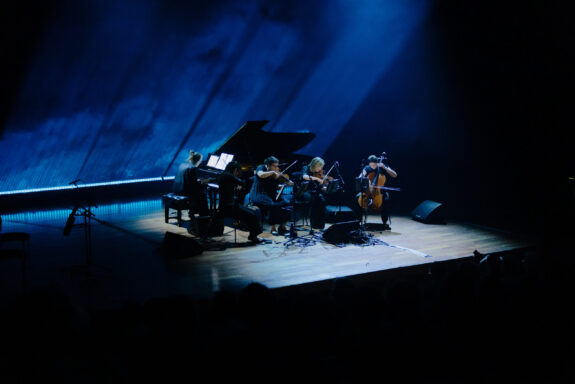
 United Kingdom Manchester Collective – Patterns in Repeat: Queen Elizabeth Hall, London, 28.6.2026. (CC)
Meredith Monk – Stringsongs: IV. ‘Phantom Strings’ (2004); Backlight (2015)
Clarice Assad – Sonic Landscapes: I. ‘Continuum’ (2002)
Cassie Kinoshi – ARTEFACT/AUTOMATON (2026, world premiere)
Cassandra Miller – Perfect Offering (2021)
Loops, patterns, Minimalism, post-Minimalism: Manchester Collective’s bread and butter, one might say, expertly performed at Southbank Centre’s Queen Elizabeth Hall. The presentation of the concert aligned with their ideas, too, although it can appear confusing to the uninitiated: we are given a one-sheet ‘setlist’ and the statement ‘We like to keep things flexible. The setlist order may change from show to show’
And it did: a QR code on the sheet allowed for the order we heard, but the announcers only arrived on the stage after the second piece (the Assad, not the Miller as surely many thought it was …).
The first time I encountered Manchester Collective, it was in their show 10 Demons, which included music by Xenakis and Jonathan Harvey (Stoller Hall, March 2018). In time their music choices seem to have softened. Their approach to performance and performance space has always been fluid where possible, and while the traditional stage/audience divide is present and correct at QEH, lighting aims to intimise the experience while projections and spatial elements broaden the remit.
Meredith Monk’s Stringsongs was premiered by Kronos Quartet at the Barbican Hall in January 2005 and was Monk’s first work for string quartet. Here, Haim Choi and Lily Whitehurst (violins) Ruth Gibson (viola), and Peggy Nolan (cello) comprised the quartet. Few if any groups play this music better than Manchester Collective: its restless shiftings seemed to speak to the quartet’s sound.
Clarice Assad’s ‘Continuum’ (from Sonic Landscapes) adds a piano (here Katherine Tinker) to the mix. I was previously impressed by Assad’s trumpet concerto, Bohemian Queen (on Çedille, a piece linked to the Occultist painter Leonora Carrington) and her The Book of Spells (Merian Ensemble, Navona Records). The sextuplets of the opening on second violin and viola at the opening of ‘Continuum’ are linked in the e-programme notes to Schubert’s Erlkönig in their urgency (the correspondence makes sense). Assad plays with cross-rhythms, and the result is undeniably feisty. The music does calm somewhat (or ‘chills,’ as Hugh Morris’s note puts it): a warm melody appears on piano.
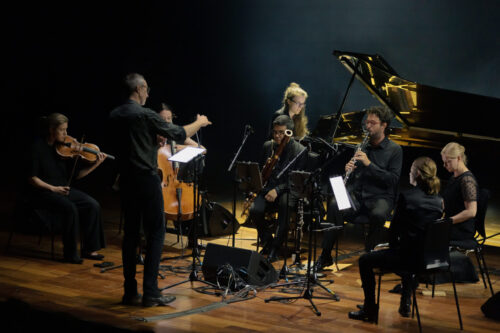
Finally for the first half, Meredith Monk’s Backlight, a piece that plays with light in a ‘sonic translation’. Scored for flute, oboe, clarinet, bassoon, piano, viola and cello and written for New York-based group AC/W Ensemble, here conducted by Aaron Holloway-Nahum. Bitonality informs the opening movement (no title, no tempo indication), presented via gentle oscillations. The music inhabits dark more than light, with melody emerging regularly, here ever-eloquently. Viola player Ruth Gibson was especially impressive in her expressivity, the lines eminently vocal in inspiration (as so often with Monk). Built on a slowly descending progression, the second panel swings slowly in a decidedly unsettled manner while the final movement allows for an uptick in activity, piano riffs invoking jazz, perhaps.
It was Cassie Kinoshi’s ARTEFACT/AUTOMOTON, scored for piano, string quartet, and electronics, which launched the second half. It is preceded by a quote from Sartre, his preface to Franz Fanon’s The Wretched of the Earth of 1961: ‘The only way the European could make himself man was by fabricating slaves and monsters.’
The programme note points out ‘blacks have clearly functioned as both. But so have machines, particularly when anthropomorphised’ (as in AI, one might suggest). Parallels of both race and machines in terms of ambivalence and anxiety, and here the e-notes quote Louis Chude-Sokei’s The Sound of Culture: Diaspora and Black Technopoetics (2015). Kinoshi’s soundworld is unique: a Behringer 2600 synthesiser and the Arturia plugin emulation ARP 2600 V plus amplified strings and piano. One of the inspirations is the extraordinary musician Sun Ra and his combination of electronics and live, experimental performance (within a science fiction aesthetic). Kinoshi improvised on the Behringer, inspired by the sadly recently deceased Dexter Wansel, who passed away May 31, 2026) and his exploration of Black ‘otherness’; another influence is African-American Queer writer Samuel R. Delaney’s experimental writings (b.1942). Kinoshi sees the piece as a link between Black music culture and science fiction.
Improvisation is important, too, and here the influence cited is Herbie Hancock’s Sextant, a union of modular synthesisers with improv. Certainly, Kinoshi’s sonic imagination is vast and impressive, and she marshals her selected sounds well, contrasting the electronica with the more traditional sound of acoustic instruments well. Distortion is a definite part of her vocabulary, while her use of overlapping ostinato is in keeping with the concert’s overall idea of loop exploration. Lighting was a distinct part of this rather immersive experience.
Finally, Cassandra Miller’s Perfect Offering. Parts of Miller’s Warblework appeared on Solem Quartet’s Orchid disc The Four Quartets, while her The City, Full of People won Best Choral Composition at the 2024 Ivors. Here, the inspiration was Leonard Cohen, encountered during a period of convalescence for the composer: ‘Ring the bells that still can ring, forget your perfect offering’ (from Anthem). Miller took the sound of the bells of a French convent and translated it into her own vernacular.
Individual on-stage groupings (violin and viola in the middle in front of the central piano, pairings to the right and left) enhance the idea of timbre moving across space. The piece is very slow-moving, the performance highly impressive, the music seeming to just breathe above an underlying silence. The control of the players was phenomenal, in particular the superhuman quietness of clarinettist Sergio Castelló López. The piece, again, is core Manchester Collective repertoire of today: boundary-pushing, but in a gentle sort of way. Maybe I need more grit from them, though.
Colin Clarke
Featured Image: Manchester Collective’s Patterns in Repeat at the QEH © Mike Skelton