 United States Various, Naumburg Orchestral Concerts: Tessa Lark (violin), Christina Courtin (violin and vocals), Jamie Bernstein (narrator), The Knights (artistic directors: Colin and Eric Jacobsen). Naumburg Bandshell, Central Park, New York, 23.6.2026. (DS)
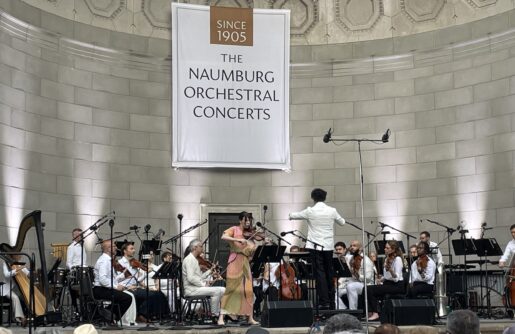
For one hundred summers, the Naumburg Orchestral Concerts have been offering some of the best outdoor music in New York City. They are easy to access in the heart of Central Park; the audience is overflowing (and provided with an uncommonly plentiful number of chairs) and the musicians are afforded excellent acoustic conditions in the neo-classically designed limestone Naumburg Bandshell – which was saved from near-demolition in 1993.
The series has become home to many internationally renowned groups who, like The Knights, often have a New York City origin story. This intrepid ensemble features a roster of players and composers whose fresh perspectives have made their mark in American music over the past 20 years. Their recent performance was an all-American program ranging from the instantly recognizable opening B-flat chord of Samuel Barber’s Adagio for Strings to a stirring encore and timely orchestral rendition of ‘I’ll Fly Away’, a gospel hymn arranged and sung by one of their own violinists, Christina Courtin. Along the way. contemporary fare was served with unabashed skill.
Courtin’s rhapsody on being giant proof set the evening’s tone. A dense musical tapestry evoking the daring experiences of everyday journeys, Courtin sings out ‘The morning belonged to me’ which depicts a mother with a few moments to herself in the space of dreams. Courtin plays jaunty chordal passages on the violin while her vocal style is marked by a choppy, abrupt approach that curtly pops within a blend of folk-like styles infused with her abstract phrasing methods. The Knights captured the emotionally searing, tight combination of brass and strings, staying in lock step with Courtin’s frenetic style. In one ascending moment, the violin section bursts into a woody symphonic boom (using col legno technique) in balance with the shapely brass melodic passages that accompany Courtin.
The featured guest of the evening was Tessa Lark, a virtuoso violinist and fiddling master who joined to perform the New York premiere of Lisa Bielawa’s Violin Concert No.2: Pulse. I had the opportunity to chat with Bielawa beforehand about the new work which she composed around the US election in 2024. She followed the news in the mornings and then wrote music about America. Nothing if not inventive, Bielawa also proves to be sincere in terms of her own musical soundworld and her approach to using material not native to her experience. She explained that replicating stylistic sounds is not her modus operandi. Rather, she extrapolates from the abstract foundations of the music or pieces together actual bits, a few pitches, rhythms in mosaic-like forms. As she explained, this keeps it ‘ethical when messing around with traditional materials’.
But it also honors voices. Bielawa respects the space and the player of original music. Pulse was written specifically for Lark and, in this performance, I perceived a deliberate communication between composed material and the performer’s sovereignty. The opening of the first movement rides on rhythmic material in the orchestra, a solitary harp, then is energetically torn open by a virtuosic, Brahms-like passage that Lark harnessed expressively. Titled ‘Tin Pan Alley’, the first movement continues with material that creates a mostly animated soundscape from splicings of Tin Pan Alley pitches, rhythms and motifs with space for Lark to improvise her own material based on chordal progressions provided in the score. An intriguing, almost-combative relationship begins to develop between the virtuosic classical and folk material. No single mood remains settled for long – variety is the common thread of this movement. What might at first sound familiar gallops ahead at an unfamiliar pace, leaving the listener to choose what to grasp and what to let go in their own listening interpretation. And that is just fine with Bielawa who stated: ‘I’m interested in giving audiences a musical experience that allows them to think about how they feel in relation to traditional music’.
Bielawa explained that she composed the concerto being ‘curious about America…I was trying to get a pulse on America, my feelings aside’. The second movement, ‘The Shapes’, uses the hymn ‘What Wondrous Love’ from her childhood singing in church choirs set against various versions of the hymn pulled from Appalachian shape-note singing communities (which Bielawa has visited). In this tradition, instead of round-headed notes on the staff, shapes are used for singers without formal musical training. The produced sound is not of perfect contrapuntal harmony but a continuous line of slipping tones that do not shy away from the microtonal. The movement kept a literal pulse – sometimes in the strings and at one moment the harp knocking in its wooden frame – while a Copeland-esque orchestral sound builds into never-quite-there climactic material. Lark’s elegant interpretation of this inventive marriage of hymnal textures flowed with ease and the orchestra performed with sensitivity.
Then Lark changed her body language. Her hip jutted out. Her scroll dipped. A foot started tapping. For the third movement, ‘Old Time’, Lark the fiddler emerged like a goddess revealed in an earthly form. Spectacular in her virtuosic style, the lilting clarity of her fiddling mode rounded out the concerto with a festive, communal feeling as she incorporated Appalachian tunes such as ‘Dry and Dusty’. The orchestra was not set up to accompany or even follow the soloist – rather, it created a sonic circle around Lark with steely material, wind solos popping out like fireworks and a massive lurking atonality churning about her. The ominous orchestral shadow left the fiddler untouched, a voice not silenced in tumultuous times. For this movement, Lark had quickly run behind the violin section to switch out instruments to a violin tuned to the needs of the folk material. Bielawa, abstracting rather than imitating, did not write an Appalachian-style line of her own but rather used the tuning structure to create a swashbuckling cadential ending for Lark to whip off in a perfect blend of classical-cum-fiddle work.
After a short interlude, Barber’s Adagio for Strings was a nod to the familiar in an evening of contemporary sounds. It was especially noteworthy in the hands of conductor Eric Jacobsen who gave the work an intimate chamber quality more in line with the work’s original place in Barber’s String Quartet Op.11 (and compared to the maudlin interpretations orchestras often peddle to audiences).
Caroline Shaw’s The Mountain that Loved a Bird followed. Whether one is a fan of Peter and the Wolf or not, Shaw’s work pairs with it as a refreshing, 21st-century version of youth-accessible music but with a sound sublime enough to tantalize adult ears. It is based on a story by Alice McLerran about endurance, empathy and friendship, masked as an origin story about how mountains got their grassy fields and flowery meadows; it was read with storytelling fervor by Jamie Bernstein, Leonard Bernstein’s daughter. Instruments and textures did not meddle with the text but clarified the glory of the simple story with Shaw’s intuitive touch – and as it came to a happy close, an ostinato representing joy was clean and propelling.
The outdoor evening closed below a misty moon with Jacobsen leading The Knights in a Brandenburg-tinged arrangement of Paul Simon’s ‘American Tune’ with Courtin on vocals. Jacobsen explained that Simon’s song about American origins and the need to work (or to fight) another day took chordal inspiration from Bach’s St. Matthew’s Passion. Tying together the folk and the classical once again brought the evening full circle and suggested an even playing field in the spectrum of American musical sound – a place where individuals are not overpowered and space exists for a diversity of musical forms.
Daniele Sahr
Christina Courtin – rhapsody on being giant proof
Lisa Bielawa – Violin Concerto No. 2: Pulse
Samuel Barber – Adagio for Strings
Caroline Shaw – The Mountain that Loved a Bird
Paul Simon (arr. Colin Jacobsen) – ‘American Tune’
Encore: Albert E. Brumley (arr. Christina Courtin) – ‘I’ll Fly Away’