 United Kingdom Grange Park Opera 2026 [2] – Wagner, Das Rheingold: Soloists, Orchestra of English National Opera / Harry Sever (conductor) Grange Park Opera, West Horsley, 26.6.2026. (JR)
Grange Park Opera started in 1998 at the Grange in rural Hampshire, north of Winchester, and staged its opera there for 17 years before moving nearer to London, to West Horsley Place (then the home of Bamber Gascoigne) in 2016. There they built the ‘Theatre in the Woods’, a five-tier opera house (sadly without air-conditioning). What was a daunting transition ten years ago, has now certainly dawned into the beginning of a golden era. Their upwards trajectory is now manifested by the bold launch of a five-year Ring cycle, exactly 150 years since it was first heard at Bayreuth. In 2030 they will perform it in its entirety. Pencil that in your diaries.
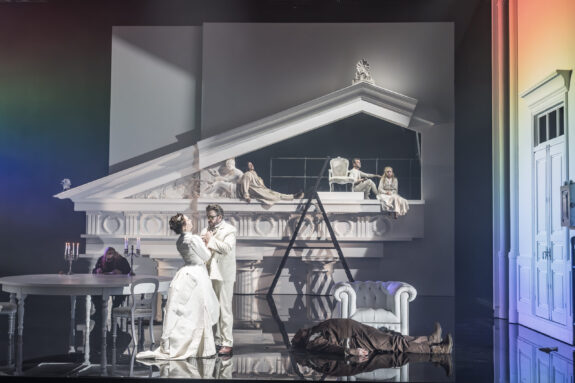
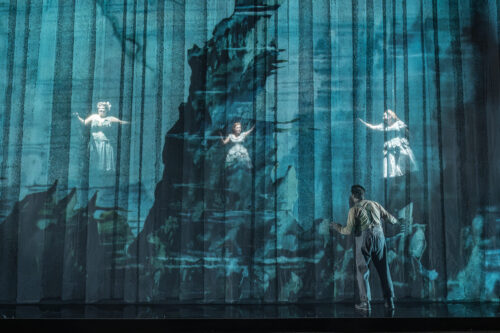
Charlie Edwards’s often witty and sparky production (with late-Victorian costumes by Gabrielle Dalton) impressed and had plenty to interest, but also to distract. The waters and rocks (the Lorelei?) of the Rhine were projected onto a screen, with the Rhinemaidens appearing on stepladders. They emerged in front of the screen to entertain Alberich, not without adult humour. The Rhinegold itself was a luminous (electric?) cable extracted from a golden orb. The ‘wonniger Höh’ (joyful heights) where the Gods live, before Valhalla is completed, is placed into a white Victorian mansion, with a view onto Valhalla in the shape of a Greek temple. The giants are depicted as carpenters and electricians, Fafner tinkers distractingly with the fuse box just a mite too often.
Nibelheim had the most scenic interest. Mime was caged until released by Wotan and Loge; Nibelheim itself was represented as a dark control room in a power station, showing the electric current in Nibelheim, Riesenheim and ultimately ‘Die Götter’. There were no armies of screeching Nibelungs in this production, so Mime did the heavy lifting on his own. The dragon and the toad were depicted in 2D on the screen, neither frightening nor amusing, but it worked; less impressive though was shining a blinding spotlight on the entire audience – were we the terrified Nibelungs? The anvils – played by three offstage percussionists – were loud, as it should be. The final rainbow was cleverly produced with the aid of lighting; here the modesty of the budget became noticeable. There was a splendid coup de théâtre – Erda appeared at the side of the Stalls and proceeds to deliver her aria (‘Weiche, Wotan, weiche’) whilst moving across the Stalls, turning to the stage and to the back of the Stalls. I had spotted the singer before the opera started, moving around in front of the audience, mingling with them and muttering indistinctly. Incidentally, Grange Park Opera copies the Bayreuth tradition of having a small number of brass players play a theme from the opera in front of theatre (but why don’t they use what looks like an upper balcony?) instead of warning bells.
On to the singers. There are some fairly big names in the cast. James Rutherford is a seasoned Wagner singer with a rich and voluminous bass-baritone; he won the Seattle Opera International Wagner Competition in 2006 and since then there are not many Wagner leading roles he has not sung, all over the world, in top opera houses. It was good to see and hear him on the outskirts of Leatherhead. Christine Rice is another highly regarded singer, and she excelled as Fricka, imperious and forthright. Rachel Nicholls, as Freia, does not have that much to sing and made little impression (except that her dress made her look dubiously young); I see she is down to sing Brünnhilde in the rest of the Ring, so we shall have to wait and see. Donner and Froh were both wonderful – Thomas Isherwood and James Schouten firm and secure of voice. Schouten had impressed me greatly at Regents Opera in Salome.
David Stout as Alberich started uneasily, I thought his scene with the Rhinemaidens was below par with his diction particualrly indistinct. He grew in stature as the evening progressed, and indeed his diction became clearer and, if still not idiomatic, his curse was properly chilling. I was, however, most surprised that he garnered the top (last) spot at the curtain call; that should surely go to Wotan who is on the stage most of the time. Adrian Thompson as Mime was a firmer tenor than many a Mime, acting skills first-rate, the top of his range not always spot on. He was gleeful when his brother got tied up.
I always think in Rheingold that the wrong giant gets killed. Get rid of the one who doesn’t sing so beautifully. To be fair, it is Fasolt who gets all the best tunes, not the ‘devil’ Fafner. Fasolt was sung by international star bass-baritone Matthew Rose who was just simply glorious. He looked cuddly too in his brown suit, and I wasn’t surprised that Freia appeared greatly taken by him, willing perhaps to forget those golden apples after all? Rose also sings Philip II in Grange Park’s Don Carlo, quite a feat. David Shipley as Fafner sounded croaky throughout: hay fever or a cold perhaps – what one heard of his black bass was fine though.
Loge often steals the show in Rheingold for his acting; here too, in splendid costume and coiffure, Mark Le Brocq sang well, whilst scribbling notes on the proceedings in his little red book. Erda, who made an impression both before the opera started and during it (as explained above) was clear of diction; I must admit I prefer a warmer, richer voice than Sara Fulgoni commands for this role. She is supposed to be the Goddess of Eternal Wisdom and the voice needs maturity and gravitas.
Three Rhinemaidens, three quite different voices: the best of them was Irish soprano Ailish Tynan as Woglinde; she was Cardiff Singer of the World (Recital Song Prize) back in 2003. Her star has risen since then and she is in demand internationally. Her sparkling soprano shone through the murk of the Rhine. Olivia Rose Tringham (Wellgunde) sang well, even though she was overshadowed by Tynan. British mezzo-soprano Charlotte Bateman (Flosshilde) is still young and possibly a star of the future though not quite yet: she was completely underpowered next to Tynan and Tringham.
It was heart-warming to hear the orchestra of English National Opera down South, and they were in top form. The sweltering heat may have explained the very first brass raspberry but after that they excelled and thrilled throughout. Much of the credit for that must go to young conductor Harry Sever. Sever, currently Music Director of the Cambridge Philharmonic, was Conducting Fellow at the Longborough Festival Opera where he was personally tutored by the renowned British Wagnerian conductor Anthony Negus who was spotted at this performance. Sever also has an ongoing relationship with English National Opera. He will return to Grange Park for Die Walküre, and then – one imagines – the rest of the Ring. Severs could do no wrong and from the very opening bars, as the waters of the Rhine began to flow, we sensed we were in good hands; Severs had the architecture of the work, its climaxes and beauties, under his complete control, and I am sure we will be hearing much more from him in the future.
I already look forward to Walküre next summer.; Wagner lovers should not miss it. I just hope it won’t be quite as hot.
John Rhodes
Featured Image: Fricka (Christine Rice), Wotan (James Rutherford), Froh (James Schouten), Donner (Thomas Isherwood), Freia (Rachel Nicholls) and Fasolt (Matthew Rose) © Marc Brenner
Cast:
Wotan – James Rutherford
Fricka – Christine Rice
Freia – Rachel Nicholls
Donner – Thomas Isherwood
Froh – James Schouten
Alberich – David Stout
Mime – Adrian Thompson
Fasolt – Matthew Rose
Fafner – David Shipley
Loge – Mark Le Brocq
Erda – Sara Fulgoni
Woglinde – Ailish Tynan
Wellgunde – Olivia Rose Tringham
Flosshilde – Charlotte Bateman
Production:
Director & Set designer – Charlie Edwards
Costume designer – Gabrielle Dalton
Lighting designer – Tim Mitchell
Associate director – Greg Eldridge
Movement director – Lynne Hockney
Fight director – Billy Bilham
Video designer – Dan Light