 United States Various: Dancers of New York City Ballet, NYCB Orchestra / Andrew Litton (conductor). Dorothy Chandler Pavilion, Los Angeles, 27.6.2026. (JRo)
It has been more than twenty years since the famed New York City Ballet and Orchestra last appeared in Los Angeles, and a grateful audience assembled on Saturday for a sterling program: Balanchine’s Concerto Barocco and Allegro Brillante, This Bitter Earth by Christopher Wheeldon and a new ballet, Concerto for Two Pianos, by the splendid NYCB ballerina Tiler Peck.
Balanchine famously said, ‘See the music, hear the dance’, and nowhere is his philosophy more embodied than in Concerto Barocco where the principal ballerinas are cast as first and second violins. Bach’s music is the perfect vehicle for Balanchine’s neoclassical form, and the composer comes to vivid life with the balletic interpretation of the score. It feels as if Bach was alive in 1941 and collaborating with Balanchine, just as Stravinsky and Balanchine worked together for decades.
This is a ballet exclusively for the female corps along with principal ballerinas Unity Phelan (Second Violin) and Emilie Gerrity (First Violin). Owen Flacke danced the only male role. Dressed in skirted rehearsal leotards, the women inhabited the music, not in a rhythmic beat-by-beat sense but expansively in a cascade of steps – steps that referred to ballet vocabulary and to classical choreographers such as Petipa and Ivanov. Upon their entrance, Gerrity and Phelan immediately created the aura of a conversation happening between them and the violins. There was an infectious sprightliness to their dancing, in large part due to Balanchine’s choreography. Balanchine, after coming to New York from the Soviet Union and Europe, was enamored with the athleticism and high spirits of American women, which he certainly put to use in Concerto Barocco.
Under conductor Andrew Litton, the NYCB Orchestra and violin soloists Kurt Nikkanen and Dennis Kim excelled at the Bach. The orchestra had a demanding program, shifting gears from Bach to Tchaikovsky to the jazzy Poulenc. All were handled to great effect, creating an enveloping sound in dialogue with the dancers. The piano performances of Hanna HyunJung Kim and Stephen Gosling contributed in no small way to the musical and dance dynamics of both the Tchaikovsky and the Poulenc.
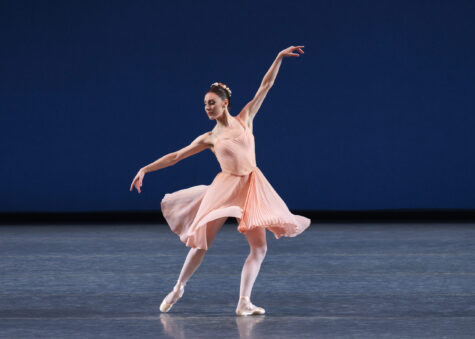
‘Everything I know about classical ballet in thirteen minutes’ – so said Balanchine about his 1956 Allegro Brillante, and it is thirteen minutes of beauty and excitement. Four couples are in motion when the curtain rises, and they dance with the delight of children released from school. The principal pair, Tiler Peck and Ryan Tomash, entered to regal notes. She wore a suggestion of a crown in her hair, a hint (along with the music) that she was the queen of the piece and he was her cavalier.
Peck’s dancing would signal royal status even if she were wearing sweats. A breathtaking dancer, she combines musicality, rigorous technique, intelligence and charm. Peck gave us a clear picture of every classic step with both lyricism and economy. She could magically produce rubato to stretch a note with the poise of an arm. She moved at the service of the choreography, and there were no frills in her dancing. Tomash was charismatic – a strong, sensitive and musically adept dancer. The four male corps members were able to show off their cabrioles and entrechats with perfect polish, and the four ballerinas were lovely (after all, this is NYCB and one wouldn’t expect any less).
Wheeldon’s This Bitter Earth, set to music by Max Richter and Clyde Otis and sung on a recording by Dinah Washington, was a touching poem of a dance. A short pas de deux, it felt like a meditation on love and grief and was beautifully performed by Sara Mearns and Gilbert Bolden III. In brown chiffon, Mearns glided across the floor in the arms of Bolden as if moving on thin ice. The strings and Washington’s distinctive sound were at one with the choreography, setting the mournful tone; and yet, despite the somber theme, there was acceptance of the inevitability of the path we all share.
Tiler Peck’s Concerto for Two Pianos, set to Poulenc’s effervescent score, was a delight – a frolicsome ballet in the neo-classical style of Balanchine. Using classical ballet’s vocabulary punctuated by jazzy touches compatible with Poulenc’s 1932 work, she accomplished the dizzying feat of choreographing her nineteen dancers (five principals and seven couples) to the shifts of mood and tempo in the complex music.
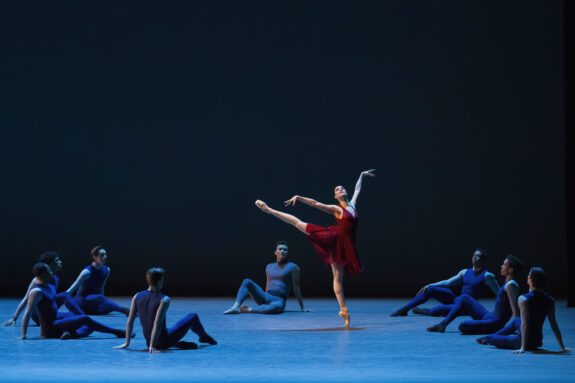
Mira Nadon and Ryan Tomash were the central pair: she in ruby-red silk, he in cool grey. While the choreography for the corps de ballet was buoyant, Nadon and Tomash performed to the more melodic and romantic sections of the score. Their partnership was a mix of simplicity and sophistication, he tenderly supporting her steps then suddenly launching her into daring lifts. In one moody section, while Tomash holds Nadon for a moment in arabesque penché, three dancers performed in silhouette at the rear of the stage. Lighting by Brandon Stirling Baker reflected the shifts in music and atmosphere and was perfectly at one with the dance.
India Bradley and Emma Von Enck formed a second partnership, and Roman Mejia was featured as the Puck of the piece: bravura leaps and pirouettes came easy to him. The choreography for Mejia was at once classically serious and humorously jazzy – an extended arm suddenly turning into a bicep curl. He reveled in the music and the steps, creating a stir with his virtuosic dancing. As for the corps, they were no mere backdrop for the principals; rather, they were in constant motion. Each couple could have been spotlighted, so convincing were their partnerships. There were quirky moments for them as well: finger snaps, a hint of flamenco or men tiptoeing on the stage with rounded backs.
What Peck’s ballet has in common with Balanchine is dance at the service of music. As Balanchine wrote, ‘…if the dance designer sees in the development of classical dancing a counterpart in the development of music and has studied them both, he will derive continual inspiration from great scores’. Peck has done just that with her Concerto for Two Pianos.
Time has proved Balanchine’s art is eternal, and we shall see what time proves for Peck. But from this one ballet, it seems like she has learned his lesson well.
Jane Rosenberg
Featured Image: Mira Nadon and New York City Ballet in Tiler Peck’s Concerto for Two Pianos © Erin Baiano
Concerto Barocco
Principal dancers – Unity Phelan, Emilie Gerrity, Owen Flacke
Choreography – George Balanchine
Music – JS Bach, Concerto in D minor for Two Violins
First violin – Kurt Nikkanen
Second Violin – Dennis Kim
Lighting – Mark Stanley
Allegro Brillante
Principal dancers – Tiler Peck, Ryan Tomash
Choreography – George Balanchine
Music – Tchaikovsky, Piano Concerto No.3
Solo Piano – Hanna HyunJung Kim
Lighting – Mark Stanley
Costumes – Karinska
This Bitter Earth
Dancers – Sara Mearns, Gilbert Bolden III
Choreography – Christopher Wheeldon
Music – Max Richter, Clyde Otis and Dinah Washington from Shutter Island soundtrack
Lighting – Mary Louise Geiger
Costumes – Reid Bartelme
Concerto for Two Pianos
Principal dancers – Mira Nadon, Ryan Tomash, Roman Mejia, India Bradley, Emma Von Enck
Choreography – Tiler Peck
Music – Poulenc, Concerto for Two Pianos
Solo Pianos – Hanna HyunJung Kim, Stephen Gosling
Lighting – Brandon Stirling Baker
Costumes – Zac Posen