
 United Kingdom Berlioz: Timothy Rideout (viola), Scottish Chamber Orchestra / Maxim Emelyanychev (conductor). City Halls, Glasgow, 25.9.2026. (GT)
Berlioz – Harold in Italy, Op.16; Symphonie fantastique, Op.14
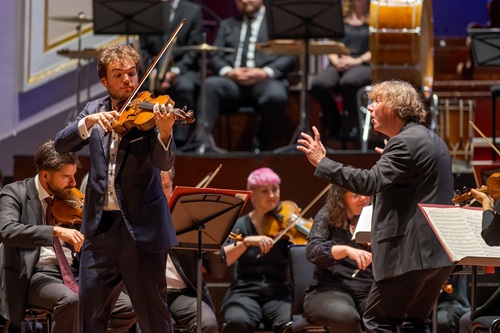
On its opening concert of the season, the Scottish Chamber Orchestra offered a programme exclusively of Hector Berlioz’s most eventful symphonic works. There was a degree of theatre at the beginning because the soloist was nowhere to be seen; but after the orchestral introduction to Harold in Italy, Timothy Rideout ambled through the auditorium and casually stepped on stage to take his place behind the first violins, calmly awaiting his moment. The element of theatre suggested that we were being offered, in the figure of the violist, a vision of Hector Berlioz, as if the composer was wandering among us in the hall, hearing his music from almost 200 years ago.
The opening, with the expansive, unhurried tempo on the strings in ‘Scenes of sadness, of happiness and joy’, suggested little hope for the protagonist, yet an upturn came from the brass, and at last Rideout on viola announced the leitmotif of Harold, eloquently accompanied by the harp of Eleanor Hudson. The woodwind offered transport to what could be a better life, with spirited chords building to the dialogue between viola and orchestra. The idea on the bassoon of Cerys Ambrose-Evans was picked up by the viola, leading to a fugato passage quoting Harold’s theme. The second movement, the ‘March of the Pilgrims singing their Evening Prayer’, opened on the harp, before the horns introduced a tentative idea, picked up by the strings. This passage heralded a noble yet reticent idea on the woodwind, heard against the repeated horn idea from Boštjan Lipovšek and beautifully intensified by the viola.
The ‘Serenade of a mountaineer of the Abruzzi to his Mistress’ opened with a folk song on the chirping piccolo of Marta Gomez and the oboe of Clara Schweinberger, added to delightfully by the cor anglais of Katherine Bryer. The clarinets and bassoons invoked the drone of bagpipes against pizzicato strings as the viola reprised his theme before the ‘Orgy of the Bandits’ and reprised the darkness of the opening. The viola tried to introduce radiance by reprising his leitmotif, and as if discouraged, the soloist departed from the stage; as the orchestra played an excitingly colourful passage invoking the intoxication of the brigands. Yet again, there was a moment of theatre as three string players took their exit from the proceedings; now Rideout appeared high above the orchestra and attempted to repeat the leitmotif, but Harold’s tune faded away, and in the final piece of theatre, the three string musicians returned to the orchestra, bringing this remarkable symphony to a glorious finale. This musical experiment in dramatic presentation was somewhat compelling in recreating Berlioz’s adventures in Italy.
There was little theatricality in the evening’s second symphonic work, the Symphonie fantastique, subtitled ‘Episode in the life of an artist’. The opening movement, ‘Reveries. Passions’, opened quietly in a largo passage leading to the allegro announcing the composer’s beloved on the flute of André Cebrián, accompanied by the strings quoting the motif before the whole ensemble joined in the passionate excitement. The leitmotif slowly disappeared as the traces of the waltz were heard on the flute of Cebrián and the oboe of Schweinberger in the second movement ‘A Ball’. Another focal point was the clarinets’ pianissimo before the third movement, ‘In the country’, with the eloquent cor anglais of Bryer in dialogue with the oboe of Schweinberger against the dulcet-toned strings. Emelyanychev now instilled great drama in the ‘March to the Scaffold’ as the percussion announced the death sentence, generating tremendous momentum: noticeably, Louise Lewis Goodwin and Laura Bradford on the timpani seemed to enjoy the moments of execution. As the tension rose, the clarinet of Maximiliano Martin piercingly reprised the leitmotif, followed by the orchestral fortissimo, and pizzicato from the lower strings and the percussion. The finale of ‘The Witches’ Sabbath’ was terrifyingly enacted by the percussion before the off-stage bells gave a parody of the Dies Irae, followed by a chorale of the tubas and bassoons, and again the bells tolled before the two main themes were united by a fugue, leading to the fortissimo climax.
Certainly, if there was little theatre in this second part of the evening, Emelyanychev conducted with energy and constantly gyrated as if alive with the music and bringing it alive before us too. He is always a joy to watch with his hands and shoulders directing as if music is in motion. Everyone is happy that the Russian conductor will be with us until 2031 after agreeing a new contract. This was a tremendous opening to the season, and this memorable concert was recorded for future broadcast on BBC Sounds.
Gregor Tassie