 United States Musgrave, Mary, Queen of Scots: Soloists, Chorus and Orchestra of San Francisco Opera / Clelia Cafiero (conductor). War Memorial Opera House, San Francisco, 26.9.2026. (HS)
In 1977, San Francisco Opera was one of the first to present Mary, Queen of Scots, composer Thea Musgrave’s take on the 16th-century queen’s ill-fated return to Scotland from France. The opera had its world premiere only two years prior in Edinburgh and was presented in San Francisco by Spring Opera, the company’s then-affiliate, a home for more experimental works.
Absent from the company’s offerings since, a new production (premiered last year by English National Opera as co-producer) proved to be something formidable in the second of five performances (the first was canceled due to the orchestra’s strike). As in London, it benefited greatly from the depth and transparency of soprano Heidi Stober as Mary and conductor Clelia Cafiero’s sure-handed and vital work with San Francisco’s sharply focused orchestra.
The Edinburgh-born Musgrave, who conducted the 1977 performances in San Francisco, wrote both the score and the libretto which explains the seamless connections between the words and the music. And, as my wife and other women tell me, the piece benefits from an especially insightful approach to the title character who, at her return to Scotland, was not yet 20 years old and already widowed by the untimely death of the French dauphin she had married.
Unlike Donizetti’s Maria Stuarda, which focuses on Mary’s later imprisonment in Queen Elizabeth I’s England after her abdication and escape from Scotland, Musgrave’s opera begins and ends in Scotland. The story may embroider the details of history, but it creates the political and religious thornbush Mary encounters on her return to Scotland in 1561 and her relationships with the men around her. There is James, her half-brother, who turned Protestant while the still-Catholic Mary was away and emerges as a rival. There are suitors – the handsome and vain Lord Darnley, who weds her and sires a son, and the military commander Bothwell, who in this production rapes her and kills Darnley.
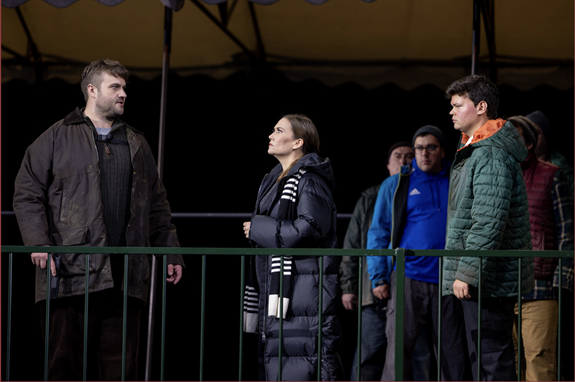
Stewart Laing’s bare-bones staging, centered on a large tent that is still under construction in Acts I and II and a metal fence along the front of the stage, served as the Port of Leith for her arrival and various locations in the queen’s castle for the rest. Characters wore modern dress, mostly windbreakers and puff jackets for the ordinary people and fancier clothing for the royals. In the Act I dance party, Darnley’s companion, Riccio, sang into a microphone and gestured to a nonexistent band.
As director, Laing drew expressive interactions from the characters and, thankfully, none of the visuals got in the way of the music. Musgrave’s sound palette combines lyrical singing with an orchestral score that conveys the emotions underlying every moment. In her San Francisco debut, Cafiero, an in-demand conductor on three continents, brought out all the punch in tough dissonant segments and segued seamlessly into romantic moments, faux-Renaissance dances and sweet lullabies, all the while keeping the pace flowing with energy.
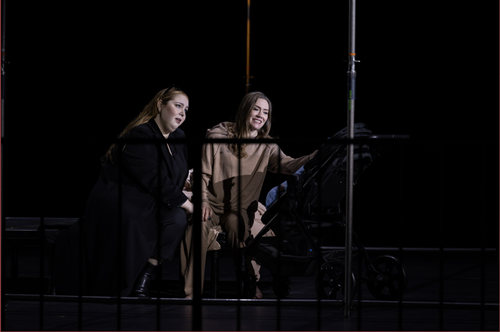
Stober, whose more than a dozen previous appearances with San Francisco Opera have included Norina in Don Pasquale, Susanna in Le nozze di Figaro and Johanna in Sweeney Todd, revealed broader capabilities as Mary. She managed to flirt girlishly with Darnley, quarrel with James and manipulate Bothwell, all the while maintaining a regal mien. ‘The Three Stars of my Firmament’ in Act I pegged her impressions of the three men with a surprising lilt and, when things were not working out in Act II, she portrayed all the nobility anyone could want in the aria ‘Alone, Alone, I stand Alone’. In contrast, ‘Mary’s Lullaby’, a duet with one of her ladies-in-waiting, set the scene with deceptive sweetness for the climactic Act III.
The singers portraying the three men competing for Mary all created specific and distinct characters. Thomas Mole as James had a polished sound and insinuating manner, and Christopher Sokolowski as Darnley came off as dashing, with a sleek lyric tenor and movie-star attitude. Thomas Kinch, a dramatic tenor, used his height and imposing stature to look properly menacing as Bothwell.
As Riccio, Hadleigh Adams made a debonair impression in the dance party scene and sang with a sweet lyric baritone. Philip Skinner, a longtime company stalwart, brought stature and steadiness with his bass-baritone to Lord Gordon, who finally convinces Mary that she must flee to England. All four of the ladies-in-waiting shone in their scenes with Mary, especially Sadie Cheslak who sang the lullaby duet.
And, as usual, the chorus provided a hefty sound to enhance their crowd scenes. But what drove this performance to its triumph were the women in the title role and the electricity in the orchestra pit.
Harvey Steiman
Featured Image: Mary (Heidi Stober) is caught between Bothwell (Thomas Kinch) and James (Thomas Mole) © Matthew Washburn/SFO
Creatives:
Director and Production designer – Stewart Laing
Lighting – D.M. Wood, Mimi Jordan Sherin
Choreographer – Colm Seery
Fight director – Dave Maier
Intimacy director – Maya Herbsman
Chorus director – John Keene
Cast:
Mary, Queen of Scots – Heidi Stober
James Stewart – Thomas Mole
Earl of Bothwell – Thomas Kinch
Lord Darnley – Christopher Sokolowski
Riccio – Hadleigh Adams
Cardinal Beaton – David Soar
Lord Gordon – Philip Skinner
Ladies-in-waiting – Sadie Cheslak, Sofia Gotch, Mary Hoskins, Alexa Frankian