
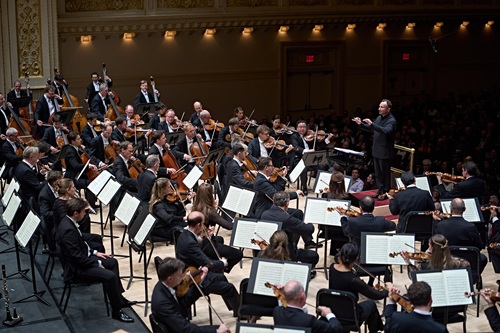
 United States Elgar, Tchaikovsky: Berliner Philharmoniker / Kirill Petrenko (conductor). Carnegie Hall, New York, 9.10.2026. (ES-S)
Elgar – Enigma Variations, Op.36
Tchaikovsky – Symphony No.4 in F minor, Op.36
After opening Carnegie Hall’s season with Italian music and exploring German Romanticism on the following evening, Kirill Petrenko and the Berlin Philharmonic turned to two contrasting late-Romantic masterpieces. In his Enigma Variations, Elgar portrays friends and loved ones while revealing something of himself; in his Fourth Symphony, Tchaikovsky confronts fate in a deeply personal drama of despair, longing and fleeting consolation. Yet the two works, coincidentally both bearing the opus number 36, revealed unexpected affinities under Petrenko’s baton.
From the opening theme of Elgar’s Enigma Variations, Petrenko’s nuanced phrasing and the Berlin Philharmonic’s warmly colored strings lent the music a Russian melancholy that seemed to anticipate the emotional world of Tchaikovsky’s Fourth Symphony. In both works, Petrenko combined sensitivity to shifting moods with a strong sense of musical architecture. The variations emerged less as isolated character sketches than as parts of a larger musical narrative. The musical world Petrenko and the Berliners created ranged from the boisterous tuttis of ‘W.M.B.’ (IV) to the gentle teasing of ‘Dorabella’ (X), and from the hurried chatter of ‘H.D.S-P.’ (II) to the barking bulldog evoked by the brass in ‘G.R.S.’ (XI).
The orchestra’s tonal richness was apparent in the interplay of dark-hued violas and cellos with the luminous upper strings and finely balanced woodwinds. In ‘R.P.A.’ (V), as later in the Andantino of Tchaikovsky’s Fourth Symphony, the seamless exchanges between instrumental sections revealed an ensemble whose virtuosity lay as much in its cohesiveness as in individual brilliance. In ‘Ysobel’ (VI), principal violist Diyang Mei gave the wistful melody an almost vocal quality. The livelier portraits were rendered with formidable rhythmic discipline, while Bruno Delepelaire’s tender cello solo in ‘B.G.N.’ (XII) offered a moment of intimate lyricism, its closing phrases fading into near silence. In the best-known variation, ‘Nimrod’ (IX), Petrenko avoided exaggerated pathos, building intensity with meticulous control as the brass entered the increasingly expansive texture without overwhelming the strings. Particularly memorable was the elusive atmosphere of ‘Romanza’ (XIII), where distant timpani rolls and delicately shaded clarinet lines evoked a sense of suspension between memory and longing. In the final ‘E.D.U.’ (XIV), the conductor unleashed the orchestra’s full power, achieving a grandeur that seemed more than a merely spectacular conclusion: the culmination of all that had come before.
After the interval, Petrenko and the Berlin Philharmonic delivered an exquisite interpretation of Tchaikovsky’s Symphony No.4, distinguished as much by expressive depth and control as by the players’ virtuosity. Free of schmaltz, the performance sacrificed none of the score’s emotional intensity. The tension never slackened, while the pacing remained measured, neither dragging nor unduly accelerated. Throughout the first movement, Petrenko shaped the music’s contrasting moods into a coherent dramatic progression, allowing moments of turbulence and quiet reflection to emerge naturally. The climaxes were imposing without becoming bombastic, their impact heightened by the restraint and subtlety of the intervening passages.
The individual instrumental contributions were no less impressive. Albrecht Mayer’s oboe sang the Andantino’s melody with tenderness and lyrical grace. Towards the end of the movement, Daniele Damiano’s bassoon brought it back with a beautifully rounded tone. In the Scherzo, the strings’ pianissimo pizzicato combined extraordinary delicacy with rhythmic precision, retaining a playful vitality even at the softest dynamics. The Finale was exhilarating in its sheer energy and brilliance. Yet Petrenko sustained its momentum without sacrificing clarity or balance, even at full orchestral force.
Alas, the Berlin Philharmonic visits Carnegie Hall only once every couple of years. Those who missed the orchestra’s New York residency – or wish to revisit its last two programs, recorded in the acoustics of its home, the Berlin Philharmonie – can find both on the Digital Concert Hall (here) along with many other performances from its archive.
Edward Sava-Segal