
 United Kingdom Spring Snow: A Kabuki Winterreise: Fleur Barron (mezzo-soprano), Suleiman Suleiman (dancer), Jong Sun Woo (piano), Hibiki Ichikawa (shamisen/shinobue), Sonoko Kamimura-Ostern (choreography), Lifeng Liao (costume and lighting designer), Misa Koide, Sophie Daneman (movement directors). Wigmore Hall, 11.10.2026. (CC)
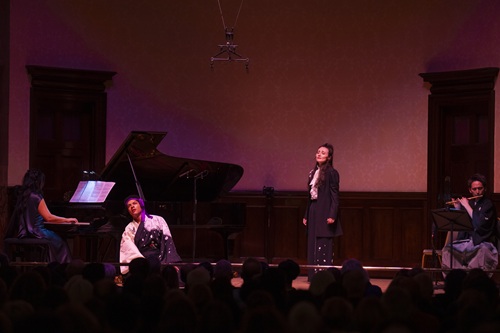
(Kabuki) Yasuna Scene 1: Preserve; Scene II: Seek; Scene III: Illusion; Butterfly Interlude
Schubert – Winterreise, D 911 (1827), excerpts.
Mezzo-soprano Fleur Barron has impressed on multiple occasions previously, both on disc (her Purcell Dido on Pentatone, or as contributor to Barber Complete Songs on Resonus), or live. This, though, took things to the next level: an inspired coupling – melding, even, as worlds bled into one another – of the Japanese art of kabuki (traditional, highly stylised Japanese theatre) and a mainstay of the Western repertoire, Schubert’s Winterreise.
The two, here, intersected, and the crossroads was at loss. A traditional Japanese costume, grandly displayed in the Wigmore Hall foyer prior to the performance, became, later in the evening, the body of the beloved Sasaki (Sasaki-no-mae in full) in the kabuki story Yasuna, (first performed in 1818 at the Miyako-za by Onoe Kikugorō III as part of a larger work; today it has its own existence). Like Schubert’s protagonist, the young nobleman Yasuna wanders a landscape (for him, a Spring one) insane through grief because of Sasaki’s unexplained death.
These are, of course, two very disparate worlds (Japan was almost unknown in Schubert’s time, although there is a 1727 History of Japan by one Engelbert Kaempfer (1651-1716). But grief conjoins Yasuna and Schubert’s unnamed wanderer in different forms: death for Yasuna, abandonment for our Romantic protagonist. Both are seen as male territory, although there have been notable female-sung Winterreisen (Brigitte Fassbaender is probably the most famous relatively recent exponent, but, while the ball started rolling with excerpts via Elena Gerhardt in 1928, one of the greatest Winterreisen is surely Lotte Lehmann with Paul Ulanowsky, 1940/41). It made sense here not only because of Louise Barron’s supreme interpretation (of which more soon) but also because of the female (Schubert)/male (Yasuna) dynamic, the male/female, yin/yang balance mirrored in the performers’ attire, each performing barefoot.
Every aspect of this performance, in fact, was carefully considered. The entire Wigmore Hall was used, Barron singing ‘Der Leiermann’ from the balcony at the back at the opening, Suleiman using the aisles, through which both would eventually exit. Lighting and shade were expert (Lifeng Liao), but it was the bleeding of worlds that was so impressive.
The Schubert songs (the choice of excerpts by Barron) reflect the mood of the kabuki scenes. It was with the sound of the shamisen the evening began, a wooden, percussive thwack and lonely pluckings, Hibiki Ichikawa on one side of the stage and the piano on the other. Pentatonicism pointed the music to the Orient as Suleiman made his way up the hall through an aisle, carrying the ‘body’ of his beloved (the kimono). Thus began ‘Preserve: Yasuna clings to the memory of his beloved through the kimono she left behind’. As he strokes the kimono, which he has laid on the floor, so the shamisen echoes the movement in glissando; percussive noises speak of loneliness. The masterstroke (of many) was the shamisen, not the piano, playing the opening of ‘Der Leiermann’ (actually the last of Schubert’s cycle), and Barron’s voice, disembodied, above and behind the main body of the audience, each line a solitary cry. Only at the third stanza, ‘Keiner mag ihn hören’, did we hear the piano, but in a sort of shamisen-equivalence through a Cageian plucking of a piano string. Only at ‘Wunderlicher Alter’ did the piano’s full resonance kick in. And only at the first song of the cycle, ‘Gute Nacht’, did Barron move towards the stage, as Yasuna leaves.
Pausing to deliver lines while still en route to the stage, Barron’s sound faltered not one jot, her voice deep and resonant. Tellingly, any shifts towards the major in Schubert’s music were minimised: there was precious little light in this good night (the final stanza coincided with Barron’s arrival on the stage), The final ‘gedacht’ (thought) was greeted by a stab of pain from Barron, as the winds of shamisen provided a remarkably wintry landscape in sound – they continued through ‘Die Wetterfahne’. Worlds collide, both East and West and, in that song, Romanticism and Expressionism – this held the first hints that Barron was to take Schubert’s words and lines far into the future, closer to the 20th-century. And how it worked – that is, after all, some of Schubert’s rawest music.
Giving the opening notes of ‘Gefrorne Tränen’ on shamisen offered a way back, a harrowing song leading to the agitation of ‘Erstarrung’. Again, any hint of relief was minimised (‘Wo find’ ich eine Blüte …’). At the end, Barron seemed to look into the far distance – it was the return of Yasuna for the second Kabuki scene, ‘Seek (Yasuna searches for signs of Sakaki in the world around him)’. We hear a whispered syllable (part of his name). A high, treble line in piano encapsulates the loneliness of his plight, closed by a cluster and echoes of his name. Ichikawa doubles on shinobue here (a slender Japanese flute used in kabuki), solitary at first then joined by a humming Barron in traditional Japanese melody against pointillist piano. The effect was transfixing; wordless, and yet out of the fragmented mêlée, the piano started to form Schubertian shapes. Woo managed the transition perfectly, and by the time Barron entered, the purity of Western tonality was re-established. Sung on her knees, ‘Der Lindenbaum’ weighed heavily. All credit to Woo for establishing the change of mood in the penultimate stanza, Schubert’s gestures without doubt illustrating a storm, and allowing for the calmer return of the opening material for the final stanza.
The two protagonists crossed onstage during this stanza, as the tree of the title promises rest. Now, with Barron singing towards the audience and Yasuna directly behind her facing the wall, her obverse, she took a daringly slow tempo for ‘Wasserflut’; and how it worked (Barron placing her breaths very strategically). In between second and third stanzas, she mirrored the stroking of the beloved seen at the very beginning by Yasuna – now both did it, facing away from each other. Maybe I would like a bit more inner voice clarity on the piano in this song, but it is a minor quibble in the grand scheme of things. It is just that detail everywhere was so carefully done – including an extended sibillant on the final ‘s’ of ‘Liebsten Haus’.
‘Auf den Flusse’ was interesting, the usual onward tread somewhat skewed, almost like Schoenberg’s Pierrot had appeared. The usual warming for the memories was lessened here (‘Der tag des ersten Grüsses’) – less fondness, more blanched recall. The shamisen’s percussive strike in the final stanza was unforgettable – truly horrifying.
Hallucinations and imaginings are part of both protagonists’ stories. In the third kabuki scene, ‘Illusion’, Yasuna imagines Sakaki is still with him before the illusion breaks. Barron stood away from him, facing the closed staged door, while Suleiman entered into a ritualistic dance, percussion achieved via body parts and stamping against the shamisen’s own percussion. Perhaps Barron represented the reality of the separation – which hits Yasuna full on via emotional punches in the solar plexus, articulated, too, in the pain of Schubert’s memory (during which the two crossed paths before Yasuna exited the stage through the previously blocked door. Nightingale and lark might be in the text to ‘Rückblick’, but this was not time for Romantic tweeting (as it were) – there was, instead, an unrelenting feel, as if memories no longer worked to calm the heart, to provide reassurance. A beautiful, wistful Kabuki Butterfly Interlude (with said butterfly on the end of a wire) brought us to the final songs from the Schubert. The piano started to imitate the shamisen, leading to ‘Irrlicht’, Barron’s firm lower register a triumph. And that blocked exit now made sense: the will-o’-the-wisp leads the wanderer into a rocky chasm, and how to get out does not concern them.
In an astonishing idea, the forward movement of ‘Der Leiermann’ was transferred into Japanese vernacular on shamisen, Barron miming a clearly exhausted wanderer. At last, the chance to rest (‘Rast’), Woo heavy, another ongoing tread. When Schubert’s defeated lover finds shelter in the charcoal burner’s cramped hut, hope remains in short supply. Even the lighter piano opening of ‘Frühlingstraum’ was laden – a dream of Spring, but another overlapping. And how effective the shamisen’s percussive strummings and interjections in the protagonist’s outbursts. In a heartbreaking coup de théâtre, Yasuna walks across the stage, the kimono clearly his beloved’s dead body, just as Schubert asks ‘Leaves on my window, when will you turn green?; when will I hold my love in my arms’. Woo’s final piano arpeggiation seemed to issue from the depths of the soul.
It was the shamisen that offered the exit music, the yin and yang incarnations of grief slowly walking out of the hall, Yasuna leading, the union of Schubert and Japan complete both movementally and in the shamisen’s authentically Japanese sound with nods to Schubert. A piano gesture, high up, led to a duet: shamisen taking the singer’s line of ‘Leiermann’, the hurdy gurdy in the piano.
Jong Sun Woo was standing in for an indisposed Julius Drake and gave a fine account of the piano part. But it was Barron whose night it was. Her diction was perfect throughout, ever married to line, her resonance with Schubert complete, Suleiman Suleiman her alter ego perhaps, captivating always. An unforgettable evening.
Colin Clarke