
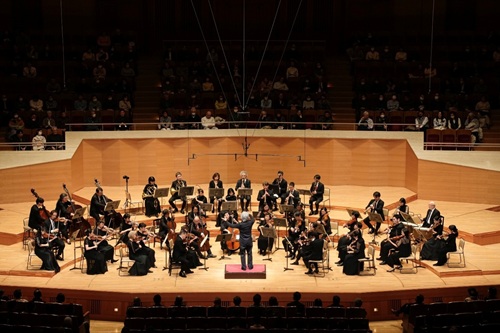
 Ireland Bach: Bach Collegium Japan / Masato Suzuki (conductor and harpsichord). National Concert Hall, Dublin, 10.10.2026. (RB)
Bach – Brandenburg Concertos, BWV 1046 – 1051
This concert from Masato Suzuki and the Bach Collegium Japan (BCJ) formed part of the National Concert Hall’s International Orchestras and Recitals series. The BCJ have a distinguished reputation of exploring Bach’s music through historically informed performances on period instruments. They have received considerable critical acclaim for their performance of Bach’s complete cantatas. It was good to see Dublin’s National Concert Hall packed out for this event.
Bach’s Brandenburg Concertos owe their name to their dedication to the Margrave of Brandenburg in 1721. They make free use of the Baroque concerto grosso form where small groups of soloists are contrasted with a larger ensemble. Each concerto employs a different combination of instruments, explores a different relationship between the soloists and ensemble, and creates its own distinctive expressive and technical world.
On this occasion, the concertos were not performed in numerical order. The concert kicked off with the Fourth Brandenburg Concerto which places a solo violin alongside two recorders. I was immediately struck by the remarkable degree of transparency which the BCJ managed to achieve. The lead violinist brought brilliance and an immaculate technical finish to the solo violin line. The two recorder players conjured delicate sonorities and contrasting colours in their imitative duet. I was impressed with the way such a small group of players were able to build layers of sound in the final fugue although some of the dazzling passagework from the lead violin was lost in the acoustic of the hall.
The BCJ moved swiftly on to the Sixth Brandenburg Concerto which dispenses with violins and uses middle and lower string instruments. The BCJ created deep mellow sonorities in the opening movement while the two violas brought an expressive eloquence to the slow movement with its exquisite suspensions. The dance-like finale was vibrant; one could not help but be swept up in the infectious propulsive energy of the movement.
The first half concluded with the second concerto which is scored for trumpet, recorder, oboe and violin with strings and continuo. The instrumental balance was excellent in the outer two movements with the solo trumpet integrating well with the other instruments while injecting brilliance into the music. There were minor intonation problems in the trumpet line although it is exceptionally difficult to play the Baroque trumpet in the higher register. In the slow movement, the solo instruments overlapped to create gorgeous, sustained lines; the playing evoked plaintive tender emotions.
The second half opened with the Fifth Brandenburg Concerto which is often seen as the forerunner of the modern piano concerto. Bach elevates the harpsichord to a star soloist role in this work, alongside the flute and violin. The solo flute and violin vied brilliantly with each other in the opening movement. Masato Suzuki performed the demanding harpsichord part, and he came to the fore in the big cadenza near the end of the movement. His digital dexterity and articulation were superb, and he played in a completely uninhibited and virtuosic way. Suzuki’s shaping of the material was excellent; he used subtle rubato to mark key transitions while maintaining the underlying pulse of the music. The tender slow movement with its sighing figurations and poignant sense of longing provided an immediate contrast. The dancing fugal finale was light and tightly coordinated and had an infectious zest and energy.
The third concerto is scored entirely for strings and unlike the others does not have a fully written out slow movement: Bach only included two chords in the original score. Suzuki included his own improvisation in place of this middle movement and it worked extremely well. I gather he took his inspiration from other Bach keyboard works, so the movement was stylistically appropriate and this practice is entirely in keeping with Baroque traditions. In the lively finale it was amazing to watch how seamlessly the rapid thematic material passed down the line of stringed instruments.
The concert concluded with the First Brandenburg Concerto which is the longest in the set and the only one with four movements. The natural horns provided a bright regal sound in the opening movement although they were not completely integrated into the musical texture and there were minor intonation issues. The ensemble created a more integrated sound in the animated third movement and they brought a bright joyful quality to the music. The series of dances which make up the final movement were well characterised bringing Bach’s immortal sequence of concertos to a dignified conclusion.
It was a pleasure to listen to such refined, stylistically appropriate and virtuosic playing.
Robert Beattie