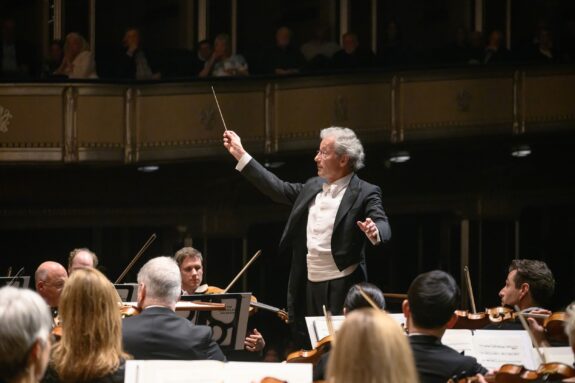
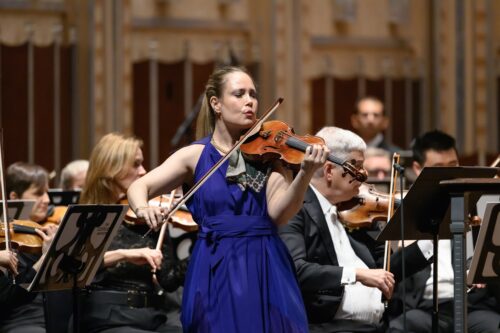
 United States Various: Leila Josefowicz (violin), Trina Struble (harp), Cleveland Orchestra / Franz Welser-Möst (conductor). Mandel Concert Hall at Severance Music Center, Cleveland, 22.5.2026. (MSJ)
Adolphus Hailstork – Epitaph for a Man Who Dreamed: ‘In Memoriam: Martin Luther King, Jr.’
Grażyna Bacewicz – Symphony No.4
Jüri Reinvere – Concerto for Violin, Harp and Orchestra
Dvořák – A Hero’s Song, Op.111
The closing orchestral concert of the Cleveland Orchestra’s Mandel Opera and Humanities Festival used four diverse pieces to illustrate the festival theme of courage. The opener was Adolphus Hailstork’s soberly concise but moving Epitaph for a Man Who Dreamed: ‘In Memoriam: Martin Luther King, Jr.’. This kind of formal, public statement is tricky, with the danger of overstatement looming constantly, but Hailstork’s composition rigorously avoids both aggrandizement and cliché and refuses to repeat itself or orate at length. It starts with understated grief but organically transforms into a sense of resolve. The reserved intensity was right up conductor Franz Welser-Möst’s alley, and the orchestra brought fierce dignity to the music without raising its voice. The depiction of courage was eloquent.
Equally fierce but far fierier was Grażyna Bacewicz’s Symphony No.4. Bacewicz, a Polish contemporary of Shostakovich, was largely forgotten after her death but is undergoing a revival of interest today. Judging by this work, the interest is well deserved for she proves to be an intense and fascinating voice. Unlike Shostakovich, who followed Mahler’s style of varying between densely and sparsely scored passages, Bacewicz is more akin to someone like Honegger (whose ‘Symphonie Liturgique’ we heard earlier this season). There were layers of activity with bursts of bright color emerging from stacked harmonies and a non-stop buzz of activity.
The passionate first movement yielded to a tragically subdued slow movement, followed by a witty and catchy Scherzo, before a slow introduction launched a fast and furious Finale. The piece was compelling from first note to last, and Welser-Möst and the orchestra tore into it with relish. Though Bacewicz was a relative conservative in Poland when she wrote this (1953), it nonetheless displays courage by taking an emotionally aggressive stance which was the sort of thing that the oppressive communist governments of Eastern Europe often frowned upon. It was doubly courageous to make such an artistic statement as a woman, just as the Cleveland Orchestra is showing courage in drawing attention to minority and female composers in their programming, in defiance of a US government that has discouraged such moves. Kudos to them for standing up for what is right and for selecting and presenting works with such quality.
The concert continued after intermission with the world premiere of an intriguing concerto for violin, harp and orchestra by Finnish composer Jüri Reinvere who was on hand for the occasion. Violinist Leila Josefowicz savored the narrative quality of the music, dramatically projecting the violin part as if she were a character moving through a fantastic landscape. Trina Struble played the glittery harp part with flair, though it was surprising that little of the concerto’s melodic material was given to the harp. One would think the instrument’s thousands of years as a bardic tool might provoke more than atmospheric texture, but perhaps Reinvere’s concept was that the violin was the singing bard with the harp accompanying. Regardless, the work was mysterious and enchanting, with the orchestra supplying the dark landscape for the music’s adventures.
The concert closed with a Dvořák rarity, his late tone poem A Hero’s Song. It was a smart bit of programming, for it had the effect of summing up the preceding mostly dark works and then releasing the atmosphere into a blazing blue sky. While not in itself top-drawer Dvořák, the piece served its function well, and Welser-Möst and the orchestra gave the rarity an effective outing, closing off what has been one of the Cleveland Orchestra’s strongest seasons in living memory.
Mark Sebastian Jordan
Featured Image: Franz Welser-Möst leads the Cleveland Orchestra in A Hero’s Song © Yevhen Gulenko/TCO