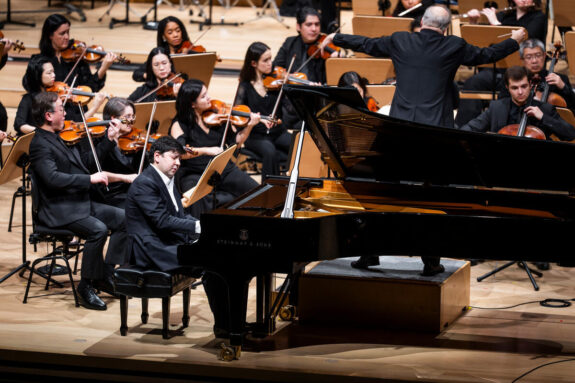
 United States Tchaikovsky, Shostakovich: Behzod Abduraimov (piano), New York Philharmonic / Gianadrea Noseda (conductor). Wu Tsai Theater, David Geffen Hall, New York, 9.1.2026. (ES-S)

Tchaikovsky – Piano Concerto No.1 in B-flat minor, Op.23
Encore: Liszt – from Grandes études de Paganini, S.141: No.3 in G-sharp minor, ‘La Campanella’
Shostakovich – Symphony No.4 in C minor, Op.43
For the first subscription week of 2026, the New York Philharmonic and guest conductor Gianandrea Noseda brought together two monumental works that belong to the same musical tradition, one Noseda has known intimately since his formative years at the Mariinsky Theatre. He thus shaped the program as a progression, drawing connections across works conceived and premiered under very different circumstances. An epitome of declarative Romanticism, Tchaikovsky’s Piano Concerto No.1 was written largely during the composer’s stay in Switzerland and performed for the first time in Boston. Marked by a distinctly twentieth-century mixture of angst and irony, Shostakovich’s Symphony No.4 was composed in Leningrad in 1935–36 under increasing political scrutiny following the Pravda attack on Lady Macbeth of the Mtsensk District. It reached the concert hall only twenty-five years later, after the political thaw that followed Stalin’s death. Both works push theatrical gesture toward excess, treating scale as an expressive necessity. In Tchaikovsky’s concerto, rhetorical breadth still carries a confident, affirmative charge. Shostakovich’s symphony revealed how that same language, carried forward under different pressures, began to lose its assurances, gradually shifting into anxiety.
In the first half, the spotlight fell on Behzod Abduraimov, making his belated debut with the New York Philharmonic, a decade after his first appearance at Carnegie Hall. The Tashkent-born pianist approached Tchaikovsky’s oft-performed First Concerto with a combination of technical assurance and restraint, favoring continuity and clarity over overt display. The concerto’s famously demanding octave passages were dispatched with feathery evenness, sounding continuous and legato rather than hammered. Sweeping arpeggios and filigree passagework were absorbed into the ongoing musical flow, without calling attention to themselves. In more lyrical episodes, particularly in the Andantino semplice, he shaped melodies with finely judged control of timing and color, allowing phrases to breathe. Even in the grand rhetorical moments of the outer movements, the emphasis remained on fluency and proportion, giving the performance an inward coherence that largely avoided the concerto’s more bombastic tendencies. As he also made clear in the encore – Franz Liszt’s celebrated paraphrase on Niccolò Paganini’s ‘La Campanella’ – technical bravura is, for Abduraimov, not an end but an expressive means.
In a hall whose acoustics are sometimes prone to piano–orchestra imbalance, Noseda initially kept the orchestral sound carefully in check, allowing the concerto’s iconic ascending chords to emerge with clarity. Later in the performance, however, as the orchestra was granted greater latitude, the equilibrium proved less consistent, with denser orchestral textures at times encroaching on the piano line.
After the interval, in Noseda’s rendition, Shostakovich’s Symphony No.4 unfolded as a work driven by relentless accumulation, its broad spans sustained with an inexorable sense of motion. The vast orchestral forces of the New York Philharmonic were unleashed with blunt force when required yet never allowed to break into episodic display. Instead, repetition and sheer mass functioned as structural tools, pushing the music forward until its gestures seemed to strain under their own weight.
In the first movement, Noseda brought into focus a defining feature of the symphony as a whole: a mode of musical thinking in which instability is ingrained, not incidental. What might initially sound incongruent was shaped to register as deliberate, part of a design that resists coherence without relinquishing control. The movement’s fugato emerged not as a display of contrapuntal brilliance but as a mechanism of increasing pressure, forcing movement without allowing release. Marches and sardonic turns followed with sharp definition but without caricature, their energy accumulating through repetition rather than development. Moments of lyric release – initiated by woodwinds or strings – were ultimately subsumed by brass and percussion, illustrating an overall approach in which dense and sparse textures alternate.
From the very first bars, Noseda maintained a firm grip on internal balance, his staccato gestures underscoring attack and precision. Despite his controlled approach, he ensured that Shostakovich’s unsettling instrumental juxtapositions stood out within the dense orchestral fabric. Julian Gonzalez’s exposed bassoon lines, set against muted brass sonorities, hovered between lament and parody. Concertmaster Frank Huang’s solo lines were shadowed by mechanized accompaniment. Christopher Martin’s trumpet entries, isolated against abruptly thinned textures, arrived with a blunt clarity that felt purposefully interruptive.
In the Moderato con moto, Shostakovich introduced a deceptive contrast, one Noseda resisted sentimentalizing. The movement’s lightly dancing surface, first entrusted to the violas, recalled a Mahlerian dance type emptied of warmth – less a Ländler than a ghostly afterimage of one. Under Noseda’s direction, the music retained a brittle poise: rhythms were neatly articulated but never allowed to settle, moments of apparent ease floating briefly before dissolving as gestures circled without arriving anywhere.
The final movement traced a long descent. Its funeral procession advanced with heavy insistence, the low brass – especially the disturbing solo trombone – lending the music a grim, impersonal weight, drained of lyric inflection. Moments of disquieting animation and hollow grandeur surfaced along the way, but they failed to generate momentum; each surge arrived already undermined. Noseda sustained a remarkable intensity up to the eerie conclusion, the music slowly receding into nothingness.
Edward Sava-Segal
Featured Image: Pianist Behzod Abduraimov, conductor Gianandrea Noseda and the NY Philharmonic © Chris Lee