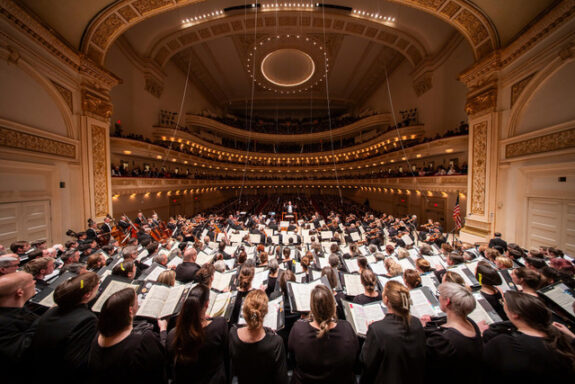
 United States Verdi, Requiem: Asmik Grigorian (soprano), Deniz Uzun (mezzo-soprano), Joshua Guerrero (tenor), Tareq Nazmi (bass). The Cleveland Orchestra and Chorus / Franz Welser-Möst (conductor). Carnegie Hall, New York, 20.1.2026. (RP)

The Cleveland Orchestra played Carnegie Hall in 2023 to sold-out houses. History repeated itself this past week when the orchestra returned under the baton of Franz Welser-Möst. Even bitterly cold weather did not keep people away from the Verdi Requiem, the first of the two concerts.
Welser-Möst has not conducted the Cleveland Orchestra in the Requiem since 2004. In the program, he writes that it is a misconception to approach the work operatically. This follows the composer’s own wishes: ‘This Mass is not to be sung in the way one sings an opera’. Verdi was not fixated on particular voice types for the soloists, insisting only that they be beautiful.
Generally, that dictate, while not ignored, has led to singers with voices that can do justice to his heaviest, most dramatic operatic roles. Welser-Möst chose an intriguing quartet of soloists, one of whom, soprano Asmik Grigorian, broke from the conventional mold. Mezzo-soprano Deniz Uzun, tenor Joshua Guerrero and bass Tareq Nazmi were cut from more traditional Verdian cloth.
Grigorian is renowned for the emotional depth she brings to a performance and the beauty of her voice. It is not the most sizable instrument, nor need it be. It does, however, take a conductor of Welser-Möst’s authority and sensitivity to set her jewel of a voice so perfectly in a work like the Verdi Requiem.
In the Pie Jesu and the Offertorio, the sections in which the quartet sings as a group, under Welser-Möst’s baton, the four singers blended perfectly. The same can be said for the Quid sum miser, a trio for soprano, tenor and bass. Grigorian’s duets with Uzan, the Recordare and Agnus Dei were among the most beautiful and moving moments of the concert. The Libera Me, however, found Grigorian at her most compelling, in an intimate, emotionally charged final plea for deliverance on the Day of Judgment.
Uzan was a revelation, with a voice that commands attention. In the Liber scriptus and the Lux aeterna, she sang of the dreadful day of reckoning with clarity and power in a measured manner, which underscored the horrors of which she sang. With Guerrero and Nazmi, Uzan found ideal partners to wrap Verdi’s musical lines with the full glory of her voice. The Lux aeterna was a perfect combination of emotion and beauty, which Welser-Möst painted with the broadest of musical brushstrokes.
Guerrero has a clarion, ringing tenor, and he employed it to full effect in the Ingemisco. The opening verses were sung full-voice, but the final plea to be among the sheep at God’s right hand on that final day was floated in soft, spinning tones that underscored the text’s sensibilities with tenderness.
Nazmi has a soft-grained, but profound bass of sepulchral depths. It was first heard trumpet-like in the Mors stupendit but was far more terrifying when Nazmi later uttered the fateful prophecies in hushed tones. In the Confutatis, where the solo bass pleads for God’s mercy, the prayer was made all the more dignified due to the lyricism and dramatic nuance with which Nazmi sang. It, and countless other instances in the performance, were undoubtedly chiefly due to Welser-Möst’s sensitive approach to the score.
The Cleveland Orchestra Chorus is made up of volunteers under the direction of Lisa Wong. They sounded wonderful in Carnegie Hall, whether thundering in the Dies Irae or, together with the soloist, made the musical lines weep in the Lacrimosa. In the Sanctus, they impressed with their vitality, lightness and clarity in its complex eight-part fugue. They were Grigorian’s partners in creating the emotionally wrought Libera me, in both its most sublime and horrifying moments.
Underpinning the soloists and chorus was a sublime performance from the orchestra. From the almost inaudible playing of the cellos in the opening Introit to the tremendous hammer strikes of the bass drum in the Dies irae, the orchestra displayed a complete mastery of the drama of the work. The strings played with particular sensitivity throughout, but never more so than in the shimmering tremolos of the Lux aeterna.
The Verdi Requiem is a brass-heavy experience, and none was more thrilling than in the Tuba mirum when trumpets, onstage and placed throughout the house, sent their wondrous sound throughout Carnegie Hall. True to the nature of the performance, even that was more subtle than usual.
Rick Perdian
Featured Image: Franz Welser-Möst (conductor), soloists, and the Cleveland Orchestra and Chorus in the Verdi Requiem © Chris Lee