 United Kingdom Kurtág, M. Simpson, R. Schumann, Webern: Víkingur Ólafsson (piano), Halla Oddný Magnúsdóttir (piano), Philharmonia Orchestra / Elena Schwarz (conductor), Tom Service (presenter). Queen Elizabeth Hall, London, 1.3.2026. (AK)
Kurtág – piano pieces: Játékok, arrangements of Bach and Haydn, Aus der Ferne, Harmonics, A little Chorale, Hommage á J.S.B; Hommage á R. Sch for clarinet, viola and piano; …quasi una fantasia, Op.27 for orchestra
Mark Simpson – Hommage á Kurtág for clarinet, viola and piano
Robert Schumann – Fugue on B-A-C-H, Op.60 (composed for organ, performed by a string quartet)
Webern – Passacaglia for Orchestra, Op.1
This year is the Philhamonia’s 80th birthday season, so their celebratory mood for this concert marking composer György Kurtág’s 100th birthday was a given. Interestingly, they titled their concert as ‘Víkingur Ólafsson celebrates Kurtág at 100’. I wonder who initiated this concert, Ólafsson or the Philharmonia? Either way, the Kurtág celebration was timely.
Originally the concert was to include Kurtág’s Double Concerto for cello, piano and orchestra, but this twenty-minute piece was omitted on short notice. I speculate that Webern’s Passacaglia and the Robert Schumann piece were included to fill the gap but, notwithstanding the merit of these pieces, it is a shame that the concert lost what would have been the most substantial Kurtág piece on the programme.
Kurtág reached his 100th birthday on 19th February and was celebrated on that day with a gala concert at MÜPA in Budapest. The star soloist of the concert was Víkingur Ólafsson who transported part of his programme to the Queen Elizabeth Hall. However, I hasten to add that the Budapest gala concert consisted only of Kurtág compositions except for a Bach arrangement composed by Ólafsson in honour of Kurtág (and repeated in London).
Of the fifteen pieces performed at the QEH, eleven was lifted from the Budapest gala concert. Of the remaining four pieces (Kurtág, Schumann, Robert Simpson, Webern) the Schumann seemed to be an inspired last-minute arrangement for string quartet, played from large, photocopied pages. Schumann wrote his six Bach fugues for the organ; in fact, these pieces were his only compositions for the organ. It is therefore a shame that there was no mention about the origin and the arranger for string quartet in the programme notes.
The delivery of the programme was of excellence; it kept the fully packed hall spellbound throughout. There was not a single seat unoccupied and nobody fidgeted despite no interval. Tom Service spoke fluently without notes and interviewed Ólafsson who is very much at home on the stage whether he speaks or plays the piano.
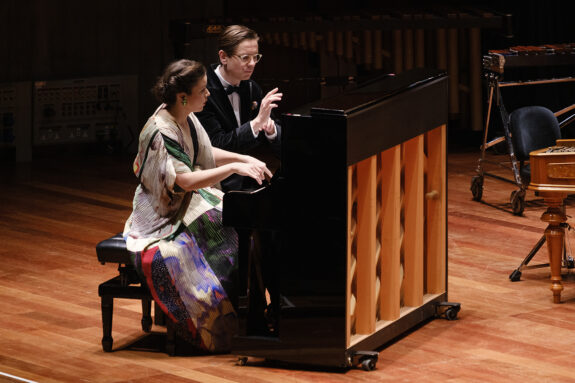
The programme started with Ólafsson and his wife Halla Oddný Magnúsdóttir playing on a muted upright piano. Kurtág and his wife Márta played many concerts on such upright pianos; Ólafsson and wife might have wanted to step into the Kurtág shoes and they had similarities on their side with a tall, charismatic male pianist and a much shorter devoted pianist wife. I do not know Kurtág’s compositions well enough to decide whether any of the Kurtág pieces were delivered as intended but all performances were respectful and enjoyable.
The string quartet drawn from Philharmonia players (Zsolt-Tihamér Visontay, Annabelle Meare [violins], Scott Dickinson [viola], Steffan Morris [cello]) gave beautiful baroque-style performances of Kurtág’s and Schumann’s Homage to Bach. The Kurtág Homage to Schumann lost a bit from the final surprise. On conclusion of the clarinet/viola/piano trio the last note is one bang on a large bass drum, played by the clarinet player. In a Budapest performance at the Kurtág festivities the week before, viola and clarinet players were standing, with the clarinet player immediately in front of the drum. I was very surprised when suddenly, the clarinet player delivered a bang on the drum, bringing the piece to a close. Here at the QEH the viola and clarinet players were sitting, the clarinet at least one meter or more from the drum. When the clarinet part finished, the clarinettist (Maura Marinucci) stood up, walked to the drum, and stood there until her great drum beat moment arrived. There was no surprise with this final note.
Conductor Elena Schwarz might have had her shortest performance time in her symphonic career, conducting the final two pieces (Webern Passacaglia and Kurtág …quasi una fantasia). For the Webern (c. ten minutes), her players were on stage and she faced them. But for Kurtág’s … quasi una fantasia (c. nine minutes) the players were scattered, as specified by Kurtág, in the available space: they took positions in various parts of the auditorium, so conductor Schwarz faced the audience to direct the piece. She seemed to be fully in control and delivered exciting performances.
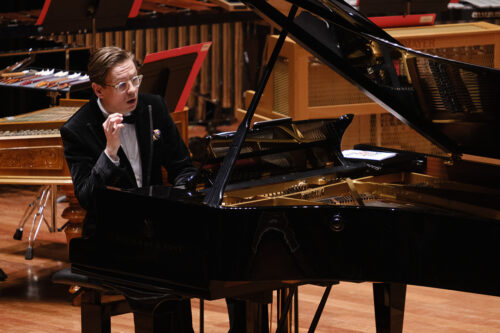
The star of the evening, as at the 19th February Budapest Kurtág birthday gala concert, was undoubtedly pianist Víkingur Ólafsson. He played with great sensitivity, whether on the small muted upright piano or on the grand piano. He seems to have the music in his body or he believes in choreography. His arm often delivers ballet-type movements and he often bends down onto the keyboard. His own arrangement and performance of Bach’s ‘Air on the G string’ leaned towards romanticism but was beautiful.
Is Ólafsson the rightful representative of Kurtág’s music? The jury is out but, for sure, he/Kurtág filled the Queen Elizabeth Hall to capacity and the concert was enjoyed by all.
Agnes Kory
Featured Image: Pianists Halla Oddný Magnúsdóttir and Víkingur Ólafsson (piano) © PO/Alejandro S. Garrido
I do not know why Mr. Ólafsson has been chosen to represent Kurtág but his attempt to ‘reproduce’ Kurtág and his wife, Márta on their own special upright piano is appallingly distasteful in my opinion. Such a superficial ‘understanding’ of both the works themselves and the spirit of Hungarian music making and Kurtâg himself has no place on the international stage. Zoltân Kocsis will be turning in his grave..