 Germany Claudio Santoro, Alma: Soloists, Ballet, Chorus of the Anhaltisches Theater Dessau, and the Anhaltische Philharmonie / Markus L. Franck (conductor), Anhaltisches Theater Dessau, 28.2.2026. (GT)
Born in Manaus, Brazil, Claudio Santoro (1919-1989) was a child prodigy, studying piano and violin before entering the Rio de Janeiro Conservatoire, where he began teaching violin at 18. His musical education advanced when he studied with Nadia Boulanger in Paris. Returning to Brazil, Santoro founded the Brazil Symphony Orchestra and taught extensively in his homeland and in Germany. He was also active as a conductor, directing many distinguished European orchestras, including in the USSR, where several of his works were recorded.
Santoro wrote 14 symphonies, 3 piano concertos, seven string quartets and many other works, including song cycles, film scores and chamber pieces. His music embraces diverse influences, including modernism and traditional Brazilian music, and these are present throughout in this opera, dedicated to his wife, Gisele Santoro. Based on the first part of Oswald de Andrade’s social critical trilogy Die Verdammten, Santoro’s only opera picks up the novel’s theme of social decay and is set in 1920s São Paulo and portrays the underworld through a mix of prostitution, drugs, alcohol and gang culture. The opera received its premiere in 1985 and was revived in 1998 (upon which this staging is based) and was only staged in 2019 at the Festival Amazonas de Opera. Of course, the subject matter is one reason for its neglect, and the relative obscurity of the composer.
Santoro’s libretto tells of the abused prostitute Alma, who despises the men of the brothel; her only moments of warmth are her friendship with the writer, Joao, who cannot fulfil his love for Alma because of his homosexuality, their scenes are at the centre of the stage work, to open up a new world to her, he wants to read to Alma from Baudelaire, but the relationship soon declines into an icy coolness, as she still lusts after sex and he cannot satisfy her.
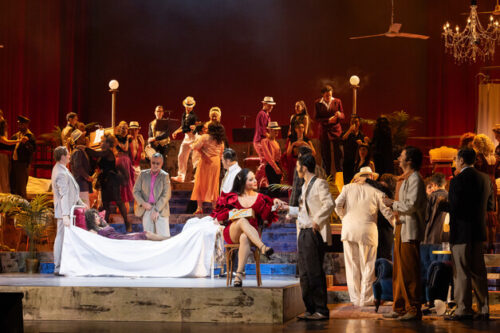
In the skilfully designed setting by Rifail Ajdarpasic, the main scene throughout is a São Paulo nightclub that also operates as a brothel. A dance band plays jazz and Bossa Nova melodies above the visitors and girls sitting around the central bed, which is the centre of the activities. As the orchestra opens with a beautifully attractive idea that hints of Puccini, the central character of Alma, in a purple nightdress, sits discontented on a sofa adjacent to the bed. Alma sings of her terrible childhood and her induction into prostitution for the wealthy citizens of the city. The tragic aria was accompanied poignantly by a solo cello, woodwind, and, by a solo flute, enhancing the sadness of her plight.
In a dramatic switch, as if to portray a parody, the action changes to the bright harmonies of the five-piece band performing Bossa Nova, a brief diversion from the horrors depicted on stage. Several characters enter the drama; some clients engage in sex with Alma as she is taken by one after another. The domination of Alma by her pimp, Mauro, is at the centre stage in his cruel beating of Alma, kicking her, and finally whipping her in a great box that descended to hide the cruelty within.
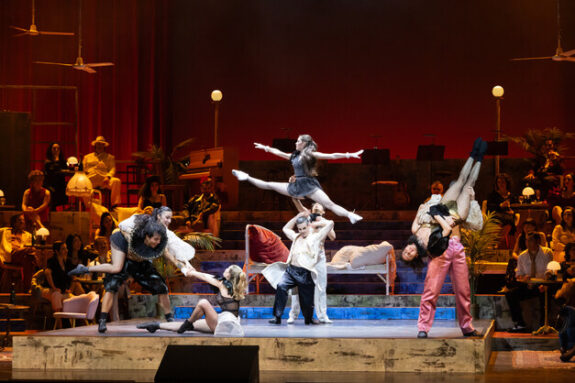
The entry of the dancers allowed a spectacular diversion, brilliantly accompanied by the orchestra playing at its maximum effect, and imparting a poignantly reflective portrayal of both Alma’s fate and that of the other prostitutes. The passage was grotesque in an explosive orchestral episode in another superbly orchestrated parody to match anything by Kurt Weill or Shostakovich.
Alma’s fate is even more powerfully portrayed in a session when she lies on her bed, and as two men raise the white curtain, she is taken by clients, one after another. In the following scene, we witness an abortion being performed on Alma in another tragic picture of her life, as if an execution is being performed. In the second half, Alma is married to Mauro, and she has his child, who dies soon after birth, but she is unable to break away from the brothel, and she is degraded to washing her grandfather’s feet and shaving him.
The outstanding performance of the evening was that of Alma, characterised by Iordanka Derilova, whose magnificent spinto soprano was outstanding, equally in the most terrible moments and those few scenes in which she is happy and content. Her acting was quite outstanding as she was brutally abused and showed her hatred for those who had betrayed her.
Another star performance was that of the tenor of Costa Latsos as Joao, portraying the intelligent writer who seeks to take Alma from the brothel. Alma’s two friends, Dona Rosaura, were finely characterised by Alyson Rosales gorgeously rich soprano, and by Alejandra Franco Vega’s Camilla in an outstanding performance both vocally and acting; their roles were crucial in portraying the depravity of the brothel. Both portrayed their roles with great sensitivity.
The Mauro of Kay Stiefermann was a frightening portrayal of a malicious thug who manipulates Alma and the other girls in the brothel to suit his purposes, making money from them while brutalising their existence. He has an outstanding baritone, and his characterisation was a major feature of the whole performance. The grandfather of Lucas, taken by the bass Michael Tews, was another wicked character who visited the brothel for sex and to degrade Alma, but was well-crafted in his acting and voice.
The choreography by Marcos Vinicius dos Anjos was excellent, especially the spectacular dance episodes, most of all as the dancers rushed in from the aisles performing circus-like gymnastics, lifting the mood into an episode of slapstick fun, yet emphasising the often-grotesque inhumanity of the brothel.
Ariane Isabell Unfried’s costumes were based on the first decades of the 20th century but could be from our own times; the narrative is as real today as it was when Santoro wrote his opera. The men were attired in expensive, fashionable suits, while the women wore bright, red, purple, and yellow- and orange-coloured dresses. The lighting arranged by Guido Petzold was a major feature of the whole evening, enhancing the lurid nature of the nightclub and brothel.
A major highlight was the choral singing, mostly in the first two acts from the nightclub, but in the third and fourth acts was mostly heard off-stage, introducing a moving emotional element, lamenting Alma’s plight and her tragic end. The singing was in Portuguese, but the lyrics were easily understandable, and sadly, the surtitles were only in German, which would have made it difficult to follow the singing if it was not brutally obvious from everything that happened on the stage. The chorus was masterfully prepared and led by Sebastian Kennerknecht.
The orchestra under the direction of Markus L. Franck was outstanding, bringing out all the colours of Santoro’s score: the orchestral palette reminded me of Italian verismo, and of Copland, Bernstein and Shostakovich, and often embraced Brazilian jazz rhythms and Bosso Nova. The theme which opened and closed the opera was memorable for its sadly reflective tone, evincing anything written by Puccini.
This staging by Christiane Iven is masterly, for it sensitively portrays the tragedy of womenkind oppressed by a male-dominated society in São Paulo is relevant today as it was 100 years ago. Despite its brutality, it is a lesson for present-day society, despite many efforts to gain equality for women everywhere.
This opera is one of the most seriously neglected works of recent years; one wonders why it has taken so long to be heard in Europe, here only now getting its premiere. Through its colourful and attractive scoring, outstanding singing and dramatic content, this production marks a triumph for Dessau’s Kurt Weill Fest, and surely this staging will help in making both Claudio Santoro and his forgotten opera win new audiences worldwide.
Gregor Tassie
Featured Image: Anhaltisches Theater Dessau’s Alma © Claudia Heysel
Production:
Direction – Christiane Iven
Sets – Rifael Ajdapasic
Lighting – Guido Petzold
Costumes – Arianne Isabell Unfried
Costume assistant – Marlene Schroder
Choreography – Marcos Vinicius dos Anjos
Chorus master – Sebastian Kennerknecht
Dramaturgy – Yuri Colossale
Cast:
Alma – Iordanka Derilova
Joao do Carimo – Costa Latsos
Lucas – Michael Tews
Mauro – Kay Stiefermann
Teles Melo – Edison Silva Junior
Lobao – Alexander Argirov
Dagoberto Lessa – Marcelo de Souza Felix
Dona Rosaura – Alyson Rosales
Camilla – Alejandra Franco Vega
A Blonde lady – Lidia Luciano
A Fat lady – Grazyna Fenger, Jagna J. Rotkiewicz
Pippermint – Anna Maria Kalka, Jieun Lee
A Doctor – Adam Fenger, Cezary C. Rotkiewicz
A Man in glasses – Murilo Sousa
Manaus the city Santoro was born in (now a city of over 2 million people) is now the home of one of Latin America’s most important opera festivals, held at the Teatro Amazonas opera house.