
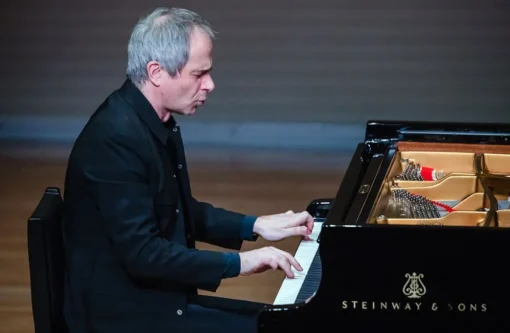
 United Kingdom Brahms and Beethoven: Piotr Anderszewski (piano). Wigmore Hall, London, 27.2.2026. (CSa)
Brahms – Intermezzi: in B minor Op.119 No.1, in C Op.119 No.3, in A minor Op.118 No.1, in A Op.118 No.2 & in A minor Op.76 No.7; Capriccio in C Op.76 No.8; Intermezzi: in E minor Op.116 No.5 & in C sharp minor Op.117 No.3; Rhapsody in E-flat Op.119 No.4; Intermezzi: in B-flat minor Op.117 No.2, in B flat Op.76 No.4 & in E flat minor Op.118 No.6
Beethoven – Piano Sonata No.32 in C minor Op.111
In a recent New York Times Guest Essay, the American concert pianist Jonathan Biss observed that in an age of government misinformation, social media falsehoods, and the way in which artificial intelligence has erased the distinction between what is real and what merely looks real, the performing arts offer a necessary corrective. ‘There is no great performance’ wrote Biss ‘…that does not have truthfulness at its core. The search for truth is an artist’s life’s work.’ This philosophical approach to music-making is shared by another great pianist, Warsaw-born Piotr Anderszewski, who made a rare but welcome appearance at Wigmore Hall in a recently revised programme of Brahms and Beethoven.
‘Music is not about being right. It’s about being true’ claims Anderszewski, a musician who regards performance as a moral responsibility, not an act of virtuosic showmanship and who is famed for his insistence on clarity of sound, meticulous balance and the need for structural perfection. Now 56 years old, he is often remembered for his famous mid-recital withdrawal at the Leeds Piano Competition in the late summer of 1990. Then aged 21 years old, he had completed playing Beethoven’s Diabelli Variations and had just embarked on Webern’s Variations for Piano Op.27 when he walked off the stage, later claiming that he could not continue because his performance just wasn’t good enough.
There was no hint of self-criticism or self-doubt evident in his authoritative and deeply introspective account of Brahms’s late solo pieces from the Op.116-119 sets. These were presented not so much as individual pieces but as coherently linked episodes in a single musical narrative. Somewhat austere in appearance and understated in manner, Anderszewski explored the rich and varied emotional range of these autumnal masterpieces, combining his unsurpassed musical sensibility and interpretive skills with supreme technical agility.
The recital began with a delicately shaded, almost impressionistic Intermezzo in B minor Op.119 No.1, the so-called ‘Grey Pearl’ – a tender ‘love letter’ to his muse, Clara Schumann. A deliciously light and graceful Intermezzo in C Op.119 No.3 was quickly succeeded by a passionate and brooding account of Op.118 No.1, an Intermezzo described by Brahms’s beloved Clara as ‘a wealth of sentiment in the smallest of dimensions.’ Anderszewski invoked and sustained an increasing sense of drama before effectively contrasting it with a wistful delicately wrought Op.118 No.2. Storms surged once again in the cascading opening bars of Capriccio in G Op.116 No.3, its surging symphonic dimensions carefully anchored by Anderszewski’s steadfast legato. A serene and melancholic Intermezzo in E Op.116 No.3 and a consolingly subdued Op.116 No.4 were juxtaposed with a ravishing rendition of the Rhapsody in E-flat Op.119 No.4 and the heart-rending Op.118 No.6, one of Brahms’s most ruminative late Intermezzi, was articulated with the utmost sensitivity but without a trace of sentimentality.
In a change to the earlier published programme which promised to link Brahms with Schubert’s Sonata in C D958, it was Beethoven’s last Piano Sonata No.32 in C Op.111 which formed the second half of the concert. Many performers have attempted to scale this transcendental work but fewer have come closer to conveying Beethoven’s harmonic understanding and architectural logic so convincingly as Anderszewski. In his hands, the opening Maestoso did not erupt but emerged exponentially. There was huge power of expression but no superficial theatrical drama; instead, the music was carefully shaped and unfolded with rumbling gravity and a sense of monumental inevitability. If the first movement was granite, then the Arietta was elemental. The theme was presented with airy simplicity and without adornment, and ornamentation allowed to develop organically. The famous ‘trill’ hovered ethereally and in the syncopated ‘boogie-woogie’ variations, Anderszewski managed to integrate Beethoven’s jazzy modernity in a long, magnificent arc of sound. The result was thrilling. As the final notes dissolved into the air, the audience sat for a long minute of silent rapture, unwilling to disturb the fragile stillness with applause. But once the silence broke, the ovation was thunderous.
Chris Sallon