
 United Kingdom Adolphe Adam, Giselle: Dancers of The Royal Ballet, Orchestra of the Royal Opera House Orchestra / Vello Pähn (conductor). Broadcast live (directed by Ross MacGibbon) from the Royal Opera House, Covent Garden, London. 3.3.2026. (JPr)
It isn’t the first time I have written how that seeing and hearing classical ballet over several recent years it is the care which is – more often than not – given to the music that is very encouraging. In times past, I have heard orchestras often play the most recognisable of scores as if it was the first time they had seen the notes in front of them. Here Vello Pähn (principal conductor and artistic director at the Estonian National Opera) treated the music of Giselle – nominally by Adolphe Adam and eclectically edited by Lars Payne – with the upmost respect. Pähn encouraged the Orchestra of the Royal Opera House to give quite a refined and deeply Romantic account of the melodious score, which was without longueurs and sensitively accompanied the dancers whilst keeping the music moving forward.
Premiered in 1841 in Paris, Giselle was first staged in England the following year, and shortly thereafter was in the repertory of almost every ballet company in the world. The original choreography of Marius Petipa, Jean Coralli and Jules Perrot remains mostly intact to this day and Peter Wright’s 1986 production has only a few of his own additions.
Giselle has considerable psychological depths, and this is not always the case in narrative ballets, and these are explored over its two concise acts. The first shows an idyllic vision of peasant life; it is harvest time in a medieval Rhineland village and the peasant girl, Giselle, believes she has won the heart of the nobly born Albrecht, who disguises himself and joins in with the villagers. Unfortunately, Albrecht’s intentions seem far from honourable as he is already engaged to the Duke of Courland’s daughter. (For many reasons I found myself thinking about the Netflix series Bridgerton where such shenanigans occur.) Giselle loses her reason when she discovers Albrecht’s deceit.
Act II is inspired by a passage in Heinrich Heine’s On Germany, about Wilis or ‘young brides-to-be who die before their wedding day. The poor creatures cannot rest peacefully in their graves’ and rise at midnight to dance beguilingly in the moonlight. In both the village setting and forest graveside, Peter Wright and his designer John Macfarlane have created a recognisable world providing an atmospheric backdrop to the serious story’s myriad themes, thus sustaining the ballet’s status as an enduring classic.
Matthew Ball (Albrecht) compared the acts in a pre-recorded interview ‘There’s a kind of earthiness into the floor of that [Act I] choreography because of the peasants being one with the earth. But that is also a very interesting contrast with in the second act there’s this ethereal quality which takes over where we have the ballerinas going up onto pointe and Giselle was one of the ballets where this was really defined [and] where the use of pointe work really tied into French romanticism movement in dance. Akane Takada (Giselle) added ‘The quality of dancing is so different to Act I, the grounded steps becomes more fluid kind of ghost-like. I really concentrate how I walk, how I run, [be]cause my arm has to be weightless.’ Ball concluded ‘These effects of weightlessness, of delay in the movement of the arms, for example, after the body moves, really summon up this otherworldly sense, this spirit world.’
I first saw Peter Wright’s Giselle in 1980 (with Lesley Collier and Stephen Jefferies) and that was the 334th performance of the ballet at Covent Garden; fast-forward to 2026 and this was its 624th! In the intervening years I have seen it with many memorable Giselles and Albrechts and it would be invidious to compare and contrast those dancers with these of the present day. Push goes to shove and of course I will always particularly remember the two Nureyev performances I saw, once when Sylvie Guillem was his Giselle.
Whether or not it was especially devised for the cinema there was a high standard of acting, not only from the dancers in the leading roles but from the entire company even if they were standing – simply as one of the villagers – right at the back of the scene. Notably there was an exceptionally nuanced portrayal of Albrecht’s fiancée Bathilde from Olivia Crowley who showed her as overcome with the heat and rather ‘high maintenance’; her gift of kindness is a necklace to Giselle but then she appears disdainful of her ultimate fate. Of course, Kristen McNally deserves the highest praise too for her mimetic skills – wonderfully revealed in a film shown at the start of the broadcast – as Berthe, Giselle’s concerned and very protective mother. Valentino Zucchetti prowled the stage and glowered as the frustrated Hilarion, almost chewing the scenery in his protestation of love for Giselle and anger at his love rival, Albrecht.
Along with the high quality of acting there was an exceptional display of dancing from all concerned. From the eye-catching Sae Maeda and Joonhyuk Jun in the Act I Pas de Six to Annette Buvoli’s imperious and unyielding Myrtha, Queen of the Wilis, with her two well-executed lieutenants, Moyna (Leticia Dias) and Zulma (Mica Bradbury). The ensemble work in Act II appeared as faultless as it could possibly be; with the synchronisation of the ghostly Wilis showing them to be suitably spectral though perversely oddly beautiful.
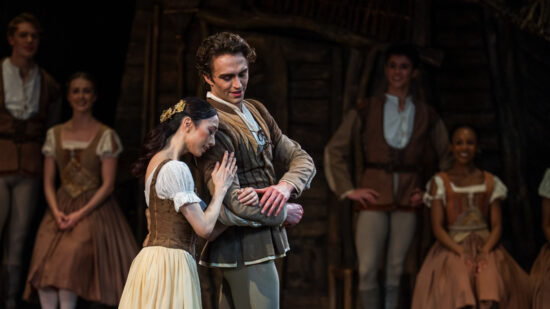
This was the most complete performance from Akane Takada I have seen; that her dancing is characterised by impeccable technique and musicality is a given, but she also created a believable character. Takada’s Giselle showed she was really in love (possibly for the first time) and revealed the vulnerability, betrayal, and abject despair of the naïve girl of the first act. However, Takada was at her very best as the wraithlike Wili in Act II as she strove to save her deceitful lover from death. Giselle’s willingness to forgive and redeem Albrecht was shown at its best in the consolation of Takada and Ball’s deeply affecting graveside duet.
Matthew Ball as Albrecht was the epitome of a Russian male dancer – more so than The Royal Ballet’s own Vadim Muntagirov – and odd for someone born in Liverpool! Ball was all power to Takada’s grace, and excelled with his (anti-)heroic bearing, athleticism (high jumps and rapid turns) and other expansive movements, as well as proving to be a splendid physical actor. He ideally conjured up a hedonistic, betrothed aristocrat wanting to play the field (think Bridgerton again). In Act I we can clearly see Ball’s Albrecht fear discovery, yet he dismisses it with a certain arrogance: then there is deep shame and agonising guilt as his duplicity has fatal consequences. In the second act, Ball made an equally convincing noble martyr with his suffering eyes and after multiple entrechat sixes it will stay in the memory how Ball collapsed to the floor as if he really had been danced to death rather than to have a lie-down as too many other male dancers seem to.
This was a very fine evening and a credit to The Royal Ballet.
Jim Pritchard
Featured Image: Matthew Ball (Albrecht), Akane Takada (Giselle), Annette Buvoli (Myrtha) and Wilis © RBO/Andrej Uspenski
Cast:
Giselle – Akane Takada
Albrecht – Matthew Ball
Myrtha – Annette Buvoli
Hilarion – Valentino Zucchetti
Wilfred – Joshua Junker
Berthe – Kristen McNally
The Duke of Courland – Bennet Gartside
Bathilde – Olivia Cowley
Leader of the Hunt – Thomas Whitehead
Pas de Six – Sae Maeda, Joonhyuk Jun, Viola Pantuso, Liam Boswell, Ella Newton Severgnini, Daichi Ikarashi
Moyna – Leticia Dias
Zulme – Mica Bradbury
Peasants, Courtiers And Wilis – Artists Of The Royal Ballet
Production:
Choreography – Marius Petipa (after Jean Coralli and Jules Perrot)
Scenario – Théophile Gautier (after Heinrich Heine)
Production and Additional choreography – Peter Wright
Music – Adolphe Adam (edited by Lars Payne)
Designs – John Macfarlane
Original lighting – Jennifer Tipton (recreated by David Finn)
Lighting design – David Finn
Staging – Christopher Carr, Samantha Raine
Loving the references to Mattsky Ballkov.
From Liverpool on Volga.😂
My touchstone Giselle was always Natalia Osipova’s debut with the Bolshoi. Unmatchable, I always thought. And always was until I saw Takada. She was SUBLIME.