 Switzerland Olga Neuwirth, Monster’s Paradise: Zurich Opera Orchestra / Titus Engel (conductor). Zurich Opera, 15.3.2026. (MF)
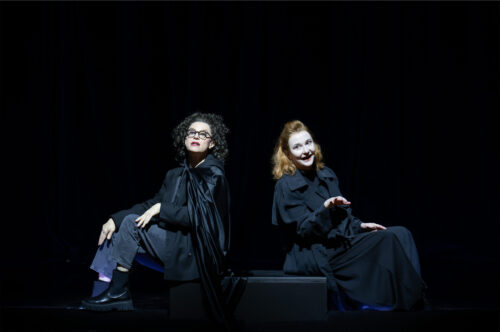
Monster’s Paradise is the culmination of nearly forty years of cooperation between Austrian composer Olga Neuwirth and Nobel literature laureate Elfriede Jelinek. Referring to the French theatre tradition from the early 20th century, they call the opus a Grand Guignol Opera, and, taking inspiration from Alfred Jarry’s Ubu Roi, bring to life an entire musical and literary universe. The result is a grand, grotesque and macabre depiction of these two artists’ world view, staged with plenty of colour and hyperbole.
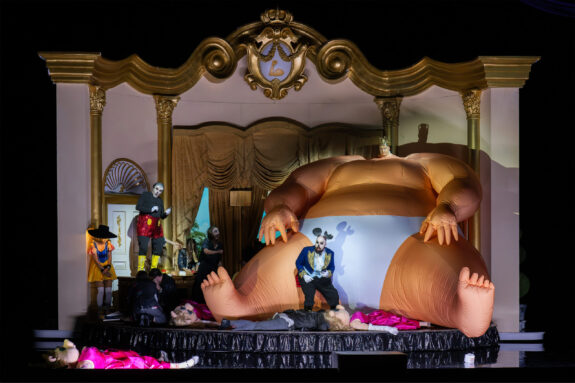
The piece is divided into five scenes (Bilder). The two vampirettes Vampi and Bampi are the protagonists, styled as Neuwirth and Jelinek lookalikes. In the prologue in heaven, Vampi and Bampi comment on the state of the world, derailed among other things by phallocracy. Unfazed, they decide to embark on a mission to save it, even though it seems beyond hope. Their peregrination is reminiscent of Dante and Virgil’s voyage in the Commedia. They face the King-President, a self-indulgent bloated orange game-show host perched on a golden toilet in an oval office of a white house. The attempt to kill him fails and backfires badly. A group of Miss Piggys and Kermits engage in a fight worthy of a pub brawl, the palace is stormed by the people transformed into zombies (January 6th, anyone?). Gorgonzilla, a kind sea monster living on its island, offers help. The monster fights and devours the King-President and his crown is left lying on the floor. Seduced by the power vacuum, Gorgonzilla crowns himself King and occupies the empty throne. But saving a lost planet surpasses even Gorgonzilla’s powers. It rains; a downpour of biblical proportions drowns the world. Vampi and Bampi end up on a raft, fitted with a grand piano on which they play Schubert for four hands. The raft drifts into the sunset. Are the two protagonists headed for a paradiso of sorts after all?
The plot is anything but linear, the score mirrors the world’s downward spiral with deliberately out-of-tune instruments. Neuwirth describes her opera as a musical-political farce against the everyday lunacy, a tragedy crossdressing as comedy. At the time of writing and composing, the Oval Office was still a place of – at least perceived – respect, American presidents had not yet put out pictures of themselves sporting a crown. In the meantime reality has caught up with and often surpassed Neuwirth’s and Jelinek’s visionary creativity. There is more gold now in the Washington power epicentre than on this stage and Truth Social easily outdoes the vulgar language ascribed to the King-President in the libretto. The text, despite its dreary substance, is full of humour and its numerous puns sharply reveal the suppression mechanisms engrained in our language.
Set and costumes by Tobias Kratzer (director of Hamburg State Opera as of this season) take us on a spectacular wild ride, matching the gloom of Neuwirth/Jelinek’s dystopia. We move from a pitch-black heaven to the ‘opulent palace’, complete with a ‘Melania’ floor lamp, where the assassination of the King-President goes awry, and then onwards to Gorgonzilla’s island, soon occupied by an army of mini-tanks. From there, the two protagonists continue their journey through a world ravaged by wars. The precipitation from above is not made of snowflakes but, we must assume, nuclear fallout. Through the evening, a projection of Charlotte Rampling as the Goddess keeps appearing on the ceiling. Like a Greek chorus, she provides a running commentary, concluding that ‘it’s not the worst as long as it cannot be said “this is the worst”.’
Neuwirth’s musical language is as hybrid as the setting. Her sound fantasy combines what in Germanic languages and minds is referred to as high and low culture, with equal enthusiasm for both. The score moves through a mostly tonal web of classical material, rock and pop references and electronic distortions, expanded by a drum kit and deliberately off-tune electric guitars. Complementing the ample video projections, there is a film music feel to the Viennese waltz passages, blasts of funk and jazz, multi-layered noise and lopsided Bach. The raft in the final scene floats to an audio track of Elisabeth Leonskaja playing Schubert on Elfriede Jelinek’s own piano (which reportedly had gone untuned for the past thirty years).
Vampi and Bampi are each represented by a duo of singers and actresses, the authors’ avatars. Sarah Defrise/Sylvie Rohrer and Kristina Stanek/Ruth Rosenfeld impress with an energetic and vivacious rendering of their parts demanding much acting from the singers and plenty of singing from the actors. Robin Adams as the unhinged King-President lustfully inhabits his character. His two sycophantic servants, countertenors Andrew Watts and Eric Jurenas, ceaselessly swirl around their master. A special mention must go to the Gorgonzilla performers, Anna Clementi with crystal clear diction as its voice and Vanessa Konzok, who animates the monster, a costume worthy of any Siegfried dragon, with formidable precision and, dare one say it, grace.
The orchestra is brilliantly held together by Zurich-born conductor Titus Engel. Like an animal tamer, he manages to keep the balance between the pit and the stage. Despite the gargantuan orchestration, we never feel overwhelmed in the comparatively small Zurich Opera House.
This production, a cooperation with Hamburg State Opera and Graz Opera, is a bewildering trip, regularly triggering thoughts of ‘if only it weren’t like this’. I do sympathize with those who feel they already hear enough about the King-President on the news but nevertheless recommend attending this performance. You will witness first-hand how art can provide a prescient perspective on reality, all the while being genuinely entertained.
Performances run to 12 April 2026
Michael Fischer
Featured Image: Monster’s Paradise at Zurich Opera © Monika Rittershaus
Production:
Director – Tobias Kratzer
Co-directors – Matthias Piro and Johanna Schuld-Bongert
Set and Costumes – Rainer Sellmaier
Lighting – Michael Bauer
Video – Janic Bebi and Jonas Dahl
Live-Electronics – Markus Noistering
Sound and Mixing – Julien Aléonard
Dramaturgy – Christopher Warmutz
Cast:
Vampi – Sarah Defrise (singing) / Sylvie Rohrer (acting)
Bampi – Kristina Stanek (singing) / Ruth Rosenfeld (acting)
The King-President – Robin Adams
Gorgonzilla – Anna Clementi (voice) / Vanessa Konzok (acting)
Mickey / King’s Doppelgänger / Angel of death II – Andrew Watts
Tuckey / Angel of death I – Eric Jurenas
A bear – Ruben Drole
The Goddess – Charlotte Rampling (on video)