
 United States Various: JACK Quartet (Christopher Otto, Austin Wulliman [violins], John Pickford Richards [viola], Jay Campbell [cello]). Herbst Hall, University of California Berkeley, 15.3.2026. (HS)
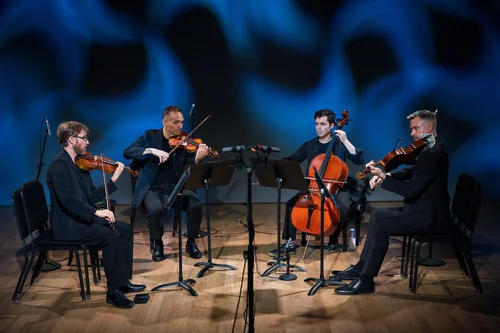
Austin Wulliman – The Late Edition (West Coast premiere)
Keir GoGwilt – ‘Future Mode 1’, from Treatise on Limited Freedoms (West Coast premiere)
Hans Abrahamsen – String Quartet No.4
Gabriella Smith – Aegolius (world premiere)
Rihm – String Quartet No.3, ‘Im Innersten’
The always edgy JACK Quartet, which brings high-level musicianship to adventurous contemporary music for string quartet, delved into some weird corners for its two-hour, no-intermission recital in Berkeley. The program included three premieres, among them a new version of a work by Bay Area favorite Gabriella Smith which, to my ears, was the most compelling and admirable of the afternoon.
One of the two West Coast premieres, Keir GoGwilt’s excursion into natural overtones, posed a challenge for anyone who might prefer playing in tune. The quartet by Hans Abrahamsen required more patience for endless repetitions than I, for one, had available to me. And the oldest piece on the program – Wolfgang Rihm’s 1976 String Quartet No.3, ‘Im Innersten’ – reminded me of the intellectually dense and dissonant mid-twentieth-century European music that minimalism rebelled against.
The program opened with violinist Austin Wulliman’s evocative The Late Edition, a shortish 2024 piece inspired by music he heard from GOAT, the Japanese percussion-heavy quintet, in which the snare drum was so closely miked that Wulliman could hear its overtones. It was like being inside the drum, he related to the audience. His piece uses nervous rhythms to create a percussive atmosphere, interrupted by occasional whacks of accented chords noted by one instrument or another, and techniques such as bowing the cello above the fingers. Disconcertingly, some chords hinted at the slightly flat or sharp pitches of natural overtones but, overall, the rhythmic energy was enough to make it an absorbing ride.
Scotland-born New Yorker GoGwilt’s ‘Future Mode 1’, from his Treatise on Limited Freedoms (2024), revels in ‘just intonation’, the technical term for tuning to natural overtones (instead of the equal temperament we are accustomed to hear from modern instruments to sound ‘in tune’). That is a lot easier to do with string instruments than keyboard or wind instruments. A violinist can adjust where the fingers go on the fingerboard to edge the notes slightly higher or lower. For many of us, unfortunately, this made the JACK Quartet sound like the cacophony of a bad grade-school ensemble. My wife dubbed the sound ‘a lake of vinegar’, and it gave her a headache. My ears suffered too, an ordeal I would rather not repeat. Others gave it a standing ovation.
The German composer Hans Abrahamsen, whose specialty is creating modern music on the forms and sounds of older classical styles, wrote that his 2012 String Quartet No.4 should be quiet and soft. The program note described it with the German ‘hoch im Himmel gesungen’ (which translates to ‘high singing in heaven’). The second movement even ends with lovely, hymn-like phrases that sounded for all the world like a quote from a Mahler song cycle. (It was not.)
The piece began with a violin playing a meandering tune at the top of its register, pianissimo and at a slow pace, ending with an exaggerated upbow. After a pause, the second violin picked up the tune and the first harmonized, also ending with an exaggerated upbow. Adding the viola at times could produce a sound like a fantastical glass armonica. The cello chimed in with a steady, slow rhythm. The second movement picked up the pace, turning the tune from the first movement on its side and ending with that Mahler pastiche. The third turns the first movement on its head, building up from the bottom, and the finale, mostly pizzicato and mostly on the pentatonic scale, sounded at times like a Japanese shamisen. The JACK’s care for detail created a sort of balm after the first two pieces.
Even better was Gabriella Smith’s Aegolius, inspired by the sounds and rhythms of the small owls so named. Although the program listed this as a world premiere, a version of it debuted with the Bay Area-based Owls Quartet last year. In any case, the piece floated serenely, opening with a lovely chord that fell away bit by bit until the remaining note became a pedal tone around which the music circulated. The piece came in and out of focus throughout, in the way that owls seem to disappear into the night until we hear them again. There was no specific hooting, however, just a feathery texture to the harmonies and mere suggestions of melodies. It felt exotic and natural, and I want to hear it again.
The program note for the final piece, Wolfgang Rihm’s six-movement String Quartet No.3, described the German composer as a pioneer in a European movement that rebelled against the insistent, grating dissonance of so many works in the 1950s through early 1970s. Unlike composers of the time, among them the Estonian Arvo Pärt who rejected atonality in favor of ear-soothing diatonic melodies and harmonies, this quartet suggests that Rihm sought to keep the more intellectual aspects of the preceding music and pare away some of the complications.
Like Abrahamsen’s quartet, Rihm’s rested on the structure and tropes of older styles but could not quite break away. As well as the JACK Quartet played it all, the result – for me, at least – was less rewarding.
Harvey Steiman