
 United Kingdom Hildegard of Bingen, Mahler: Jane Archibald (soprano), Christina Bock (mezzo-soprano), Philharmonia Chorus (chorus master: Gavin Carr), Philharmonia / Kent Nagano (conductor). Royal Festival Hall, London, 19.3.2026. (CK)
Hildegard of Bingen – O vis aeternitatis
Mahler – Symphony No.2, ‘Resurrection’
Urlicht. Out of the wreckage of human fears and aspirations, a vast silence; a small voice, tentative at first, alone in the cosmos; like a distant constellation, light years out of reach, a ghostly chorale.
It is an existential moment, or Mahler meant it to be: it was on Thursday, thanks to a conductor who knows that silences are as important as sound and fury, a singer of rare and touching sensitivity, and an offstage group of brass players (joined by bassoon and contrabassoon from the onstage orchestra) placed in the distance. Mahler says that they should be ‘in the background’ rather than offstage: I remember Vladimir Jurowski having them placed to one side, but I have never heard them so separate, so far away. A coup de théâtre: and it worked.
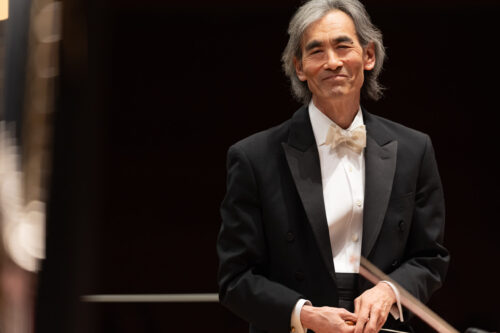
The concert had started with another: disembodied female voices in the distance, gradually drawing nearer, materialising as a small choir processing slowly around the hall, disappearing and fading back into silence. They were chanting Hildegard’s O vis aeternitatis (roughly corresponding to Mahler’s Unsterblich leben); with one’s eyes closed, a haunting and hypnotic experience. Then Kent Nagano – till then immobile on the podium – sprang into life, and we were catapulted forward seven centuries to Mahler’s very modern-sounding (for so it was) angst: eruptive violas, stabbing cellos and the rest.
Nagano – now in his 70’s – is an elegant conductor: and it seemed at first that we were in for an interpretation that prioritised elegance and precision over drama. But of course, performed with such sharp and intelligent focus, the drama looked after itself. Everything was clear, without sounding studied: the music of horror implacable, the E major episodes a distant and misty dream. The second movement was almost too exquisite, the pizzicato section verging on preciousness; but the turbulent central section – almost like a visitation from the first movement – put all that in context.
St Anthony’s fishes wriggled and slithered convincingly in the scherzo; the nostalgic passage for four trumpets in close harmony was meltingly played. It was a shame, though, that the arrival onstage of the solo singers robbed the movement’s opening of the impact it has when the timpani shatter the beatific calm – harps and strings – with which the Andante ends. Having the chorus file into their places in the break stipulated by Mahler after the first movement was a good idea: having the soloists appear between the second and third, less so.
And so we reached Urlicht; and we entered a new dimension. The German mezzo-soprano Christina Bock sang it beautifully, her voice gradually gaining in confidence and fullness of tone towards a hushed, heart-stopping final cadence. At the other end of the movement, Canadian soprano Jane Archibald was equally touching as her voice detached itself gently from the choral mass and floated above.
Nagano ensured that the extended orchestral drama that takes up the first half of the finale made its full effect. Nothing was exaggerated, but everything told; it was not the conductor’s fault if Mahler’s march of the dead after that vicious percussion crescendo sounded like music on autopilot. The Last Trump, though, was spine-tingling; I don’t think I have ever heard those icily brilliant offstage trumpet fanfares and the onstage flute and piccolo – the crowing of the bird of death – sound quite so chilling: again, Nagano was able to conjure a sense of vast silence and emptiness around them.
In many performances, the chorus remain seated for their ppp misterioso entry, standing only when the soloists enter together. Here, they shot to their feet at the orchestral cataclysm that precedes the Last Trump. A dramatic effect: and somehow it gave their hushed entry an extra intensity. The final ascent was as remarkable for clarity as it was for splendour; a performance that never seemed to strive for the apocalyptic (as Rattle’s performances often do, as Tennstedt’s used to do) paid off handsomely on its own, purely musical, terms.
More than thirty years ago, during his stint with the Hallé, I heard Kent Nagano conduct the London Symphony Orchestra in Mahler’s Third Symphony in the Barbican Hall (preceded on that occasion not by Hildegard, but by Ute Lemper in high heels and a little black dress performing Brecht/Weill). It was a fine performance, growing in intensity, free from excess (one critic likened it to Horenstein). A long time ago; yet it seemed to me that this performance of the Second shared the same qualities. Remarkable that performances from 1993 and 2026 should sit together so harmoniously in my memory.
Chris Kettle
Was very special!
Yes, absolutely sensational.